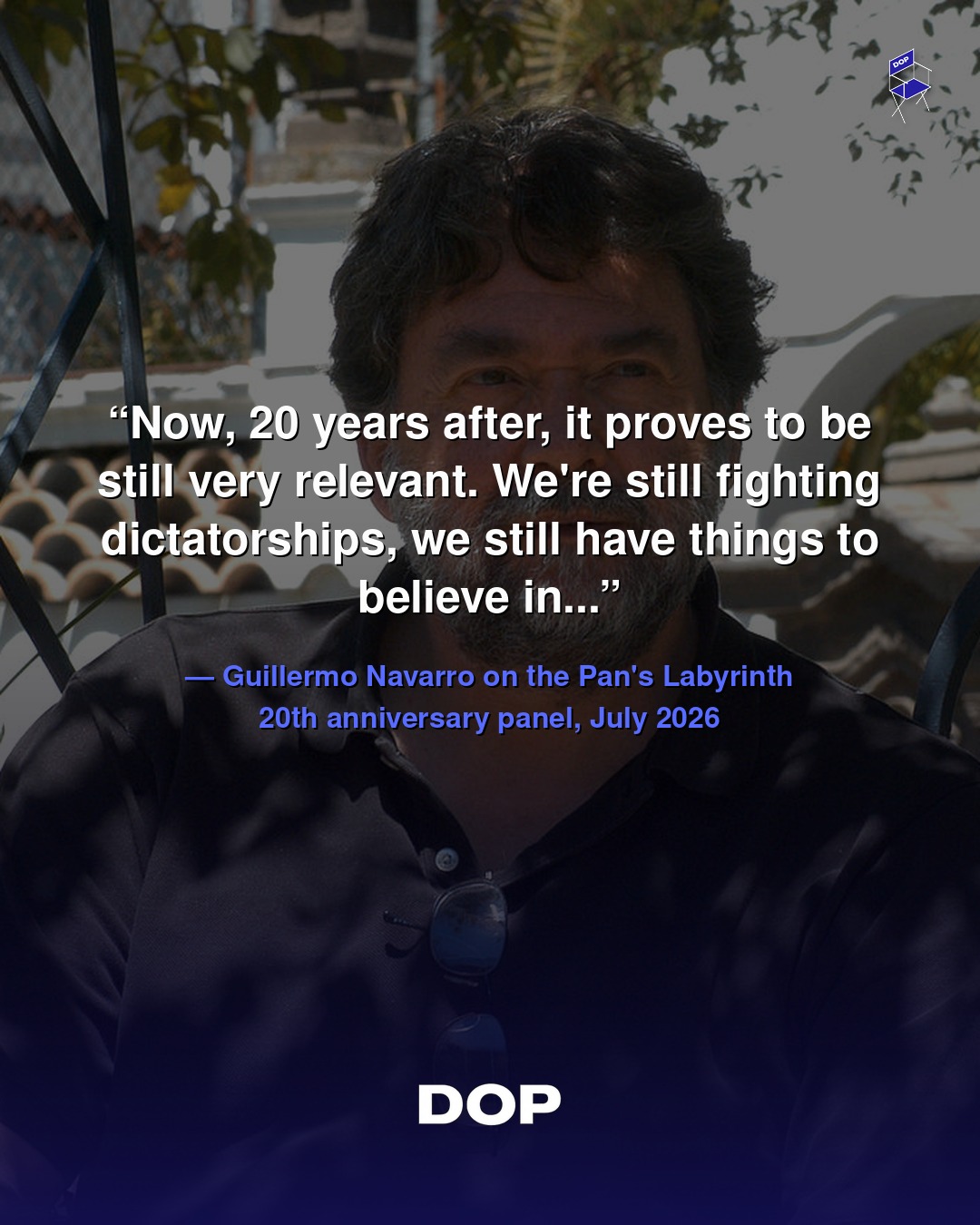
When a film reaches a milestone anniversary, retrospective panels tend to dissolve into sentimental trivia and affectionate behind-the-scenes anecdotes. But at the recent San Diego Comic-Con anniversary panel for Pan’s Labyrinth (El laberinto del fauno), Oscar-winning director of photography Guillermo Navarro, ASC, AMC refused to let the 2006 masterpiece rest comfortably in the past. Speaking alongside director Guillermo del Toro, Doug Jones, and Ivana Baquero, Navarro made a deliberate and politically charged distinction: the film is not a preserved period piece. Its examination of creeping fascism and institutional cruelty remains a contemporary reality.
For cinematographers, Navarro’s assertion resonates far beyond the political realm; it speaks to the enduring vitality of the film's visual architecture. Shot on 35mm using Moviecam Compact and Arriflex 535 cameras paired with Zeiss Ultra Prime lenses, Pan’s Labyrinth achieved its visual power not through soft-focus historical detachment, but through hard, uncompromising technical discipline. The image was crafted with sharp edge-to-edge clarity and deliberate tonal separation, denying the audience the comfort of romanticized nostalgia.
The Chromatic Divide: Cold Realism vs. Subterranean Gold
Navarro’s cinematography in Pan’s Labyrinth serves as a masterclass in psychological color theory and dual-world visual structuring. Rather than relying on heavy digital grading in post-production, Navarro and del Toro engineered a strict physical color palette built directly into the production design and lighting setups. The terrestrial world of Captain Vidal’s post-Civil War military outpost is rendered in desaturated, oppressive cold blues, slate grays, and institutional greens. Here, Navarro utilized harder, directional key lights, often striking faces with harsh angles that accentuated Vidal's mechanical brutality.
In stark contrast, the labyrinth and the underground realm unfold in rich, monochromatic crimson, amber, and golden hues. To create the uterine warmth of the underworld, Navarro deployed custom-gelled tungsten units, utilizing soft diffusion and wrap-around keys that bathed young Ofelia in an environment that felt ancient yet living. By strictly avoiding cross-contamination between these color palettes, Navarro established two distinct psychological spaces that collide violently throughout the narrative.
Navarro refused to let the film rest in amber, reminding us that cinematography is not merely an aesthetic choice, but an ideological stance on how we bear witness to power.
Camera Movement as an Omniscient Moral Observer
Beyond color, Navarro’s spatial choreography remains one of the defining achievements of modern dark-fantasy filmmaking. The camera in Pan’s Labyrinth rarely remains static; instead, it executes continuous, motivated physical moves, panning behind tree trunks, descending through floorboards, and tracking through stone corridors. Navarro utilized meticulous dolly and crane movements that physically tied the fascist realities above ground to the mythical horrors below, ensuring the two realms felt tangibly interconnected rather than disconnected vignettes.
Consider the infamous Pale Man sequence: Navarro’s camera glides with hypnotic dread, balancing wide-angle perspective to emphasize the feast's sickening abundance against tight, suffocating medium shots of the monster. The lighting is deceptively inviting, a roaring fireplace bouncing soft, warm light against ancient masonry, which makes the sudden violence all the more jarring. By treating mythical monsters and human fascists with the exact same visual weight and tactile presence, Navarro established a chilling moral equivalence.
A Working Legacy of Visual Resistance
Navarro’s long-standing collaboration with del Toro, spanning Cronos, The Devil’s Backbone, Hellboy, and Pacific Rim, has always been defined by an obsession with texture, shadow density, and physical practical craft. In Pan’s Labyrinth, Navarro balanced Kodak Vision2 film stocks to capture rich shadow detail in the deepest recesses of the mill while maintaining crisp highlight retention in exterior night scenes lit by massive Maxi-Brute arrays through heavy diffusion frames.
Nearly two decades later, Navarro’s refusal to treat the film as a historical artifact underscores the responsibility of the image-maker. Pan’s Labyrinth endures precisely because its visual language was designed not to decorate a fairy tale, but to interrogate how authority oppresses innocence. In Navarro’s lens, light is not just exposure, it is resistance.