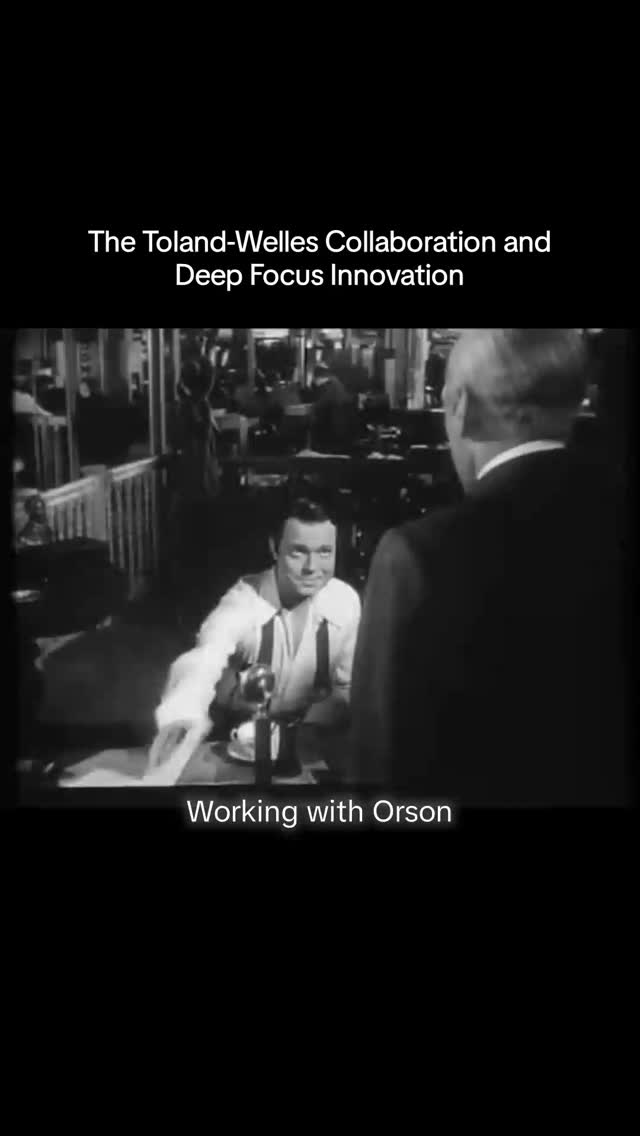
In the annals of cinematic history, few collaborations resonate with the transformative power and audacity as profoundly as that of Orson Welles and Gregg Toland. Their partnership on Citizen Kane (1941) wasn't merely a successful film; it was a seismic event, a visual manifesto that rewrote the grammar of filmmaking. The Instagram caption aptly describes them as a "cinematic powerhouse duo" and, more importantly, "risk-takers who changed filmmaking forever." But what exactly transpired behind the scenes as these two titans plotted their visual revolution?
It's tempting to view their work through the lens of pure technical wizardry, a mere flexing of optical muscles. Yet, as the caption shrewdly points out, "It wasn't just about technical skill." Indeed, their genius lay in a profound understanding of the established cinematic language of their era. Hollywood in the late 1930s and early 1940s operated on a largely conventional visual lexicon: soft focus for leading ladies, medium shots for dialogue, and a clear separation of foreground and background. Welles, with his theatrical background and a burgeoning, almost defiant vision, found himself aligned with a cinematographer whose technical prowess was matched only by his willingness to experiment.
Breaking the Rules with Purpose
Toland, already a seasoned veteran with a diverse filmography including works like Wuthering Heights (1939) and The Grapes of Wrath (1940), brought an unparalleled mastery of light and shadow, and an insatiable curiosity for new photographic possibilities. Welles, a prodigious talent with an almost terrifying self-assurance, provided the intellectual framework and the narrative ambition that demanded a radical visual approach. Their collaboration was less a simple director-DP relationship and more a dynamic intellectual sparring match, fueled by mutual respect and a shared desire to push boundaries.
"They understood the rules of the game so thoroughly that they knew exactly which ones to break."
The innovation that most profoundly defines their collaboration is, of course, deep focus. While not invented by Toland, his application of it in Citizen Kane was unprecedented in its scope and deliberate narrative function. Utilizing wide-angle lenses (reportedly down to 25mm), high-intensity lighting, and faster film stocks (reportedly Kodak Super-XX), Toland managed to keep elements in extreme foreground, mid-ground, and deep background all in sharp focus simultaneously. This wasn't merely a technical flourish; it was a narrative tool. It allowed Welles to compose complex frames, inviting the audience to actively explore the visual information, to piece together relationships and emotional states within a single shot, challenging the conventional method of editing to convey such information.
The Craft Behind the Vision
Consider the famous scene in the Thatcher library, where young Charles Foster Kane is playing in the snow, framed in a distant window, while his fate is decided in the foreground. The depth of field here is not just impressive; it's emotionally devastating, trapping the child within the confines of his predetermined future. This deliberate use of deep focus, often paired with low-angle shots that emphasized ceilings – a rarity in Hollywood sets of the time – created a sense of oppressive grandeur and a unique visual perspective that mirrored Kane’s own distorted view of the world.
Their lighting philosophy was equally revolutionary. Toland, often working with Welles in pre-production, meticulously planned each shot. They embraced chiaroscuro, utilizing stark contrasts between light and shadow to sculpt faces and environments, adding psychological depth and dramatic tension. The famous sequence in Xanadu, with its cavernous halls and pools of light, speaks to a painterly approach to cinematography, where light doesn't just illuminate but defines character and mood. The use of practical lights and intricate gags to achieve specific effects was paramount, moving away from flat, generalized studio lighting.
The legacy of Welles and Toland extends far beyond Citizen Kane. Their work inspired generations of filmmakers to question conventions, to see the camera not merely as a recording device but as an active participant in storytelling. Their "masterclass in creative rebellion" reminds us that true innovation in cinematography often stems from a profound understanding of the craft, coupled with the courage to dismantle its perceived limitations, all in service of a compelling narrative. It's a lesson that remains as vital today as it was in 1941, urging DPs and directors alike to continually re-evaluate the rules and, when the story demands it, to boldly break them.
This article contains affiliate links. We may earn a small commission at no extra cost to you. Learn more.