When John Harrison set out to adapt Frank Herbert’s sprawling sci-fi masterpiece Dune as a three-part miniseries for the Sci-Fi Channel in 2000, he did not turn to sprawling desert locations in Jordan or Namibia. Instead, he hired three-time Academy Award winner Vittorio Storaro, ASC, AIC. Storaro, fresh off his chromatic manifesto on Bertolucci’s The Last Emperor and Coppola’s Apocalypse Now, brought a radical, stage-bound philosophy to Arrakis: construct an entirely artificial universe governed by absolute mathematical and optical discipline.
The Universal Constant: T4 at 180 Degrees
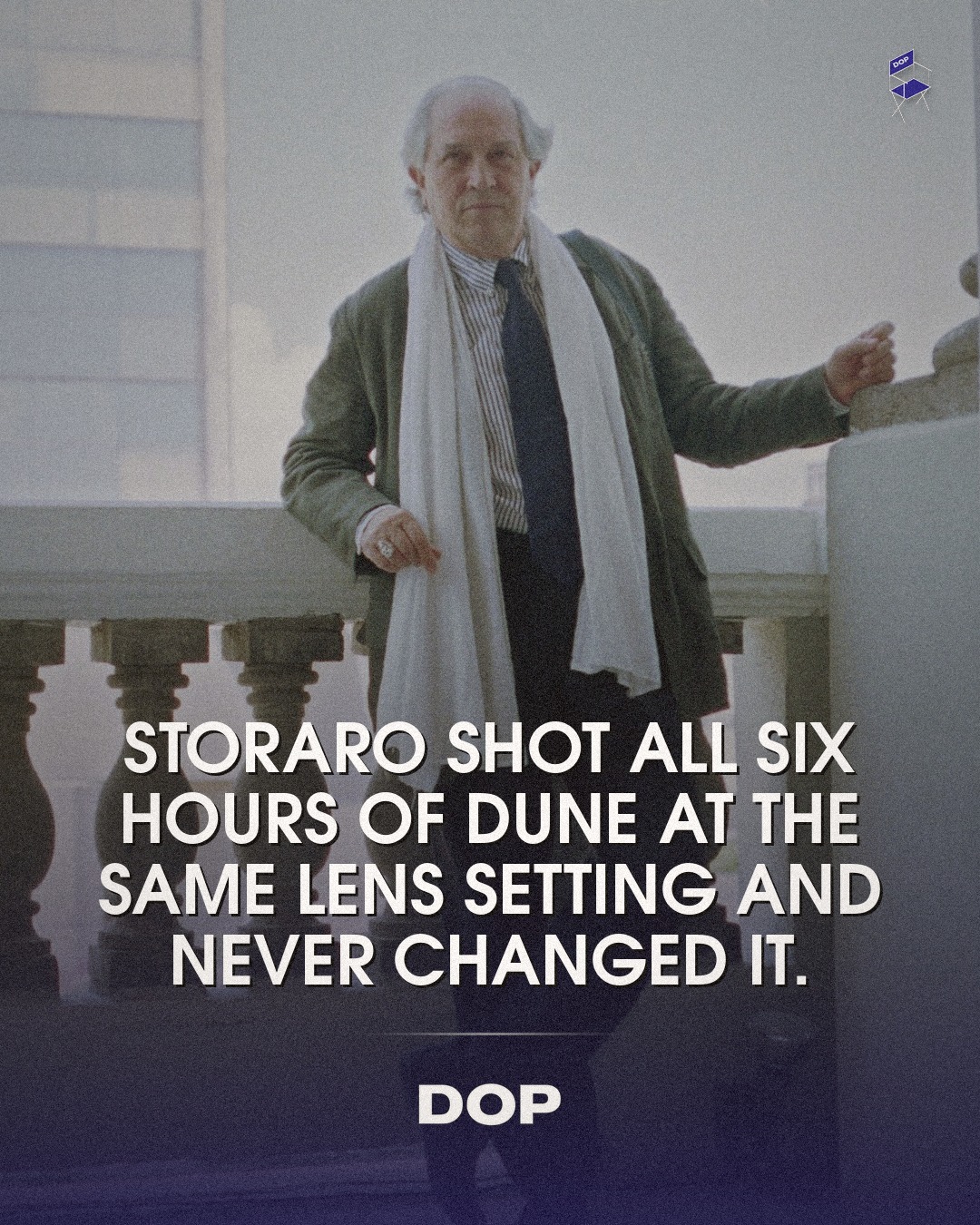
Storaro’s defining rule on Frank Herbert’s Dune was uncompromising: every frame of the six-hour runtime was exposed at exactly T4 with a standard 180-degree shutter angle. In an era where DPs were beginning to chase wide-open glass and the shallow-depth trend that would dominate the 2000s, Storaro maintained that a T4 stop yielded the optical sweet spot of prime glass, maximizing MTF contrast, eliminating edge distortion, and preserving spatial volume. Locking the stop meant depth of field remained identical whether the camera was pointing at a claustrophobic imperial council or a vast expanse of artificial sand.
To execute this dogmatic approach across three feature-length installments, Storaro turned to Cooke S4 primes, mounted on his preferred 3-perf Super 35 setup framed for his proprietary Univisium 2.00:1 aspect ratio. Crucially, his decision to shoot Cooke was entirely utilitarian rather than romantic. Where modern cinematographers crave the warm flare characteristics and soft roll-off dubbed the 'Cooke Look,' Storaro chose the newly engineered S4 series specifically for their proprietary anti-reflective coatings. Shooting inside soundstages surrounded by intense backlight and massive cycloramas, he required lenses that rejected veiling glare and flare entirely, maintaining punchy black levels under hostile lighting conditions.
Storaro didn’t chase the fabled Cooke Look; he chose Cooke S4 primes for their brutal optical discipline and multi-layer anti-reflective coatings.
The Science of Single-Layer Gels and Stage-Bound Arrakis
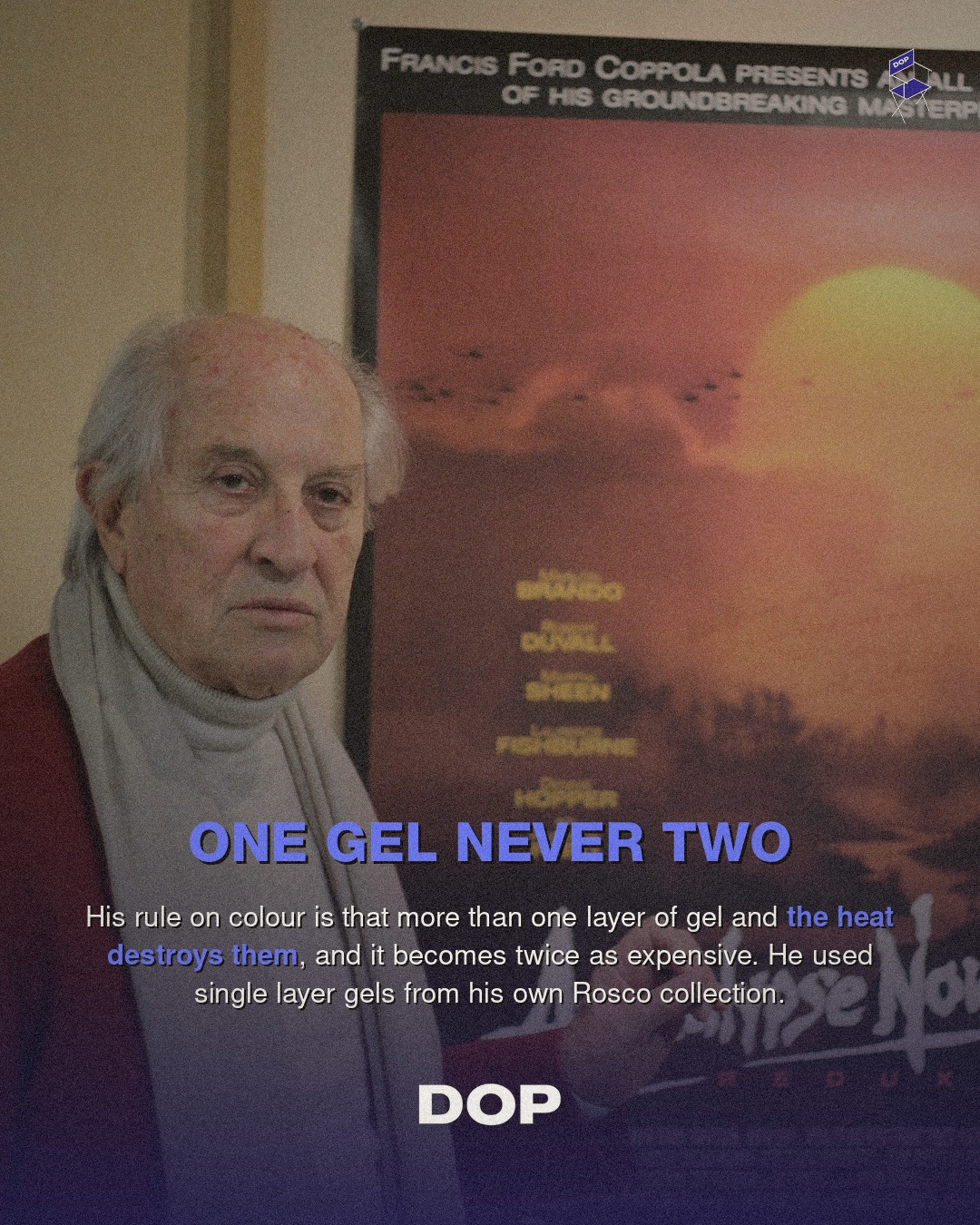
Storaro’s visual palette has always been tethered to his chromatic ideology, assigning precise emotional and psychological values to the visible spectrum. For Dune, he needed saturated, surgical separation between the arid gold of Arrakis, the cold green-blue tones of Caladan, and the malevolent red-magenta hue of the Harkonnen stronghold on Giedi Prime. Rather than stacking multiple diffusion or color correction filters, a standard industry practice that traps thermal energy and destroys expensive gel stock under 12K and 18K HMIs, Storaro developed custom, single-layer gel recipes. This not only cut material costs in half across the massive studio footprint at Cinecittà and Prague, but it kept the spectral output pure, avoiding the muddy transmission drop-offs that occur when photons pass through stacked sheets of polyester.
Perhaps the most audacious technical triumph of the miniseries was that Arrakis never saw actual sunlight. Storaro adamantly opposed shooting in real deserts, arguing that dynamic daylight would compromise the narrative control of time and light. Instead, Storaro and his son Fabrizio photographed real desert landscapes on 8x10 large format film, digitally stitched the exposures, and printed them onto enormous photographic backdrops, some stretching up to 300 feet in length and 40 feet high.
TransLite Engineering and The Illusion of Horizon
These massive TransLite drops wrapped around the soundstage, rigged with sophisticated dimming systems that allowed front-lit day sky to transition instantaneously into back-lit sunset or deep, starry night without shifting a single physical light stand. By balancing the stage fill to precisely match the luminance value of the TransLite at T4, Storaro merged the practical sand on the stage floor with the photographic background seamlessly in-camera. Foreground actors stood in front of an illusion engineered with the mechanical precision of an Italian renaissance painting.
Viewed today, Frank Herbert’s Dune stands as an unapologetic masterclass in studio cinematography. Storaro treated cinema not as a documentary capture of physical reality, but as a deliberate ideological canvas. By binding himself to an unyielding exposure stop, hyper-engineered glass, and hand-crafted optical illusions, Storaro delivered an alien world whose visual cohesion remains unmatched in television history.
This article contains affiliate links. We may earn a small commission at no extra cost to you. Learn more.