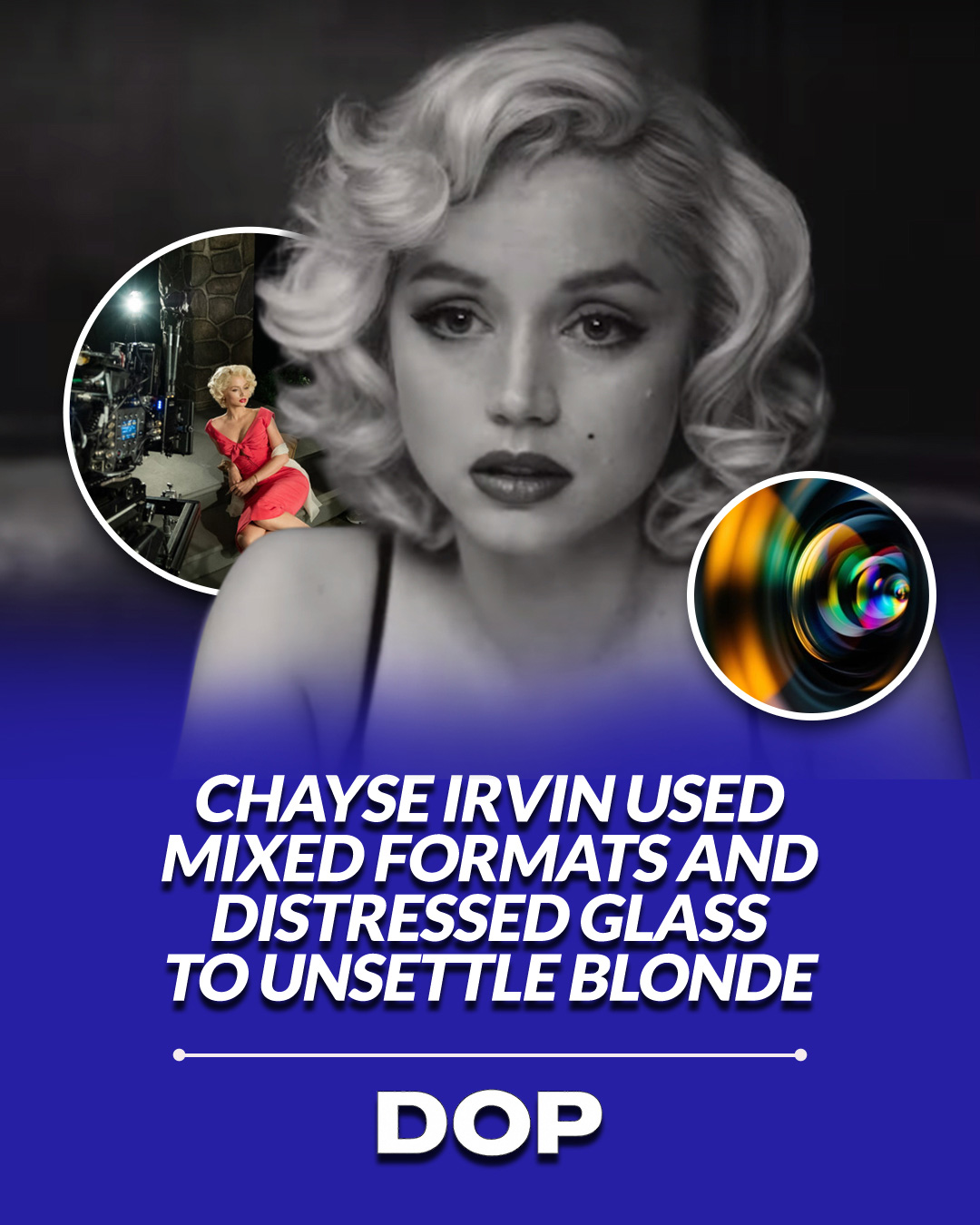
In Andrew Dominik’s Blonde, the image is never allowed to settle into a comfortable rhythm. Cinematographer Chayse Irvin, ASC, CSC, constructs a visual landscape that feels less like a traditional biopic and more like an unstable hallucinatory memory. Instead of imposing a uniform aesthetic across the narrative, Irvin treats the image as a living, fragile entity, one that fractures, bleeds, and degrades alongside the inner life of Marilyn Monroe.
To achieve this constant aesthetic metamorphism, Irvin deployed an expansive array of capture formats. The production combined digital acquisition via the ARRI Alexa Mini LF with 35mm and 16mm film stocks, including Kodak Double-X 5222 for deep monochromatic textures and Vision3 500T 5219 for rich, tungsten-lit night scenes. Rather than using format switches chronologically to mark distinct decades, the camera transitions fluidly between digital precision and silver-halide grain based purely on psychological temperature.
Embracing the Bruised Optical Path
Central to Irvin’s approach was the deliberate introduction of optical defects. Working with detuned vintage glass, including custom-modified Panavision PVintage lenses and detuned speed primes, the DP purposefully compromised the image plane. Edge softness, chromatic aberration, and extreme spherical distortion were actively invited into the frame. Instead of correcting focal falloff, Irvin allowed field curvature to swallow the background, isolating Ana de Armas in a shallow haze that mirrors her character's claustrophobic alienation.
Heavy optical diffusion, ranging from classic nets mounted behind the lens to modern Pro-Mist and fog filters, was layered to bloom specular highlights. The resulting halation creates a ghostly glow around studio lights and paparazzi flashes. In scenes where tungsten units fire directly into the front element, the internal lens flaring wipes out shadow detail entirely, transforming aggressive media attention into an overwhelming physical assault of light.
Aspect Ratios as Emotional Architecture
The film’s shifts in aspect ratio further reinforce this psychological instability. Irvin bounces between the claustrophobic 1.33:1 Academy ratio, 1.85:1 widescreen, and ultra-wide 2.39:1 anamorphic framing. When Marilyn is trapped by studio executives or hunted by flashbulbs, the tight square frame locks her into a rigid box. When her reality briefly expands, or dissociates, the image pushes outward, forcing the viewer to reorient their spatial awareness.
“We weren't interested in making a clean historical reproduction. We wanted the optics themselves to feel bruised, as if the camera was reacting to the trauma unfolding in front of it.”
Color science in Blonde follows a similarly radical logic. High-contrast black-and-white sequences featuring deep black levels and biting highlights drop suddenly into sickly, desaturated color palettes. Irvin often unbalances his lighting temperatures, deliberately shooting daylight-balanced scenes with warm tungsten fill, or drowning night exteriors in harsh, green-tinted mercury-vapor tones to emphasize a sense of unnatural exposure.
Flaws as Narrative Subtext
Irvin’s mastery lies in how he weaponizes technical mishaps. Micro-misfocus, lens breathing, and dynamic rack pulls that hesitate or stall mid-take are retained throughout the edit. Having previously demonstrated his fluid, intuitive camera work on projects like Beyoncé’s Lemonade and Spike Lee’s BlacKkKlansman, Irvin brings an unfettered, almost documentary-like immediacy to Blonde’s surreal set pieces.
For modern cinematographers, Blonde serves as a powerful testament to the expressive potential of physical optics and hybrid workflows. In an era dominated by clean sensors, perfectly corrected glass, and predictable post-production pipelines, Irvin proves that optical imperfection and format fluidity are not merely nostalgic gimmicks. When tied directly to character state, visual instability becomes a devastatingly articulate narrative language.
This article contains affiliate links. We may earn a small commission at no extra cost to you. Learn more.