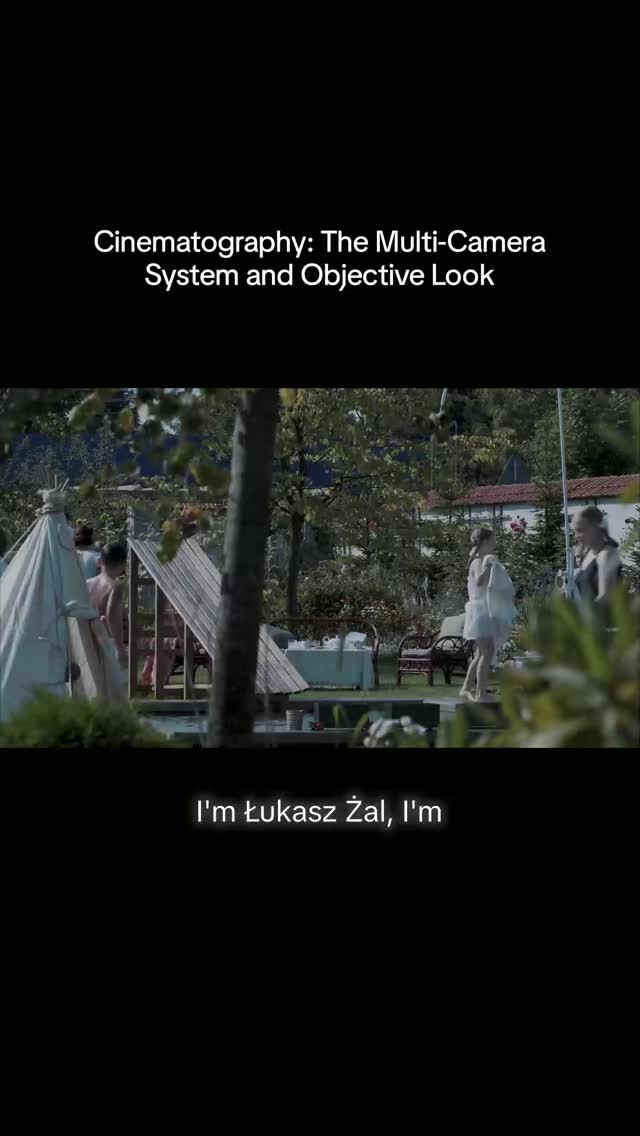
In the often-glamorous world of cinematography, where the artistry of light and shadow frequently announces its presence with bold strokes, there exists a profound counter-current: the pursuit of invisibility. This is the realm where the cinematographer’s ultimate triumph lies not in a dazzling display of technique, but in its utter disappearance. Few DPs embody this ethos with more conviction and technical ingenuity than Łukasz Żal, whose work on films like Ida and Cold War has already cemented his reputation for a stark, evocative aesthetic. However, his more experimental endeavors, particularly his exploration of a 10-camera Multi Camera System, reveal a radical philosophy aimed at achieving total objectivity – making the film set, and indeed the filmmaking process itself, vanish.
Żal’s approach isn't merely about minimizing crew or equipment; it’s a deeply philosophical stance on the nature of cinematic observation. He articulates a desire to remove the inherent judgment that traditional filmmaking often imposes, to capture life as it unfolds without the conscious manipulation that can inadvertently shape or distort reality. This isn't verité in the traditional sense, which often foregrounds the presence of the camera operator; instead, Żal seeks a kind of omniscient, unblinking gaze, a pure conduit for observation. The multi-camera setup is not about coverage for editing, but about creating an environment where the act of filming becomes so diffuse and integrated that it ceases to be an external force.
The Multi-Camera System: A Panoptic Eye
The technical elegance of Żal's 10-camera Multi Camera System lies in its strategic deployment. Imagine an array of compact, high-resolution digital cinema cameras – perhaps something like the Blackmagic Pocket Cinema Camera 6K Pro, known for its dynamic range and manageable form factor, or even a custom-rigged system of mirrorless cameras with cinema-grade glass. These aren't just redundant angles; they are carefully positioned to create overlapping fields of view, allowing for continuous, unbroken recording across an entire space. The goal is to eliminate the 'hot spots' of attention that a single camera creates, where actors inevitably play to the lens. With ten cameras silently capturing from various vantage points, the pressure of performance dissipates, replaced by a more natural, unselfconscious unfolding of events.
"By removing the lights and the feeling of a movie set, the goal is simple: total objectivity. It’s all about capturing life as it unfolds without judgment, just raw, unadorned observation."
Crucially, Żal emphasizes the removal of traditional lighting setups. This is a radical departure for a cinematographer, whose primary tool is light. Instead, he relies on available light, often augmenting it subtly and imperceptibly, perhaps with practicals or bounced ambient sources designed to blend seamlessly into the environment. The pursuit here is not to sculpt and define with light, but to capture the existing light as an intrinsic part of the observed reality. This choice impacts everything from sensor selection – cameras with exceptional low-light performance and robust noise handling become paramount – to lens choice, favoring fast primes that can drink in every available photon without imposing their own character too heavily.
Beyond the Gaze: The Unseen Influence
This philosophy extends beyond the technical. The 'feeling of a movie set' Żal refers to encompasses the entire ecosystem of production – the cables, the stands, the crew. By distributing the camera's presence, and by minimizing the intervention of artificial light, he aims to create an environment where subjects are less aware of being filmed. This is not about hidden cameras in a voyeuristic sense, but about creating a psychological space where the act of observation is normalized, almost invisible. The data management and post-production implications of such a system are immense, requiring meticulous synchronization and a disciplined workflow to coalesce ten separate streams into a cohesive narrative, or perhaps, a non-narrative, observational experience.
Żal’s work, particularly his acclaimed black-and-white cinematography, often features a minimalist aesthetic that strips away the superfluous to reveal essential truths. Whether it’s the stark, composed frames of Ida, shot on ARRI Alexa XT in 4:3 aspect ratio with Cooke S4 lenses, or the nuanced desaturation of Cold War, his visual language always serves the narrative's emotional core. This multi-camera exploration is a logical extension of that pursuit – a quest for an even purer, unmediated form of cinematic truth. It challenges us to reconsider the very definition of a 'shot' and the role of the cinematographer, not as a painter of light, but as a facilitator of unadorned vision.
For DPs, Żal’s experiment is a provocative reminder that sometimes the most powerful visual statements come from effacing the authorial hand. It's a call to observe, truly observe, and to allow the world to present itself, unburdened by the apparatus of its capture. In an era where visual spectacle often reigns supreme, Żal's invisible cinematography offers a refreshing, profound counter-narrative – a testament to the enduring power of objectivity in a medium often defined by its subjective interpretations.
This article contains affiliate links. We may earn a small commission at no extra cost to you. Learn more.