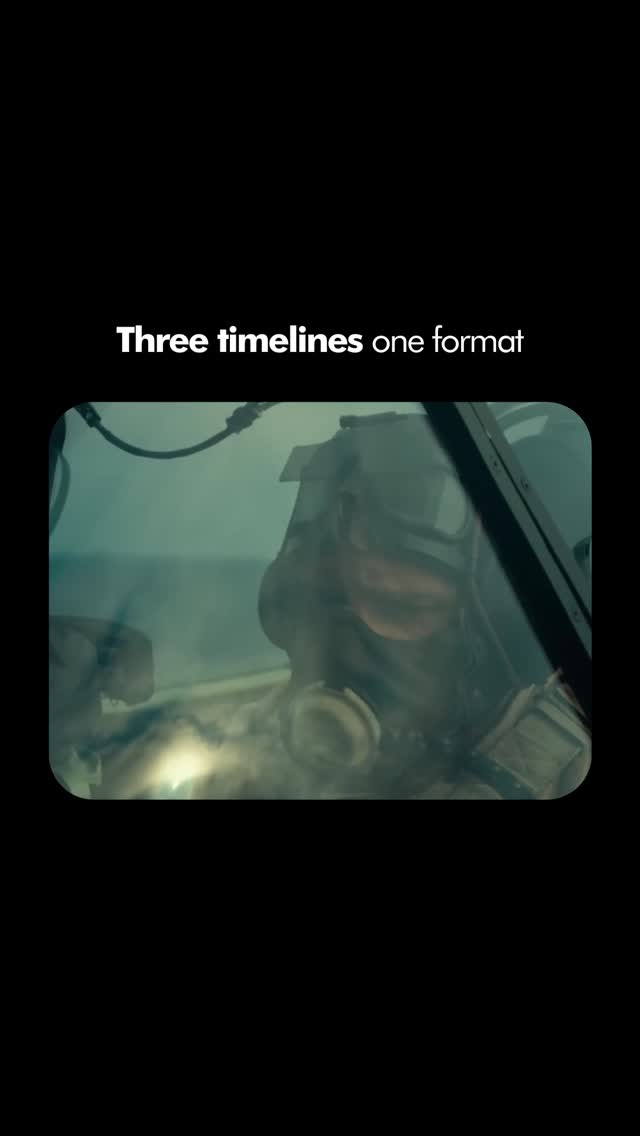
When Christopher Nolan and cinematographer Hoyte van Hoytema ASC, FSK, NSC set out to make Dunkirk, they were not merely staging an epic historical recreation; they were designing a relentless, sensory engine of survival. Coming off their collaboration on Interstellar, the duo abandoned traditional narrative exposition in favor of visceral, image-driven cinema. The result is a film that operates less like a standard war drama and more like an immersive physical experience, driven almost entirely by the raw communicative power of light, scale, and motion.
At the core of Dunkirk’s visual strategy was an uncompromising commitment to large-format analogue capture. Approximately 75 percent of the film was shot on 15-perf 70mm IMAX film, with the remainder captured on standard 5-perf 65mm for dialogue scenes where camera noise would prove prohibitive. Rather than using large-format canvas exclusively for majestic wide shots, van Hoytema inverted the medium's tradition, shoving massive IMAX cameras into intimate, claustrophobic spaces where they had theoretically no business being.
Pushing IMAX into the Cockpit
The technical zenith of this approach is undoubtedly the air sequence, centered on the cockpits of Royal Air Force Spitfires. To capture the kinetic terror of dogfights from the pilot’s immediate perspective, van Hoytema worked closely with Panavision optical genius Dan Sasaki. Together, they engineered custom periscope lenses and specialized low-profile housing for the bulky IMAX MSM 9802 camera, allowing it to be mounted inside the narrow cockpits of vintage aircraft, as well as on specialized external rigs clamped directly to wings and fuselages.
For Dunkirk, the IMAX camera wasn't just a recording device for grand landscapes, it became a participant in the cockpit, subjecting the viewer to every g-force, glare, and terrifying mechanical vibration.
Operating at high altitude over open sea presented immense lighting challenges. Van Hoytema relied entirely on natural, unassisted sunlight, balancing the brutal highlights of clouds against the deep, shadowed interiors of the cockpit. Choosing Kodak Vision3 50D 5203 and 250D 5207 daylight-balanced film stocks, the production captured an astonishing dynamic range. The highlight retention on the optical negative preserved the subtle textures of sea foam and harsh sky reflections without ever clipping into digital harshness.
Temporal Alignment and Photochemical Mastery
Dunkirk’s narrative is famously structured across three overlapping timeframes: a week on the land (The Mole), a day on the sea (The Sea), and an hour in the air (The Air). Cross-cutting these distinct timelines required an intricate visual balance. A sunny afternoon on the water had to seamlessly intercut with overcast twilight on the beaches and shifting cloud cover at 5,000 feet, all while maintaining a consistent emotional temperature and visual rhythm.
Achieving this required meticulous planning on set rather than relying on heavy digital manipulation in post-production. True to Nolan and van Hoytema’s philosophy, Dunkirk maintained an entirely photochemical workflow from negative to final release prints. Color timing was executed optically at the lab, preserving the rich, organic color science inherent to celluloid. The cool, muted blues of the English Channel, the oxidized green tones of vintage military gear, and the warm flesh tones under overcast skies feel grounded in physical reality because they were captured directly onto silver halide grains.
The Art of Pure Cinematic Expression
With minimal dialogue throughout its runtime, the camera carries the weight of characterization and dramatic tension. Van Hoytema’s framing frequently employs low-angle, medium close-ups with wide lenses, keeping characters grounded within their immediate environments. On the beaches of Dunkirk, the vast 1.43:1 IMAX aspect ratio emphasizes the crushing isolation of 400,000 trapped soldiers, juxtaposing the endless expanse of sea and sky against their absolute vulnerability.
Dunkirk stands as a high-water mark in modern cinematography, proving that the largest movie camera in the world can be wielded with the intimacy of a handheld unit. Through sheer optical craftsmanship, raw mechanical rigging, and a steadfast devotion to the physical medium, Hoyte van Hoytema and Christopher Nolan stripped cinema down to its purest, most potent elements: time, space, light, and survival.
This article contains affiliate links. We may earn a small commission at no extra cost to you. Learn more.