When discussing the pantheon of modern cinematographers capable of managing gargantuan scale without sacrificing intimate texture, Dariusz Wolski ASC is inevitably at the center of the frame. Leaving Warsaw in 1979 at just 23, Wolski cut his teeth as a camera assistant on the gritty streets of New York and Los Angeles before exploding into the MTV era. His visual work on music videos, most notably David Fincher’s iconic promo for Aerosmith’s “Janie’s Got a Gun”, established his signature command over atmospheric contrast, tactile shadows, and dynamic camera movement that would soon dominate feature filmmaking.
Yet, despite serving as Ridley Scott’s primary visual collaborator across nine monumental features since Prometheus in 2012, Wolski holds just a single Academy Award nomination: his evocative, candle-and-lantern-lit work on Paul Greengrass’s News of the World in 2021. That year, the Oscar went to Erik Messerschmidt ASC for Mank, a poetic passing of the torch, given Messerschmidt was David Fincher’s long-time gaffer. The contrast highlighted an enduring industry paradox: how one of the most prolific architects of contemporary visual language remains perpetually under-recognized by institutional accolades.
Subverting Widescreen: The Spherical Philosophy
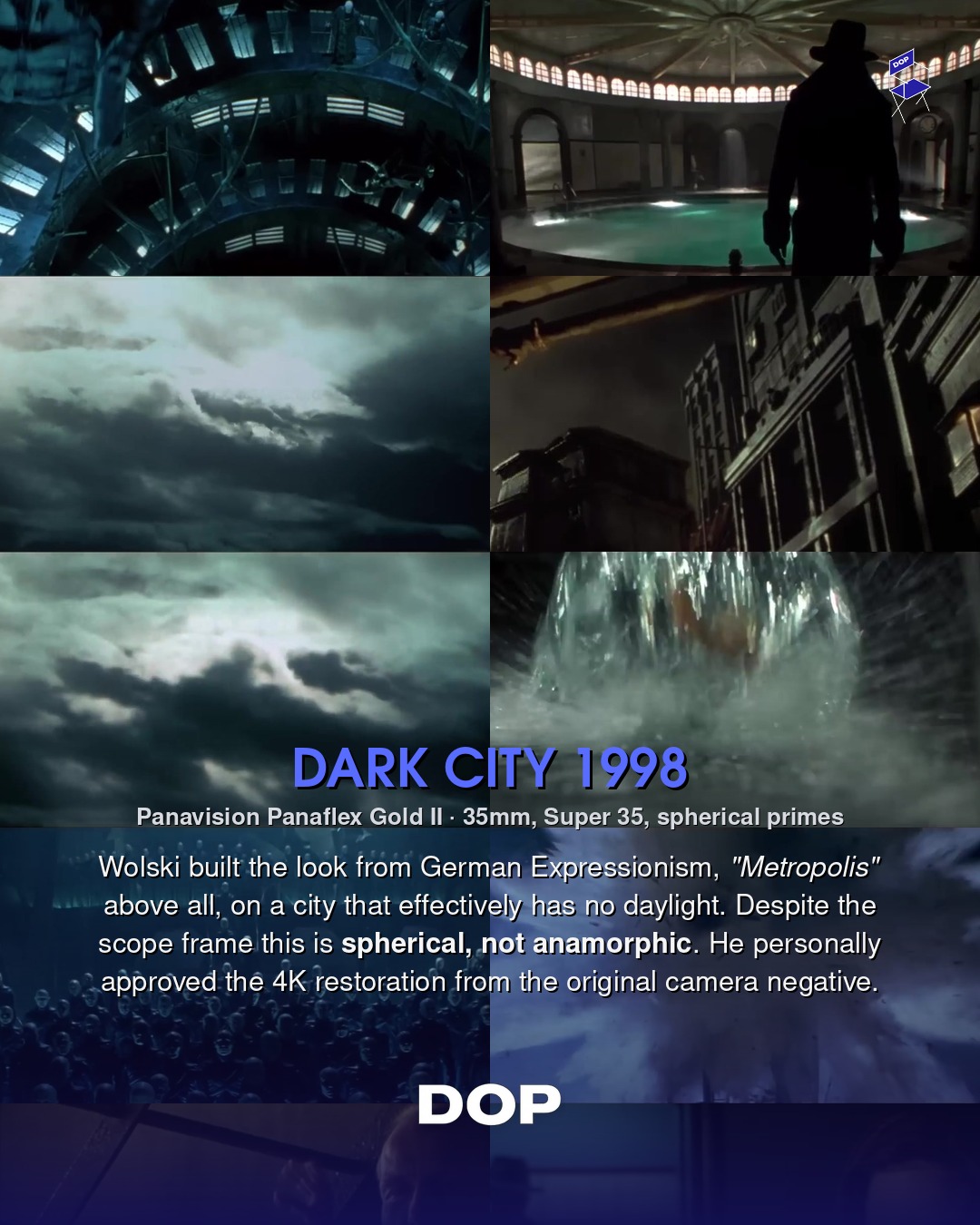
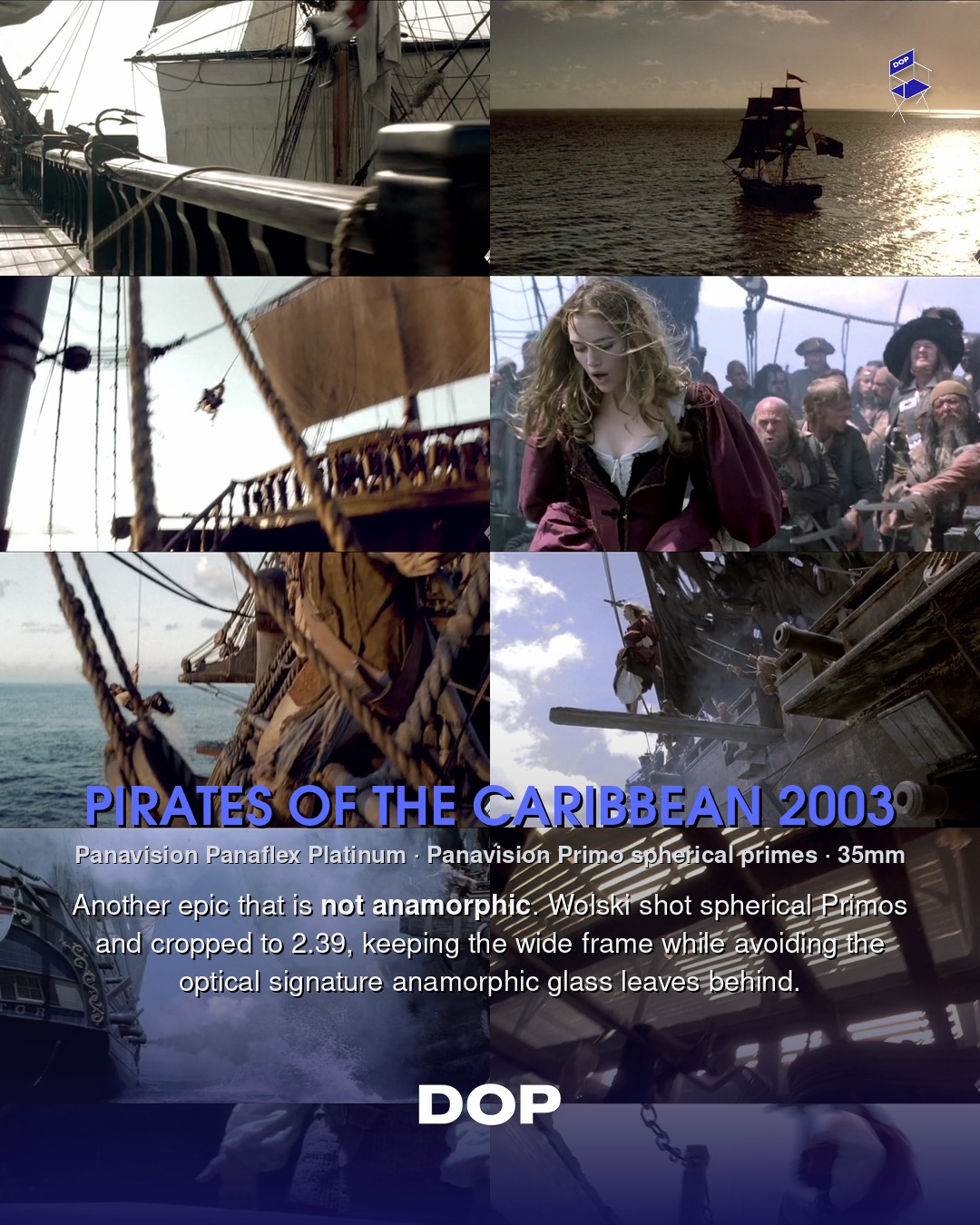
Part of Wolski’s genius lies in his refusal to lean on visual clichés to achieve cinematic weight. Two of his most iconic widescreen masterworks, Alex Proyas’s Dark City (1998) and Gore Verbinski’s Pirates of the Caribbean: The Curse of the Black Pearl (2003), are widely misidentified by audiences as anamorphic triumphs. In reality, Wolski captured both spherically on Panavision glass, framing for 2.39:1 via Super 35 extraction.
On Dark City, Wolski channelled German Expressionism and Fritz Lang’s Metropolis, utilizing standard spherical Primos to maintain precise geometric control across a perpetual nocturnal cityscape. Avoiding the optical distortions, chromatic aberrations, and shallow fall-off of anamorphic glass allowed Wolski to render razor-sharp practical architecture, cutting through dense smoke with high-contrast, directional key lights while maintaining rich, velvety blacks that never turned to digital or photochemical mud.
“Wolski doesn’t chase optical nostalgia; he chooses glass that serves architectural geometry, high-contrast separation, and narrative momentum over vintage flair.”
Similarly, for Pirates of the Caribbean, Wolski bypassed anamorphic lenses to manage harsh tropical water reflections and high-speed multi-camera setups. Cropping spherical Primos afforded him faster apertures, tighter close-focus capabilities, and cleaner edge-to-edge resolution across vast maritime action sequences, proving that widescreen drama is a product of compositional discipline rather than anamorphic barrel distortion.
Pioneering Digital Realism and Multi-Camera Scale
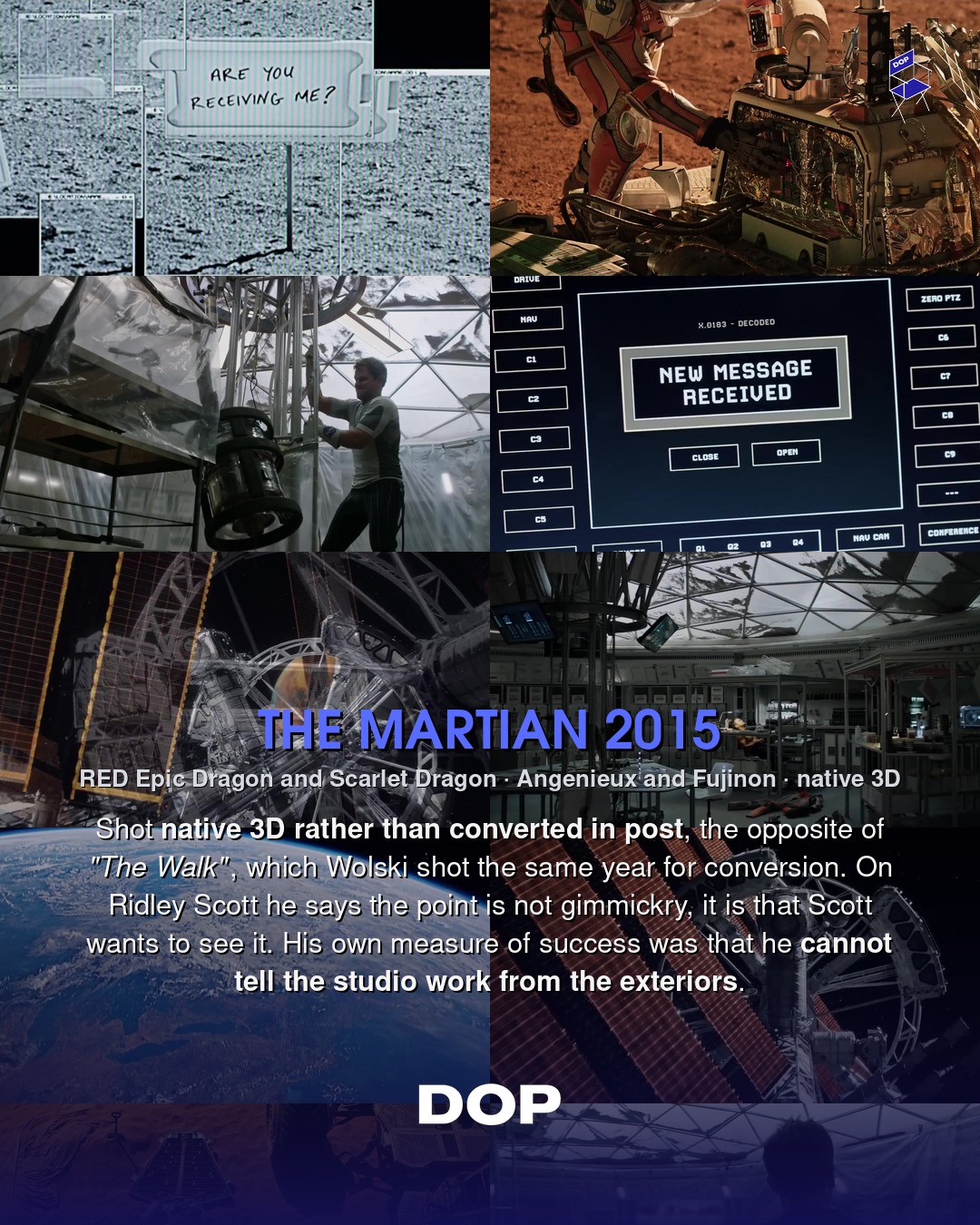
Wolski’s seamless transition into digital cinematography solidified his enduring partnership with Ridley Scott. Where many purists resisted digital stereoscopy, Wolski embraced native 3D on Prometheus and The Martian (2015). Shooting The Martian on Red Dragon sensors paired with custom 3ality Technica TS-5 stereo rigs in the searing deserts of Wadi Rum, Wolski captured genuine volumetric depth in-camera, resisting the flat compromises of post-conversion stereoscopy.
His collaboration with Scott relies on a fiercely pragmatic, multi-camera shooting style. Wolski routinely lights vast sets for up to four or five Red and ARRI cameras rolling simultaneously, maintaining delicate key-to-fill ratios that provide each operator with a cuttable, cinematically motivated angle. On historical epics like The Last Duel and Napoleon, Wolski balanced large-format ARRI Alexa LF and Mini LF sensors with custom Cooke and Angénieux glass, capturing muddy medieval skirmishes and candlelit interiors with painterly desaturation and naturalistic softness.
The Legacy Beyond the Ballot
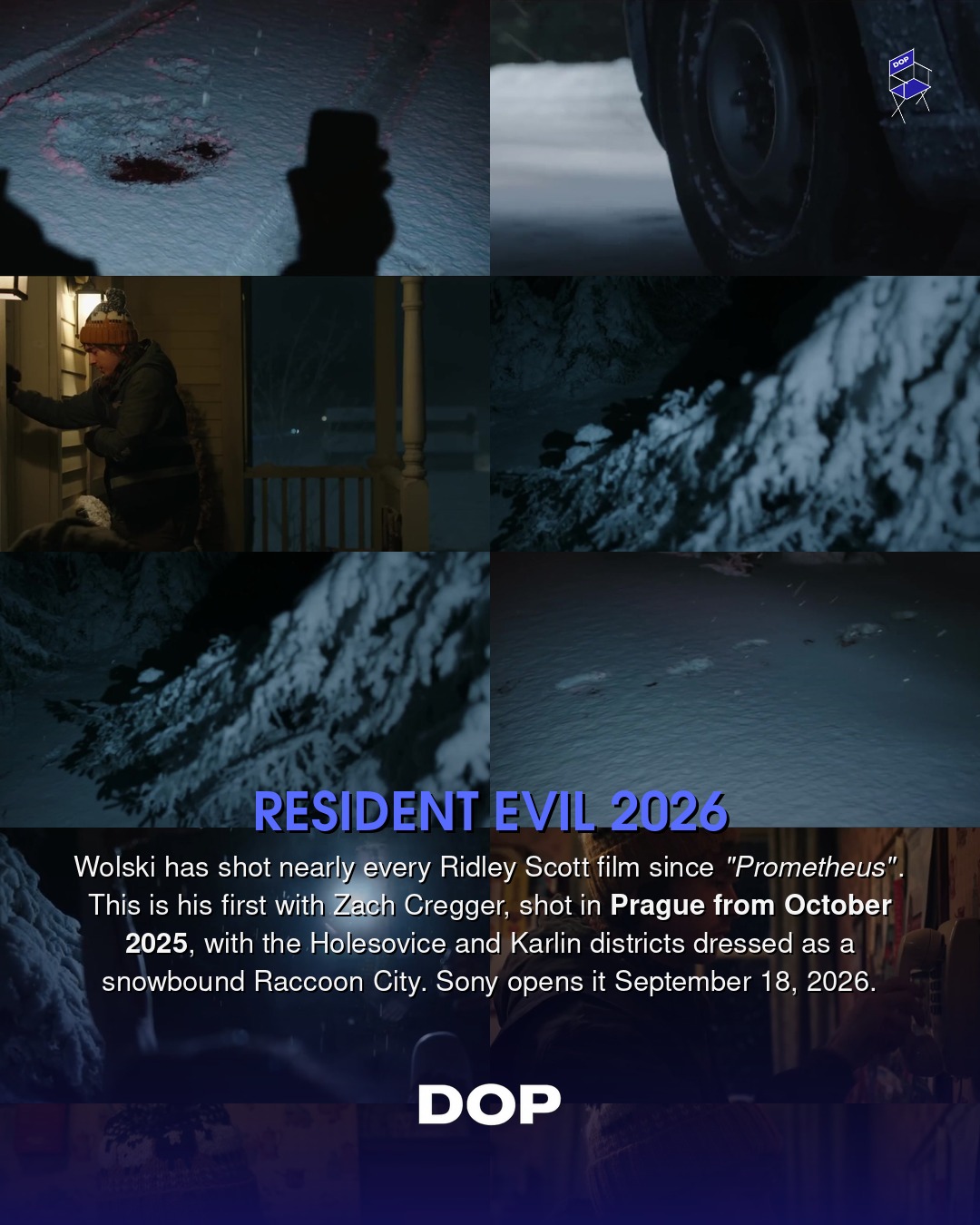
Wolski’s upcoming work on Zach Cregger’s highly anticipated horror feature in Prague marks another genre pivot, proving his technical curiosity remains as restless as ever. Whether manipulating exposure latters in desolate frontier landscapes or sculpting light across massive studio soundstages, his filmography is a masterclass in visual storytelling.
Awards seasons inevitably favor the overtly stylized and self-contained chamber pieces, frequently overlooking the immense logistical and aesthetic mastery required to command sprawling, hundred-million-dollar canvases. For cinematographers, camera operators, and gaffers who study the frame, Dariusz Wolski’s legacy is already secured in the work itself, uncompromising, technically fearless, and undeniably cinematic.