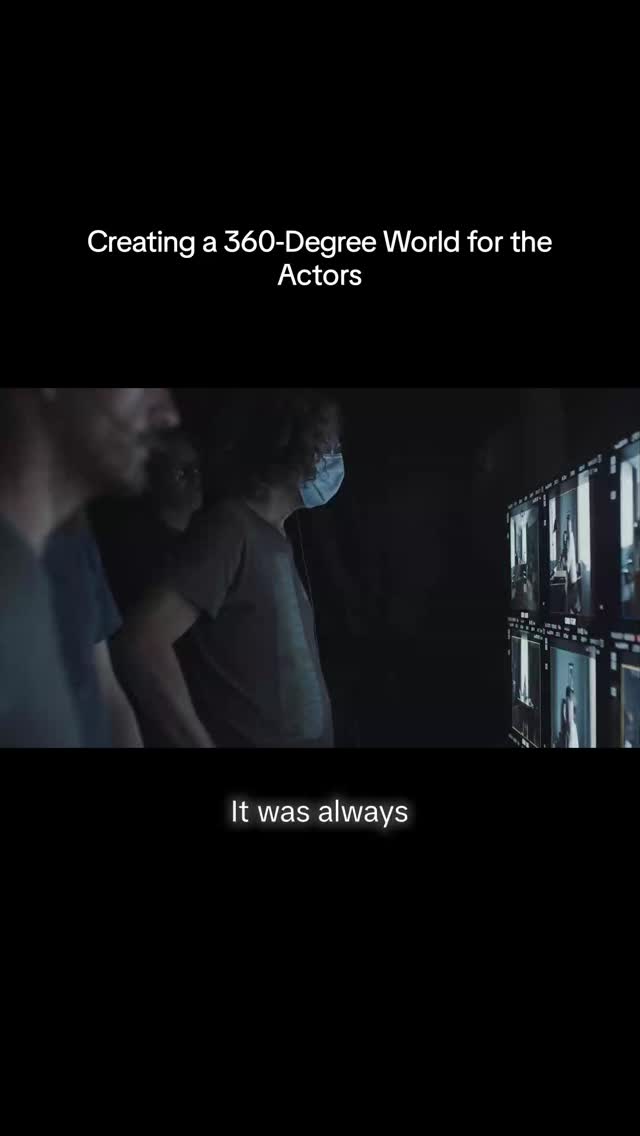
In an industry often defined by its meticulous control and the artifice of its construction, a recent production has dared to challenge the very foundations of cinematic world-building. The Instagram caption, a concise declaration of intent, speaks volumes: to strip away the artifice and embrace a raw, 360-degree environment. This isn't merely a stylistic choice; it's a profound philosophical commitment to realism that reverberates through every aspect of the visual craft, offering a masterclass in how constraint can unlock unparalleled authenticity.
The core principle here is the construction of a complete, immersive world. This isn't a partial set with carefully dressed angles; it's an environment designed for free, uninhibited camera movement. For the Director of Photography (DP) and their crew, this liberates the camera from the tyranny of the frame, allowing it to dance with the performance in single, unbroken takes. Think of the logistical genius required to achieve this: the careful consideration of sightlines, the seamless integration of practical elements, and the near-invisible presence of the crew. This approach inherently pushes cinematographers to think beyond traditional blocking and coverage, forcing an organic, almost documentary-like engagement with the narrative.
The Power of Authentic Light
Perhaps the most radical departure, and certainly the most compelling from a cinematography standpoint, is the eschewing of artificial lighting. The caption explicitly states: “without the need for artificial lighting or romanticized embellishments.” This is not a casual decision; it's a bold declaration in an industry where light is often sculpted, diffused, and artfully placed to achieve a specific mood or aesthetic. Instead, the DP opted for “hard, authentic light sources.” This choice immediately brings to mind the work of groundbreaking DPs like Conrad Hall, who famously embraced natural light and sometimes even the 'ugly' realities of available illumination to heighten emotional truth in films like In Cold Blood or Cool Hand Luke. It's a philosophy that prioritizes the inherent drama of existing light, allowing shadows to fall where they may and highlights to flare with unvarnished intensity.
"To strip away the artifice and embrace a raw, 360-degree environment... opting for hard, authentic light sources to let the scene breathe exactly as it is."
This commitment to natural, or at least naturally motivated, hard light profoundly impacts the visual texture of the film. Hard light, by its very nature, creates sharp, defined shadows and high contrast, lending a gritty, almost visceral quality to the image. It reveals textures, accentuates facial contours, and can imbue a scene with a palpable sense of realism and immediacy. Imagine the meticulous planning involved in scheduling shoots around the sun's trajectory, or the ingenious use of practical fixtures within the set to serve as the primary illumination. This isn't about absence of light; it's about the intelligent harnessing of existing light, perhaps augmented subtly with negative fill or carefully positioned bounces to shape rather than create.
Technical Choices for Unvarnished Reality
To achieve this unvarnished reality, the choice of camera and lens becomes paramount. One might speculate on the use of cameras known for their exceptional dynamic range, such as ARRI's ALEXA Mini LF or Sony's VENICE, capable of holding detail in both deep shadows and bright highlights when dealing with challenging natural light. Lenses would likely lean towards those with character, perhaps vintage glass or modern primes known for their honest rendition of reality – not overly corrected, allowing for subtle flares or fall-off that add to the organic feel. The color science, too, would be crucial, likely favoring a neutral, unmanipulated palette that reflects the authenticity of the light rather than imposing an artificial grade.
This approach stands in stark contrast to the often 'romanticized embellishments' of mainstream cinema, where soft, diffused light and meticulously controlled environments are the norm. It challenges the audience to engage with the narrative on a deeper, more unmediated level. When a scene is lit by the harsh reality of a single overhead bulb or the unfiltered sun streaming through a window, there's an undeniable sense of being present, an almost voyeuristic intimacy that artificial lighting often struggles to replicate. It's a courageous act of trust – trusting the environment, trusting the light, and most importantly, trusting the performances to carry the weight of the story without the crutch of overt visual manipulation.
Ultimately, this production serves as a powerful reminder that sometimes, the most profound visual statements are made not by adding, but by stripping away. By embracing the raw, the unadorned, and the authentic, the DP and their team have crafted a visual language that speaks volumes about commitment to the craft and the unwavering pursuit of cinematic truth. It's a challenging, yet deeply rewarding path, one that pushes the boundaries of conventional cinematography and reaffirms the power of light, in its most unvarnished form, to tell a story with unparalleled honesty.
This article contains affiliate links. We may earn a small commission at no extra cost to you. Learn more.