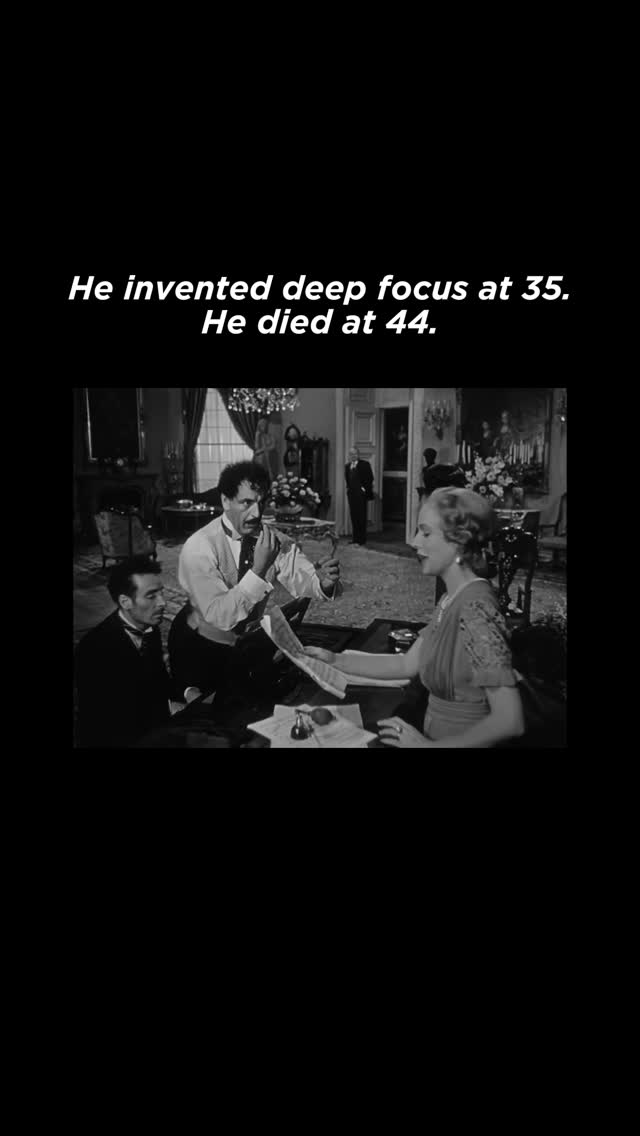
Few cinematographers in the history of motion pictures have reshaped the visual language of cinema as radically, or as rapidly, as Gregg Toland. When he passed away suddenly in 1948 at the age of just 44, he left behind a body of work that effectively divided film history into two distinct eras: before Toland and after Toland. In less than a decade of peak creative output, he dismantled the soft-focus, romanticized aesthetic of 1930s Hollywood and replaced it with a stark, hyper-articulated visual grammar that rendered the entire frame active, meaningful, and alive.
Before Toland revolutionized the craft, the standard practice in studio filmmaking relied heavily on shallow depth of field. Directors and directors of photography used selective focus to direct the audience's gaze, keeping stars sharp against intentionally blurred backgrounds. Toland saw this not as an aesthetic imperative, but as a limitation. Collaborating with directors who favored theatrical blocking and social realism, such as John Ford on The Grapes of Wrath, Toland began experimenting with Panchromatic film stocks and high-contrast lighting to capture grim, uncompromising realities with uncompromising clarity.
The Physics of Deep Focus and Technical Ingenuity
Toland was not merely a stylist; he was a relentless technician who understood that breaking artistic conventions required engineering entirely new tools. To achieve deep focus, maintaining razor-sharp clarity from three feet in front of the lens to the back wall of a studio set, he had to overcome the fundamental laws of optics. Stopping down a lens to f/8, f/11, or f/16 dramatically cuts the light hitting the film emulsion, requiring an exponential increase in illumination.
To make this viable, Toland partnered with Mitchell Camera Corporation to modify the Mitchell BNC camera, making it quieter and easier to maneuver. He worked with optics engineers to coat his lenses with Vard Optics water-repellent and anti-reflective chemical coatings, which increased light transmission and allowed him to shoot directly into light sources without devastating internal flare. To illuminate these stopped-down frame compositions, Toland deployed high-intensity carbon arc lamps previously reserved for Technicolor productions, flooding his sets with unprecedented foot-candles of light.
Cinematography isn't merely about capturing action; it is about organizing space to reveal psychological truth. Depth of field is depth of meaning.
When Orson Welles arrived in Hollywood to make Citizen Kane, he found in Toland a collaborator willing to throw out the studio rulebook. Together, they designed sets with real muslin ceilings, allowing Toland to conceal light fixtures overhead and tilt the camera upward to showcase low angles previously unseen in studio filmmaking. In scenes where physical optical depth was impossible to achieve naturally, Toland employed brilliant in-camera split-focus exposures and optical compositing, layering two separate exposures on the same negative to keep both extreme foreground elements and distant background action in crisp focus.
From Baroque Expressionism to Humanist Realism
While Citizen Kane stands as a monument to baroque visual bravado, Toland’s mastery lay in his versatility. Working with William Wyler on The Best Years of Our Lives, he adapted his deep focus system to serve a completely different emotional frequency. Rather than exaggerating psychological isolation through dramatic perspective distortion, Toland used deep focus to create a democratic frame. In the famous piano-bar scene, the audience is free to observe multiple emotional arcs occurring simultaneously across foreground, midground, and background without a single cut disrupting the spatial continuity.
Toland’s lighting philosophy was equally revolutionary. Moving away from the conventional three-point lighting setup, he mastered chiaroscuro, the dramatic interplay of extreme light and deep shadow. He treated shadows not as empty space, but as positive structural elements within his compositions, using low key-to-fill ratios to carve out geometry and mood with surgical precision.
Every contemporary cinematographer who stops down to keep visual context intact, every operator who tilts up from a floor-level rig, and every lighting director who uses shadow as a primary storytelling tool owes a direct debt to Gregg Toland. Though his life was cut tragically short, his relentless drive to expand the physical and conceptual boundaries of the camera redefined visual storytelling forever.
This article contains affiliate links. We may earn a small commission at no extra cost to you. Learn more.