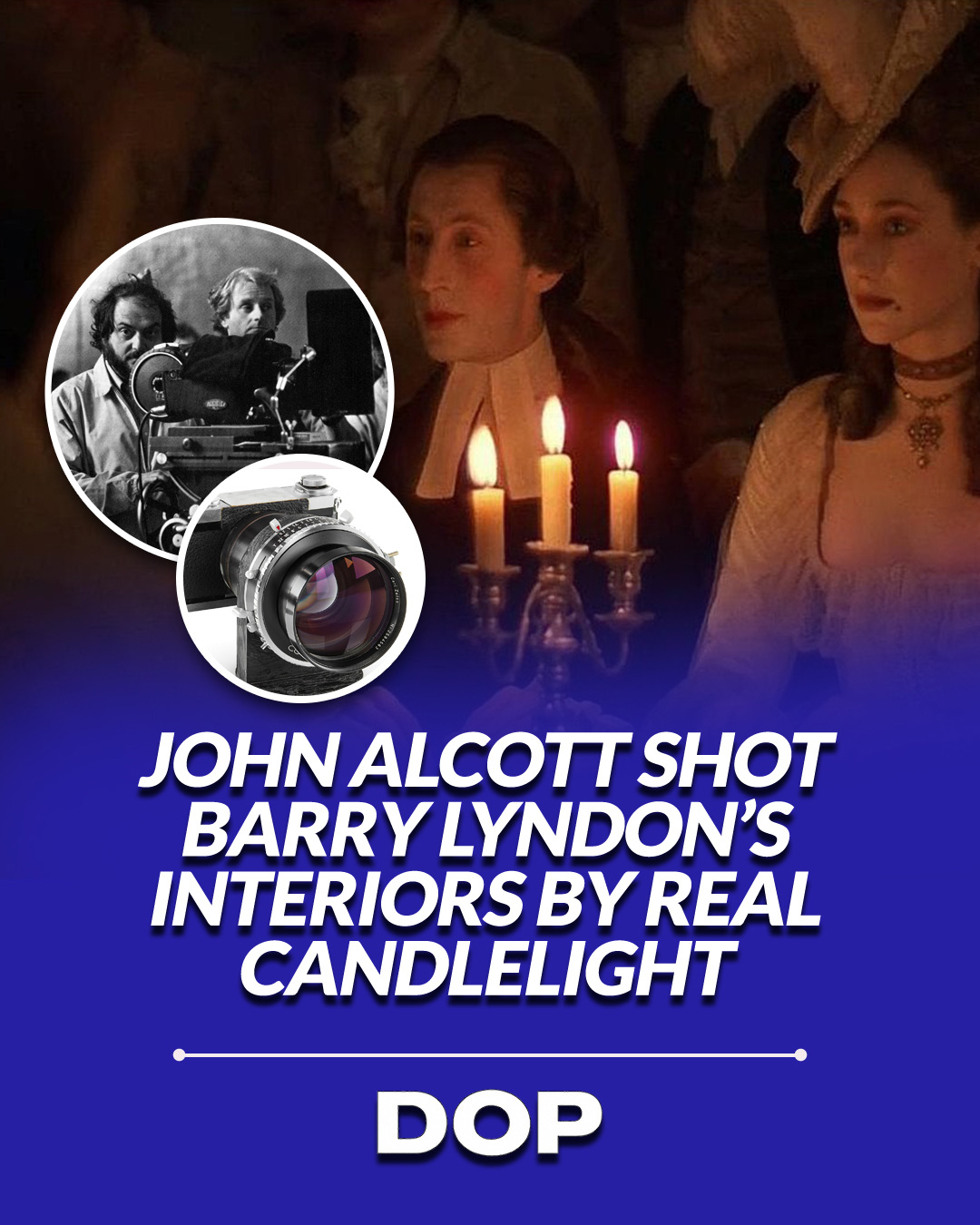
Stanley Kubrick’s 1975 masterpiece, Barry Lyndon, stands as a watershed moment in the history of motion picture cinematography. Driven by a uncompromising desire to replicate the visual atmosphere of the 18th century, Kubrick and director of photography John Alcott BSC rejected the artificial aesthetic of contemporary period dramas. Instead of concealing tungsten units behind set walls or pushing artificial key lights through faux windows, they pursued an audacious goal: shooting interior scenes illuminated exclusively by genuine candlelight.
Standard studio practice of the era relied on heavy arc lights and tungsten fixtures to achieve adequate exposure on slow film stocks. To break away from this theatrical approach, Alcott and Kubrick needed an optical solution that simply did not exist in standard cinema rental houses. The challenge was not merely creative; it was a physics problem that demanded a radical approach to lens design, camera modification, and practical lighting design.
The Optical Gamble: Adapting NASA Glass for Cinema
The solution came in the form of ultra-fast optical glass developed for aerospace exploration. Kubrick discovered that Carl Zeiss had manufactured ten 50mm f/0.7 lenses for NASA’s Apollo program, designed specifically to photograph the dark side of the moon. Featuring a hyper-large aperture, the lens gathered roughly two stops more light than the fastest standard cinema lenses available at the time. However, retrofitting an optical element engineered for space photography onto a 35mm motion picture camera was an unprecedented engineering hurdle.
Kubrick enlisted optical engineer Ed DiGiulio of Cinema Products Corp to adapt the glass. Because the physical rear element of the Zeiss f/0.7 sat a mere 5.2mm from the film plane, it could not clear the spinning mirror shutter of a standard reflex camera. DiGiulio had to heavily modify a non-reflex Mitchell BNC camera, stripping out its internal mechanics and building a custom fixed optical viewfinder. To further maximize light transmission, Alcott paired these lenses with Kodak Eastman Color Negative 5254 film stock (rated at 100 ASA), pushing the stock one full stop in processing to achieve a workable 200 ASA index.
"Once you commit to an uncompromising real source, every other decision, from glass and T-stop to blocking and art direction, must fall strictly in line."
Precision Focus and Unforgiving Depth of Field
Lighting the sets required its own specialized engineering. The production utilized multi-wick candles specially manufactured to produce a broader, brighter flame, often arrayed across elaborate chandeliers and candelabras backed by silvered mirrors to bounce ambient exposure throughout the frame. Because no supplemental movie lights were concealed on set, the candle flames served as the true key, fill, and rim light simultaneously, wrapping actors in a soft, flickering glow that mimicked classical oil paintings by Thomas Gainsborough and William Hogarth.
The technical trade-offs of operating wide open at f/0.7 were brutal. The depth of field was measured in fractions of an inch, leaving focus puller Doug Milsome with virtually zero margin for error. Traditional visual focus pulls were impossible through the non-reflex body during takes. Instead, the crew relied on a closed-circuit video camera mounted at a 90-degree angle to monitor actor distances, while actors were instructed to keep their movements strictly parallel to the focal plane to avoid drifting soft.
The Legacy of Motivation First
The resulting visual texture of Barry Lyndon is impossible to replicate with modern digital shortcuts or artificial fill. The wide-open Zeiss glass introduced organic spherical aberrations, gentle flare, and an abrupt focal falloff that naturally isolated subjects from dark, velvety backgrounds. The light wraps around skin with a natural, delicate roll-off, highlighting the textured fabrics and delicate makeup of the era without harsh hot spots.
For contemporary cinematographers, Alcott and Kubrick’s work on Barry Lyndon remains the ultimate masterclass in the philosophy of motivated light. By refusing to compromise on the purity of their light source, they forced every aspect of optical, mechanical, and logistical production to evolve. It stands as a timeless reminder that when technical rigor is placed in service of visual truth, the results transcend technique to become pure cinema art.
This article contains affiliate links. We may earn a small commission at no extra cost to you. Learn more.