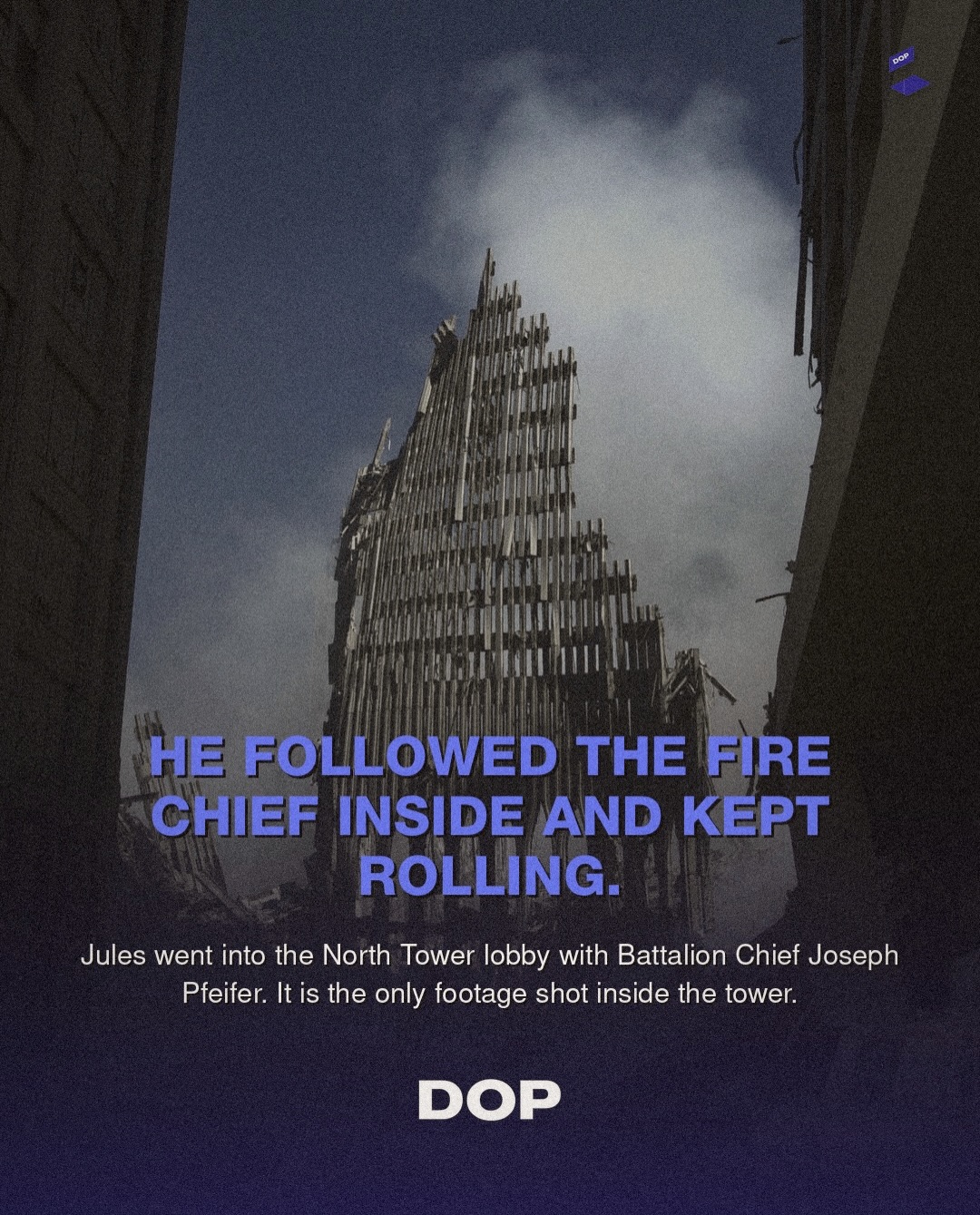
On the morning of September 11, 2001, Jules Naudet was doing the unglamorous, everyday work of cinéma vérité. Shadowing Battalion 1 Chief Joseph Pfeifer of the FDNY, Naudet and his brother Gédéon were months into filming a documentary about a probationary firefighter’s rookie year. Stand-ups, waiting periods, false alarms. At the intersection of Church and Lispenard Streets in Lower Manhattan, Chief Pfeifer investigated a routine report of an underground gas leak. Jules held his camera shoulder-level, rolling on the municipal mundanity that documentary cinematographers log by the hundreds of hours.
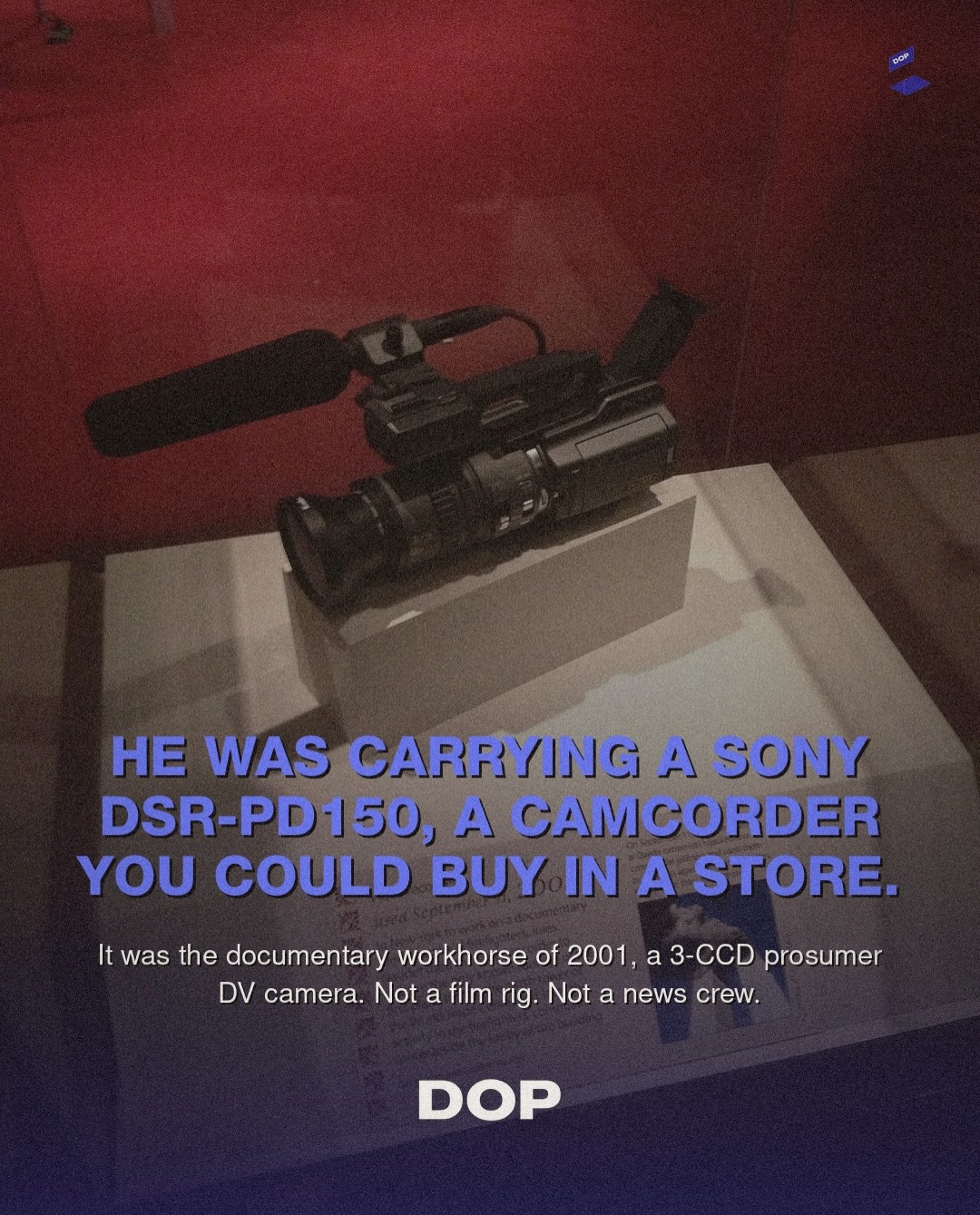
The camera in Naudet’s hands was a Sony DSR-PD150, an instrument that arguably altered independent cinema and non-fiction filmmaking more than any tool since the Éclair NPR. Introduced in 2000, the PD150 was the professionalized twin of the consumer VX2000. It utilized three 1/3-inch CCDs pushing roughly 380,000 effective pixels each, writing 8-bit 4:1:1 digital component video to MiniDV and DVCAM tape at a fixed 25 Mbps. In an era when broadcast Betacam SP packages weighed 20 pounds, the three-pound PD150 offered built-in balanced XLR inputs, switchable phantom power, and an integrated 12x optical zoom lens (6.0, 72.0mm, f/1.6, f/2.4) featuring Sony’s prism-based Super SteadyShot optical stabilization. It was agile, unforgiving, and ubiquitous.
Instinct, Discipline, and the Tilt-Up
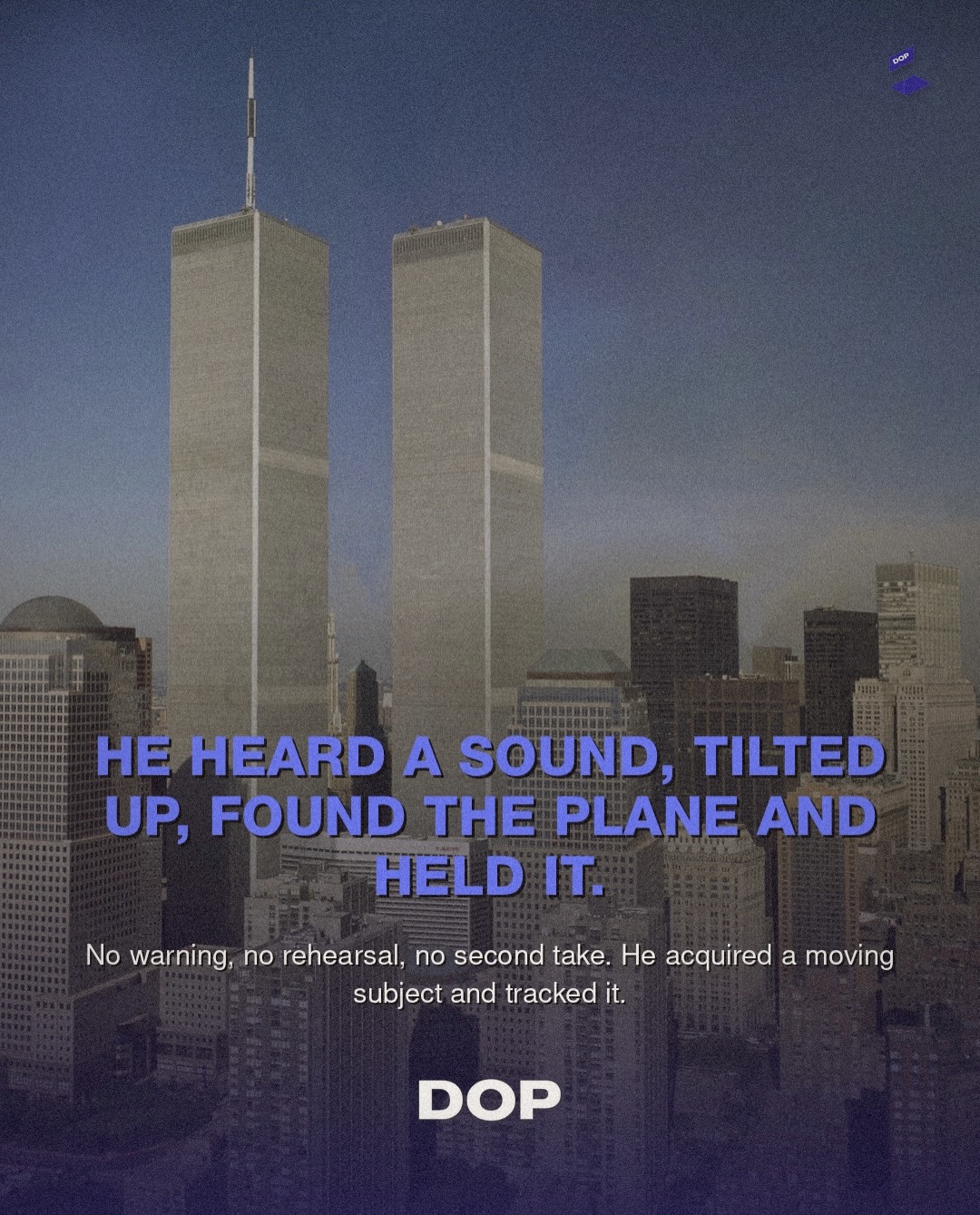
Documentary operating is governed by instinct built upon muscle memory. When an anomalous, low-frequency roar echoed off the concrete canyons of Tribeca, the sound of two Pratt & Whitney JT9D turbofans running at full throttle, Naudet didn’t lower the camera to look with his naked eyes. Instead, he executed a fluid, handheld tilt upward, panning along the flight path of American Airlines Flight 11 as it banked aggressively low over the skyline.
What happened in the subsequent four seconds separates amateur video from true camera operation. Faced with an incomprehensible, terrifying visual event, Naudet did not panic-zoom. He did not search for focus. He held the focal length, framed the trajectory against the North Tower of the World Trade Center, and tracked the impact dead-center. The optical image stabilization dampened his immediate bodily startle, and his training kept his finger off the zoom rocker and away from the stop button.
“Faced with an incomprehensible visual event, Naudet did not panic-zoom or hunt for focus. He locked his frame, maintaining documentary discipline while the world fractured.”
In standard run-and-gun shooting, the impulse during high-stress chaos is to zoom in to inspect or wildly pan to seek shelter. Naudet did neither; he held a stable wide-to-medium field of view, maintaining spatial context. That single decision preserved the scale, vector, and brutal physics of the collision with devastating clarity, uncompromised by hunting autofocus or digital artifacting.
Three Records, One Human Eye
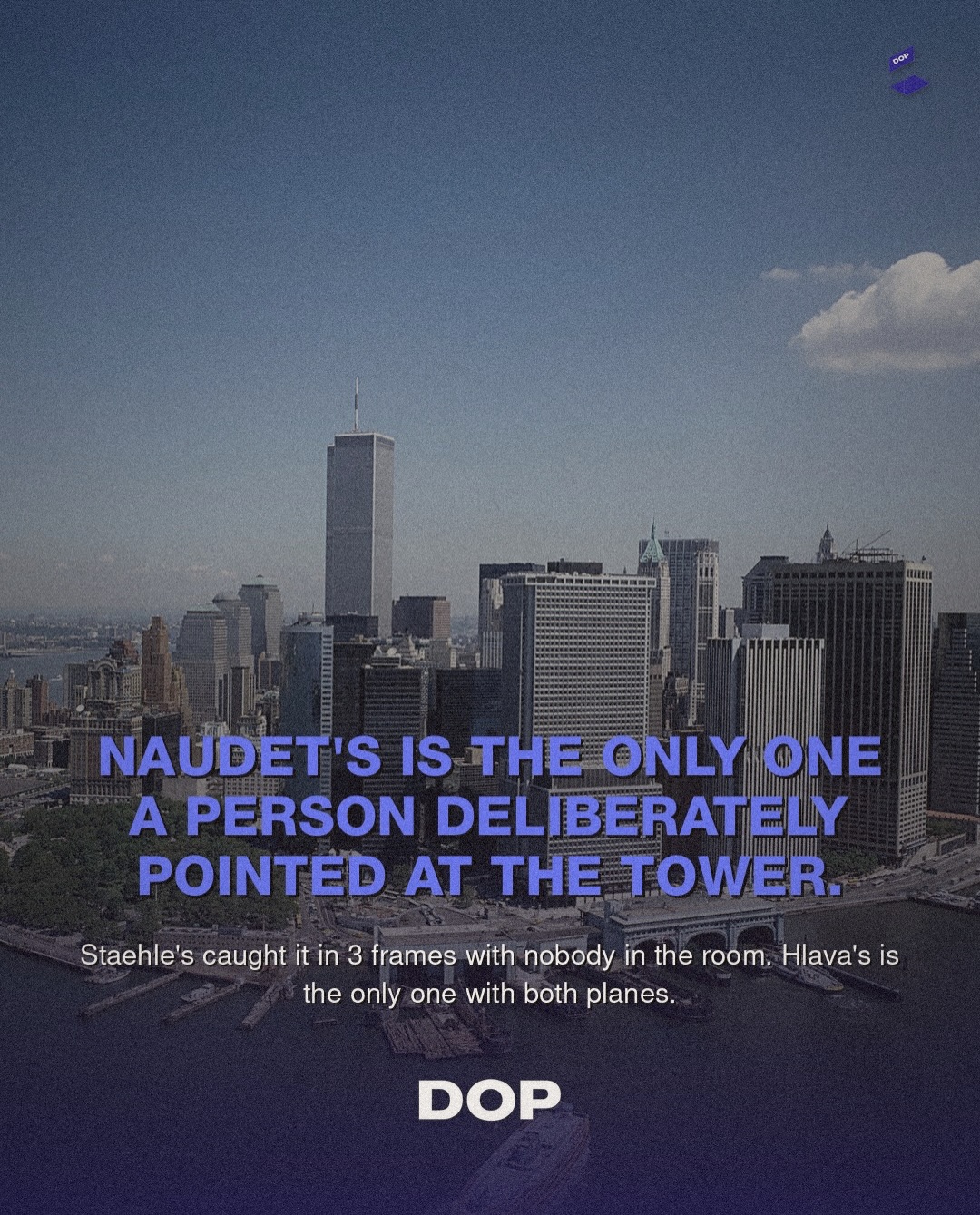
Modern history knows only three visual records of Flight 11 striking Tower One. The technical divergence among these three captures illustrates the chasm between mechanical monitoring and deliberate camera operation. The second recording was made by Pavel Hlava, a Czech immigrant shooting a handheld VHS-C camcorder from a car passing through the Brooklyn-Battery Tunnel entrance; Hlava’s camera was passively capturing traffic, happened to tilt briefly toward the towers, and captured the strike from miles away through dirty automotive glass, completely unaware of what he had recorded until days later.
The third capture was entirely automated. Artist Wolfgang Staehle had mounted an unattended webcam across the East River in Brooklyn for an art installation at the Postmasters Gallery. Driven by a Silicon Graphics workstation, the camera snapped a still frame every four seconds to stream the Manhattan skyline. It recorded the impact across three disjointed, silent stills, separated by cold temporal gaps. There was no soul behind the glass, no awareness of the horizon.
Naudet’s footage remains the solitary recording aimed by a conscious human operator. It is the only document that accounts for motion, composition, and human presence in the moment of impact. The 60i interlaced motion cadence, burned into standard-definition NTSC tape, gave the sequence a hyper-immediate, kinetic realism that defined the visual vernacular of modern breaking news.
The Artifact of the Interlaced Age
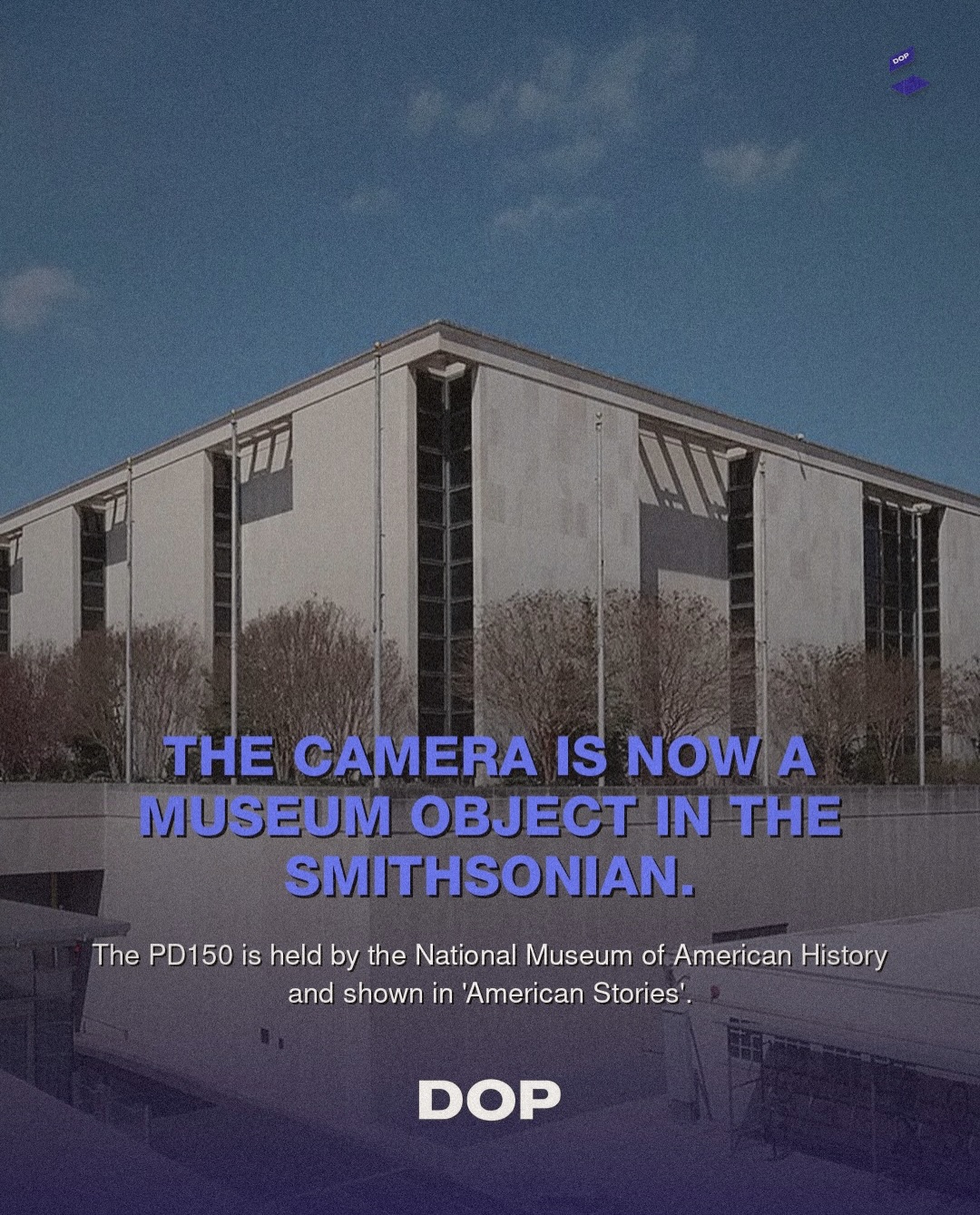
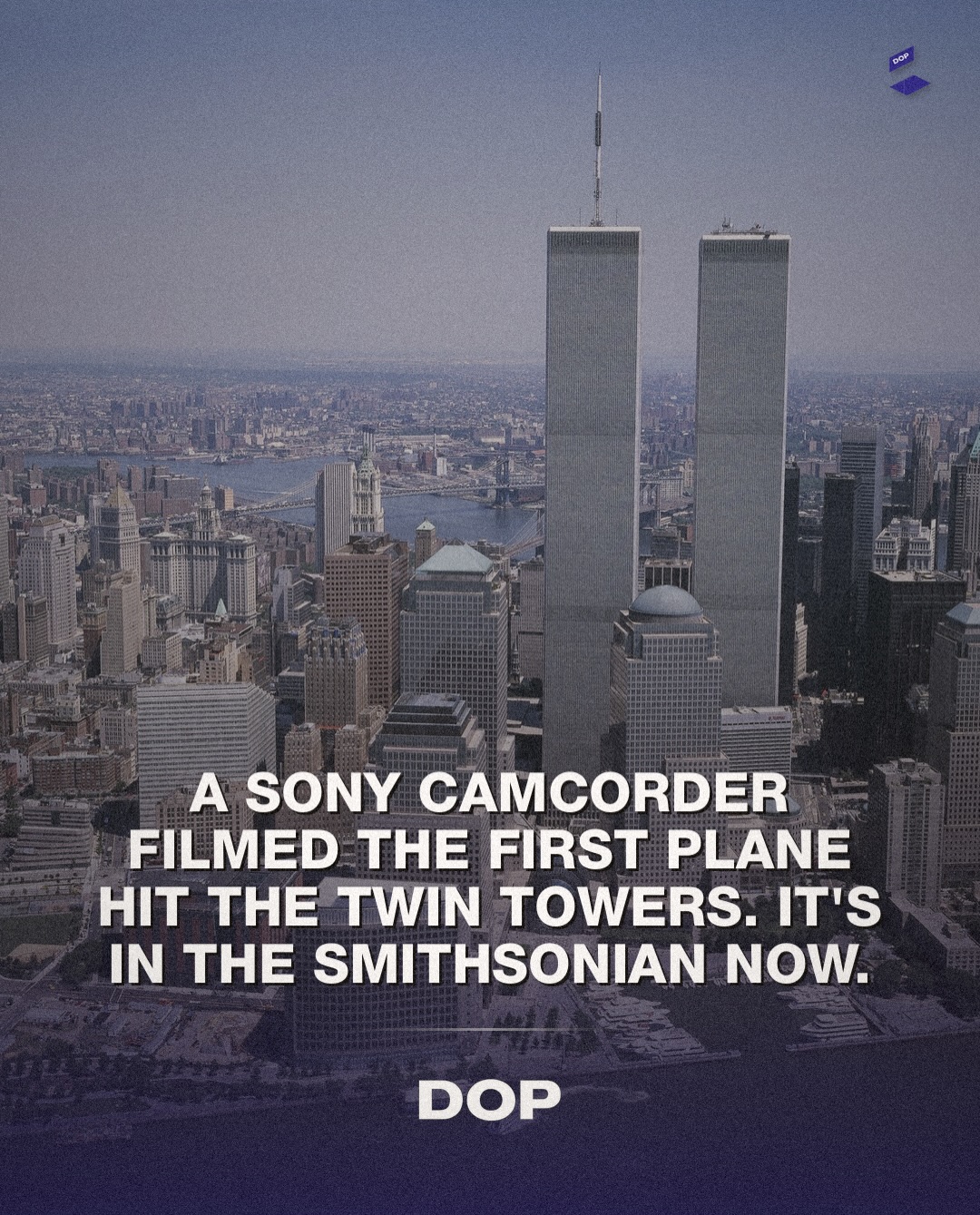
Today, Jules Naudet’s Sony DSR-PD150 rests in the Smithsonian’s National Museum of American History. For cinematographers, looking at that scuffed, plastic-bodied camcorder encased in museum glass is a sobering reminder of what our craft actually demands. We obsess endlessly over large-format sensor size, dual-native ISO, Cooke look versus anamorphic flare, and color spaces mapped for 4K HDR projection.
Yet the most historically significant sequence of moving images shot in this century was captured on a 1/3-inch CCD block, standard-definition DV compression, through a fixed zoom lens, because an operator stood his ground, trusted his frame, and kept rolling.