In the annals of cinematic innovation, few films command the reverence and analytical scrutiny of Orson Welles' 1941 masterpiece, Citizen Kane. While Welles' narrative genius, innovative editing, and audacious use of sound are rightly celebrated, it is the film's groundbreaking cinematography, helmed by the legendary Gregg Toland, that truly redefined the visual lexicon of cinema. Toland didn't just shoot a film; he engineered a revolution, solving what was then considered an impossible depth of field problem, forever altering the way filmmakers could tell stories.
Before Citizen Kane, the prevailing aesthetic often favored shallow depth of field, driven largely by the limitations of available film stocks and lens technology. Cinematographers typically focused on a single plane, blurring out the background or foreground to direct the audience's attention. Toland, however, envisioned a frame where every element, from a character's intense close-up to a distant, intricately detailed backdrop, remained in sharp focus. This wasn't merely an aesthetic preference; it was a narrative imperative for Welles, who sought to create a more dynamic, theatrical staging within the frame, allowing the audience the freedom to choose where to look, much like in a stage play. This visual democracy was radical.
Engineering the Impossible: Faster Lenses and Lighting Innovation
Achieving this 'deep focus' wasn't a simple tweak; it required a wholesale reinvention of existing methodologies. Toland's genius lay in his relentless pursuit of technical solutions. The primary hurdle was the lack of light sensitivity in film stocks of the era, which necessitated wide apertures for sufficient exposure, inherently limiting depth of field. Toland's solution was multifaceted. He worked closely with Kodak to push the boundaries of film stock development, utilizing their then-new, faster Super XX Panchromatic film, which offered greater light sensitivity. But equally crucial was his collaboration with lens manufacturers, particularly the development of custom-made, extremely wide-angle lenses with unprecedented maximum apertures, some reportedly as fast as f/0.9. These lenses, combined with meticulous lighting, were the bedrock of his technique.
“Toland's genius lay in his relentless pursuit of technical solutions. He didn't just shoot a film; he engineered a revolution.”
The lighting strategy for Citizen Kane was equally revolutionary. To compensate for the inherently less efficient wide-angle lenses and the need to stop down significantly for deep focus, Toland bathed the sets in an extraordinary amount of light. This often involved using powerful arc lights, meticulously positioned to achieve the desired exposure across multiple planes, while simultaneously sculpting the scene with dramatic chiaroscuro. The sets themselves were often built with ceilings to facilitate realistic top lighting, a departure from traditional Hollywood practices that favored open sets for easier lighting access. This attention to detail extended to the art direction, with sets designed to provide visual information at varying depths, enhancing the illusion of immense spatiality.
The Narrative Power of Deep Focus
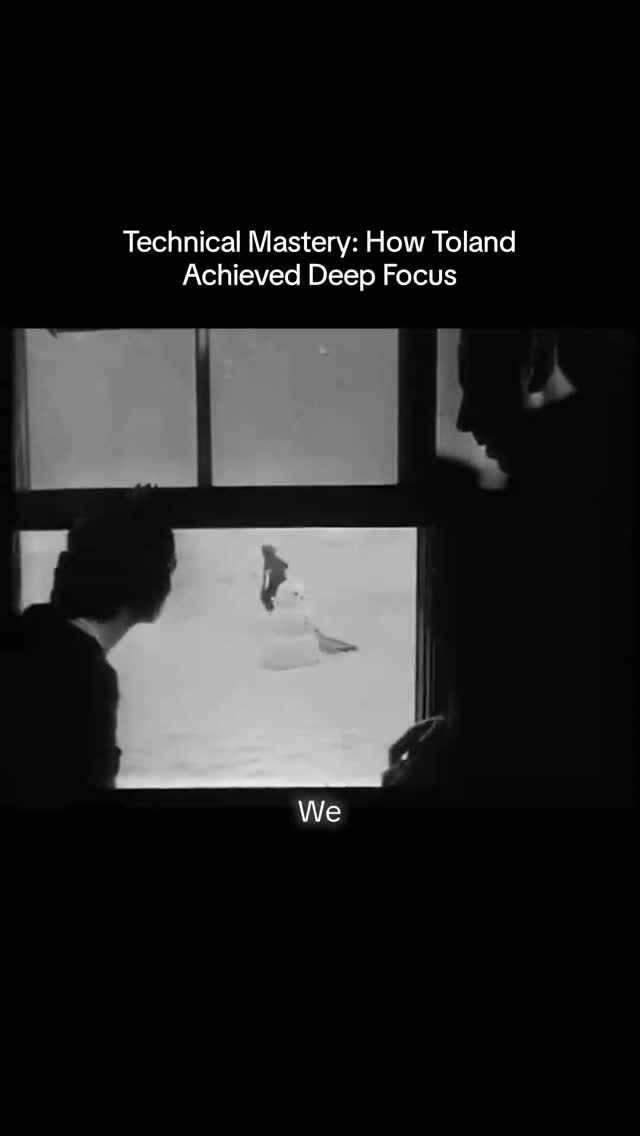
The impact of Toland's deep focus on the narrative was profound. It allowed for complex visual compositions where multiple actions could unfold simultaneously, enriching the storytelling without resorting to rapid cuts. Think of the iconic scene where young Charles Foster Kane is signing away his future, while in the background, his parents and Thatcher discuss his fate. Every face, every gesture, is sharp, allowing the audience to absorb the full weight of the moment without the distraction of a rack focus. This technique empowered the viewer, inviting them to actively participate in the visual decoding of the narrative, rather than being passively led by the cinematographer's focus pull.
Toland's influence extended far beyond Citizen Kane. His work on films like The Grapes of Wrath (1940) and The Best Years of Our Lives (1946) further cemented his reputation as a master of visual storytelling. While the technological landscape has evolved dramatically since the 1940s – modern digital sensors boast incredible low-light capabilities, and lenses are sharper and faster than ever – the principles Toland championed remain foundational. His insistence on pushing the boundaries of technology in service of narrative, his meticulous approach to lighting, and his understanding of the psychological impact of framing and depth of field continue to inspire cinematographers today.
The legacy of Gregg Toland is not just about a technical achievement; it's about a philosophical shift in how we approach visual storytelling. He demonstrated that cinematography is not merely about recording images, but about crafting them with intention, using every tool at a DP's disposal to deepen the audience's engagement with the story. Citizen Kane remains a towering monument to this ethos, a visual masterclass that continues to teach us the profound power of an infinite gaze.