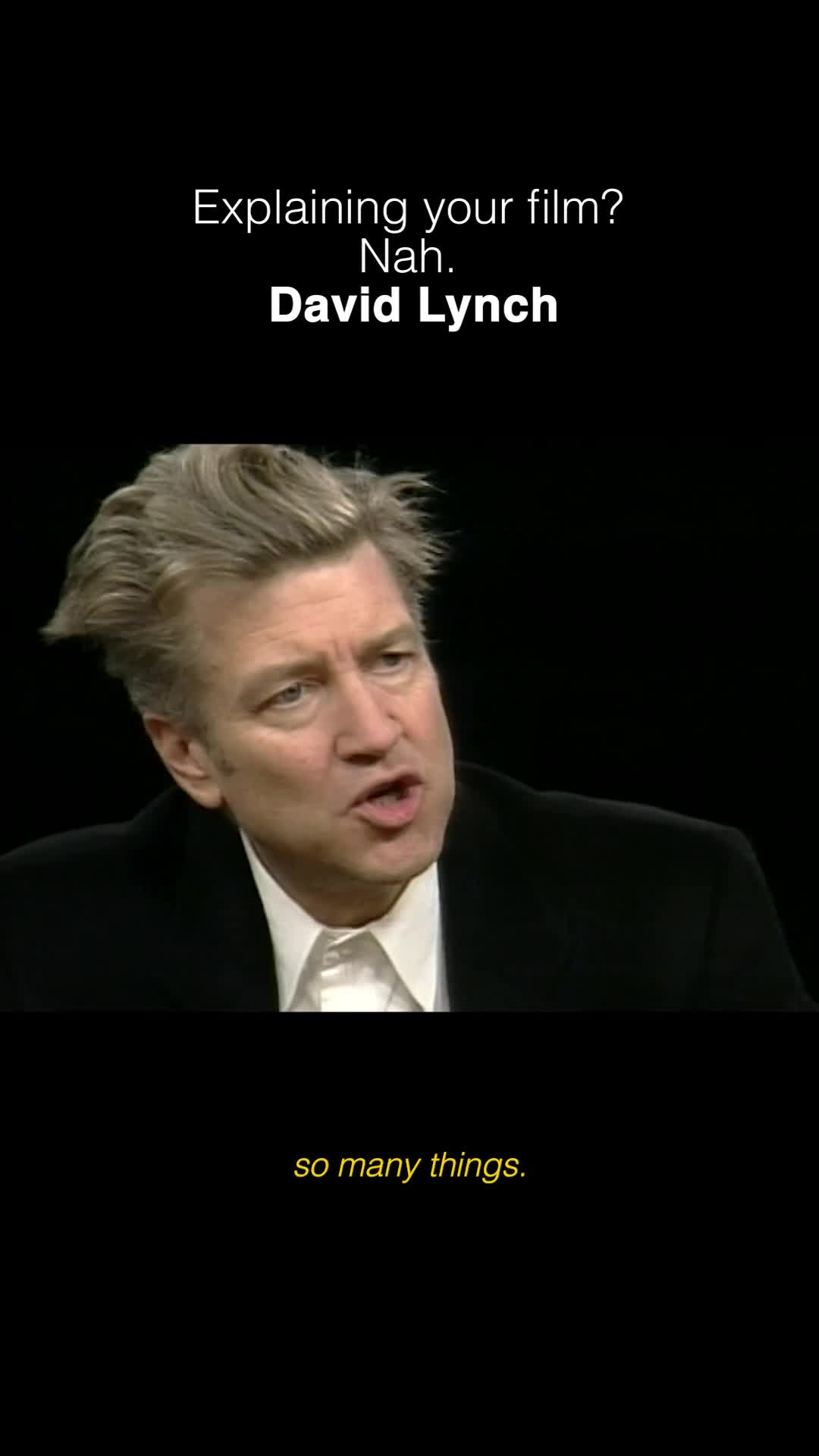
David Lynch, a filmmaker whose name is synonymous with the visceral and the ineffable, famously grappled with the inadequacy of language when discussing his own work. His struggle to articulate the essence of films like Lost Highway isn't just a personal quirk; it's a profound commentary on the very nature of cinema itself. For cinematographers, this resonates deeply. We spend months, sometimes years, meticulously crafting a visual and sonic tapestry, only to be met with the inevitable, reductionist question: “So, what’s it about?”
Lynch's candid admission that he lacked a “gift for words” and that summarizing his films felt like “failing the work” speaks volumes. He understood that a film like Lost Highway, with its labyrinthine narrative, disorienting soundscapes, and dreamlike imagery, operates on a plane far beyond mere plot points. Every frame, every cut, every sonic texture was painstakingly orchestrated to evoke a specific feeling, a particular psychological state. To distill this into a two-minute verbal explanation is not just challenging; it’s an act of intellectual violence against the artistic endeavor.
The Multi-Sensory Canvas of Cinema
Unlike a novel, which primarily relies on language to construct worlds and convey emotions, cinema is a multi-sensory experience. It’s the interplay of light and shadow, the subtle shift in a lens's focal length, the rhythmic cadence of editing, and the emotional resonance of sound design. Think of the disquieting, almost tactile quality of the low-key lighting in Eraserhead, or the way the deep blacks and saturated reds in Blue Velvet create a palpable sense of unease and hidden desire. These are not elements that can be easily translated into prose. They are felt, experienced, absorbed.
“Film is sound, image, rhythm, and feeling working together simultaneously. Language is one track running in a straight line. The two formats are not compatible and Lynch knew it.”
Consider the technical choices that contribute to this ineffability. The choice of a wide-angle lens for a disorienting sequence, distorting perspective and creating a sense of claustrophobia. The use of practical effects and in-camera trickery to achieve a surreal aesthetic, rather than relying on CGI that might feel too polished or literal. A cinematographer might spend days perfecting the subtle flicker of a neon sign, understanding that this seemingly minor detail contributes to the overall mood and subtext in ways that words simply cannot capture. It's about crafting an emotional architecture that bypasses the rational mind and speaks directly to the subconscious.
Beyond the Logline: The DP's Contribution to Feeling
For cinematographers, this challenge is particularly acute. Our work is to translate abstract concepts, emotions, and narrative beats into tangible visual forms. We select the camera, perhaps a large format Alexa 65 for its immersive quality, or a Super 16mm for its raw, gritty texture, not just for resolution, but for its inherent character. We choose lenses, understanding that a vintage anamorphic lens will render bokeh and flares in a way that imbues a scene with nostalgia or dreaminess, while a modern spherical lens might offer clinical precision. The lighting setups, from the stark chiaroscuro of film noir to the soft, naturalistic glow of a period drama, are all designed to sculpt mood and guide the viewer's eye and emotion.
Lynch’s struggle highlights the fundamental truth that if a film’s essence could be encapsulated in a sentence, there would be no need to make the film at all. The very act of filmmaking is an exploration of that which defies simple articulation. It’s an attempt to communicate complex ideas and feelings through a language of light, movement, and sound that transcends verbal boundaries. So, the next time someone asks “what’s it about,” perhaps we should take a page from Lynch's book and simply invite them to watch. Because some experiences, especially cinematic ones, are truly beyond words.
The beauty of cinematography lies in its ability to convey the unspoken, to hint at subtext, and to evoke profound emotional responses without a single line of dialogue. It’s the subtle shift in focus that draws attention to a crucial detail, the precise color grade that imbues a memory with melancholy, or the handheld movement that plunges the audience into a character's chaotic reality. These are the tools of our trade, and through them, we build worlds that resonate not just in the mind, but in the very core of one's being.
The Enduring Legacy of the Inarticulable
Lynch's frustration with verbal explanations isn't a weakness; it's a testament to the power and unique language of cinema. It reminds us that the art form is not merely a vehicle for storytelling, but a medium capable of creating experiences that defy conventional description. For DPs, this understanding is crucial. It elevates our role beyond mere image capture to that of visual poets, crafting the very fabric of a film's emotional and psychological landscape. Our work is to ensure that when the words fall short, the images speak volumes, resonating with an audience on a level that is deeply personal and profoundly inarticulable.
This article contains affiliate links. We may earn a small commission at no extra cost to you. Learn more.