For decades, visual effects-heavy filmmaking was defined by the oppressive glare of green screen stages. Cinematographers were forced to illuminate actors with neutral, ambient light sources while making educated guesses about environments that would only be constructed months later in post-production. The result was often a subtle, intangible disconnect between the subject and the background, a flat, ungrounded reality where interactive light felt unnatural or entirely absent.
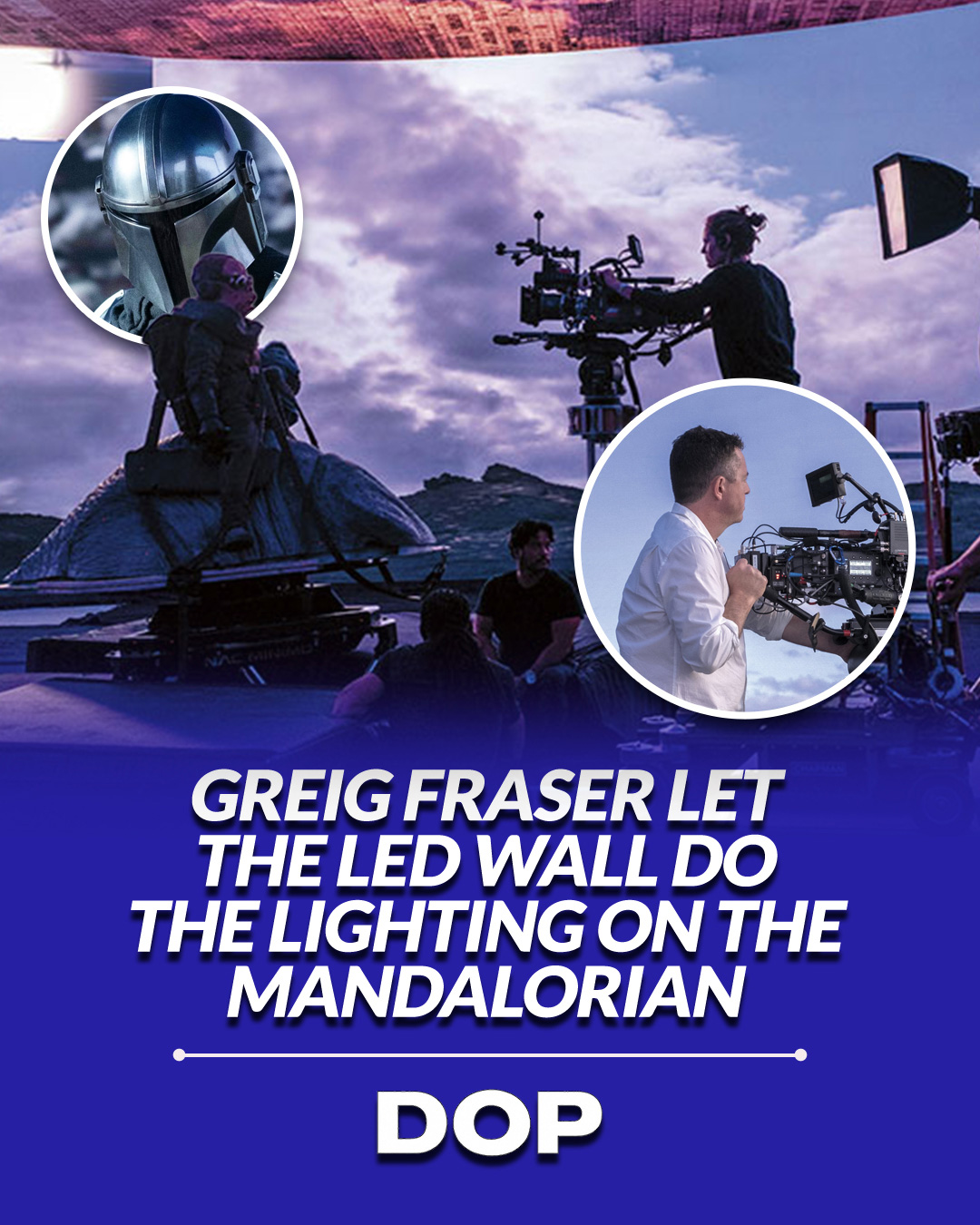
When Greig Fraser, ASC, ACS, stepped onto the soundstages for The Mandalorian, he helped spearhead a fundamental paradigm shift in modern production. Working in tandem with Industrial Light & Magic (ILM) inside their groundbreaking StageCraft LED volume, Fraser didn't merely view the curved 20-foot-high, 270-degree LED wall and ceiling as a substitute for location shooting. Instead, he treated the entire screen array as his primary lighting fixture.
The Volume as a Giant Light Source
In traditional virtual production setups, LED screens were frequently treated as glorified backing plates, with traditional tungsten or LED fixtures doing the heavy lifting for actor key and fill light. Fraser flipped this dynamic on its head. On The Mandalorian, the digital skies, alien sunsets, and scorched desert horizons displayed on the wall were literally what lit the characters, casting authentic color and light directly onto their costumes and faces.
This approach solved a notorious nightmare for DPs and visual effects supervisors: hyper-reflective surfaces. The lead character’s Beskar armor is effectively a mirror on set. Under traditional green screen, Din Djarin's suit would have caught bright green spill across every polished surface, requiring painstaking post-production roto work and painted reflections. Inside the StageCraft volume, the chrome suit naturally reflected the high-resolution Unreal Engine renders in real time, grounding the character perfectly into his digital surroundings.
Your biggest light fixture is no longer a 20K tungsten or a massive LED array, it is a live, high-resolution moving image rendered in real-time.
Technical Realities and Optical Craft
Lighting with pixels comes with its own unique set of technical hurdles. LED panels do not emit a broad, continuous color spectrum like natural sunlight or tungsten filaments; instead, they produce narrow RGB spectral peaks. This can present distinct challenges for skin tone rendition and color fidelity. To combat this, Fraser and his lighting team integrated supplementary programmable fixtures, carefully color-matched to the LED wall's emission, to punch up exposure or wrap key lights while preserving natural flesh tones.
Camera and lens selection played a critical role in bridging the gap between digital rendered environments and physical foregrounds. Shooting on the large-format ARRI Alexa LF, Fraser paired the sensor with custom-tuned optics to introduce vintage softness, geometric character, and subtle flare dynamics. The larger sensor format allowed for tight control over depth of field, gently blurring the background panels to eliminate moiré artifacts while retaining the soft, organic falloff characteristic of traditional cinematic glass.
Fixing It in Prep: A New Philosophy
Beyond the technical mechanics, Fraser’s method demands a radical shift in the production pipeline. The age-old safety net of "fixing it in post" is replaced by a philosophy of committing in prep. Because the background plate, ambient light, and interactive reflections are captured simultaneously in-camera, decisions regarding time of day, sun position, and color palette must be finalized long before the camera rolls.
The success of The Mandalorian proved that virtual production is at its most potent not when it replaces traditional cinematography, but when it enhances the DP's fundamental toolset. By elevating the LED volume from a simple backdrop to a dynamic, living light source, Greig Fraser established a new visual language for modern filmmaking, one where light, optics, and digital space merge seamlessly into a single frame.
This article contains affiliate links. We may earn a small commission at no extra cost to you. Learn more.