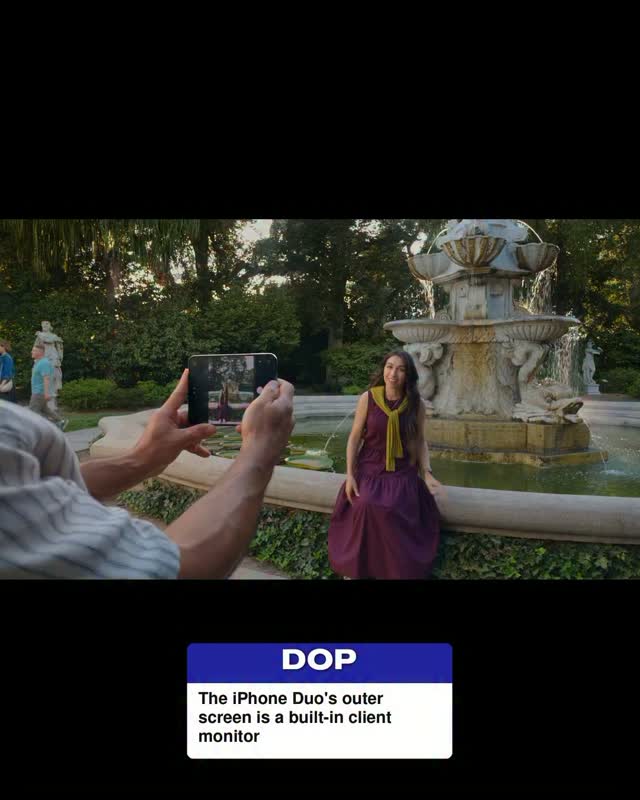
In an industry constantly chasing the next technological leap, the siren song of consumer electronics often rings hollow for professional cinematographers. We demand precision, control, and a robust ecosystem designed for the rigors of production. So, when a device like a foldable phone touts a feature that directly addresses an on-set workflow, it warrants a closer look, not just for its current utility, but for what it portends. Apple's 'Duo Preview' on their foldable concept is precisely this kind of feature, a seemingly minor innovation that could, in theory, streamline a fundamental aspect of capture: talent monitoring.
The core promise of Duo Preview is elegantly simple: a live feed from the rear cameras mirrored onto the phone's smaller outer display, allowing talent to self-frame without the need for an external monitor. For indie filmmakers, run-and-gun crews, or even specific commercial setups, the appeal is immediate. Imagine a scenario where a director or DP needs a quick, intimate shot with an actor, and instead of rigging a small monitor or relying on verbal cues, the actor can see their own composition in real-time. This isn't just about convenience; it's about empowering the talent, fostering a more collaborative and efficient creative process, and potentially saving precious minutes on a tight schedule.
The Allure of Streamlined Monitoring
For decades, on-set monitoring has evolved from bulky CRT screens to sophisticated wireless systems feeding multiple high-resolution displays. Yet, the fundamental problem of talent seeing themselves remains. Directors often position monitors for actors, or DPs use external monitors to guide framing. This adds equipment, cabling, and setup time. Duo Preview, in its purest form, offers a tantalizingly elegant solution. It’s a direct response to a common friction point in production, particularly valuable for single-operator setups, vlogging, or even for quick pick-up shots where a full monitoring setup might be overkill. The concept itself is a powerful demonstration of how thoughtful design can simplify complex workflows, even if the current implementation is tethered to a consumer device.
“The true innovation isn't in pixel count, but in how technology removes friction from the creative process. Duo Preview, despite its limitations, points to a future where monitoring could be intrinsically linked to the capture device itself, democratizing real-time feedback.”
However, the devil, as always, is in the details, or rather, the glaring omissions. The Instagram caption rightly highlights the stark reality: 'Everything else in the pro stack is gone.' No variable aperture, no Pro controls, no ProRes, no ProRes RAW, no Apple Log 2, no ACES, no genlock. These aren't minor inconveniences; they are foundational pillars of professional cinematography. Without robust codecs, proper color science, and granular control over exposure and focus, the footage generated, no matter how conveniently framed, remains firmly in the realm of consumer content. A DP planning a feature film, a commercial, or even a high-end documentary would never consider a device lacking these fundamental tools.
Bridging the Consumer-Pro Divide
This dichotomy forces us to consider the broader implications. Is Apple's strategy to slowly introduce professional features into consumer devices, or are they simply showcasing a neat trick for their existing user base? The latter seems more likely for now. Yet, the concept of a foldable screen offering a live self-view isn't exclusive to Apple. Imagine a professional cinema camera, perhaps a future ARRI Alexa Mini LF or RED V-Raptor, incorporating a small, articulate, or even detachable secondary display specifically for talent monitoring. This wouldn't replace the DP's primary monitor or the DIT's station, but it could serve as an invaluable on-camera tool for specific shots, offering immediate feedback to the performer without adding bulk or complexity to the camera rig.
The conversation around Duo Preview isn't about replacing our dedicated cinema cameras. It's about recognizing clever problem-solving. It’s about the potential for integration. While the current iteration is a novelty for our world, it seeds ideas. Could we see a future where camera manufacturers integrate smaller, dedicated talent-facing displays directly into their bodies, perhaps even with customizable overlays for aspect ratios or safe areas? The pursuit of efficiency and creative freedom is endless in cinematography, and sometimes, the most unexpected ideas originate from the consumer space before being refined and integrated into the professional toolkit.
Ultimately, Duo Preview serves as a fascinating thought experiment. It underscores that innovation isn't always about bigger sensors or faster frame rates; sometimes it's about elegant solutions to persistent workflow challenges. While the phone itself remains firmly outside the professional cinematography ecosystem due to its profound lack of professional controls and output capabilities, the 'Duo Preview' concept itself is a brilliant piece of design. It reminds us that even consumer-grade tech can occasionally spark a conversation about how we might make our professional lives just a little bit smoother, pushing the boundaries of what integrated camera monitoring could become in the future.
This article contains affiliate links. We may earn a small commission at no extra cost to you. Learn more.