In an era of relentless camera movement, where Steadicams glide, drones soar, and handheld vérité reigns supreme, there's a quiet rebellion found in the locked frame. It’s a deliberate act of cinematic zen, a refusal to guide the viewer’s eye with kinetic energy. Instead, it demands contemplation, forcing us to engage with the entire composition, to find the narrative within the stillness. This technique, far from being a limitation, often unlocks profound depths, transforming the passive act of watching into an active, almost meditative experience.
Consider the masterful simplicity of Babette Mangolte's cinematography in Chantal Akerman's Jeanne Dielman, 23 quai du Commerce, 1080 Bruxelles. Mangolte, under Akerman's precise direction, positioned the camera at the protagonist's eye height, a medium shot that remained unyielding for the film's extraordinary three-and-a-half-hour runtime. This wasn't merely a stylistic choice; it was a philosophical one. The static frame, often capturing mundane domestic tasks in real-time, forces the audience into an intimate, unblinking witness to Jeanne's existence. There’s no escape, no cut to relieve the tension, only the slow, inexorable unfolding of her routine, which eventually, devastatingly, fractures. The camera, likely a 16mm Arriflex, with its inherent grain and slightly softer image, only amplified this raw, observational quality, making the viewer a silent, almost complicit, presence in her world.
The Art of Unflinching Observation
Michael Haneke, a director known for his unflinching gaze, frequently employs the locked frame to disquieting effect. Christian Berger's cinematography for Haneke’s Caché provides a masterclass in this. The film opens on a static shot of a seemingly ordinary Parisian house. It holds, and holds, and holds, long enough that the audience, accustomed to rapid-fire edits, begins to question the image itself. Is it a photograph? A security camera feed? This prolonged, unmoving shot instills a creeping sense of unease, blurring the lines between observer and observed, and setting the stage for the film's psychological torment. Berger's use of high-definition digital cameras, like the Sony HDW-F900, with their crisp, unforgiving clarity, made these prolonged observations even more stark and unsettling, revealing every minute detail with an almost clinical precision.
The locked frame, in its purest form, is an act of profound trust in both the image and the audience. It says, 'Here is the world; now, look.'
The beauty of the locked frame lies in its ability to amplify the subtle. Without the distraction of camera movement, every gesture, every shift in expression, every nuance of light and shadow becomes magnified. It transforms the frame into a stage where the drama unfolds within its fixed borders, demanding that the viewer actively scrutinize and interpret. This approach often requires meticulous production design and blocking, as every element within the frame must contribute to the narrative without the crutch of dynamic compositions.
Building Worlds, One Frame at a Time
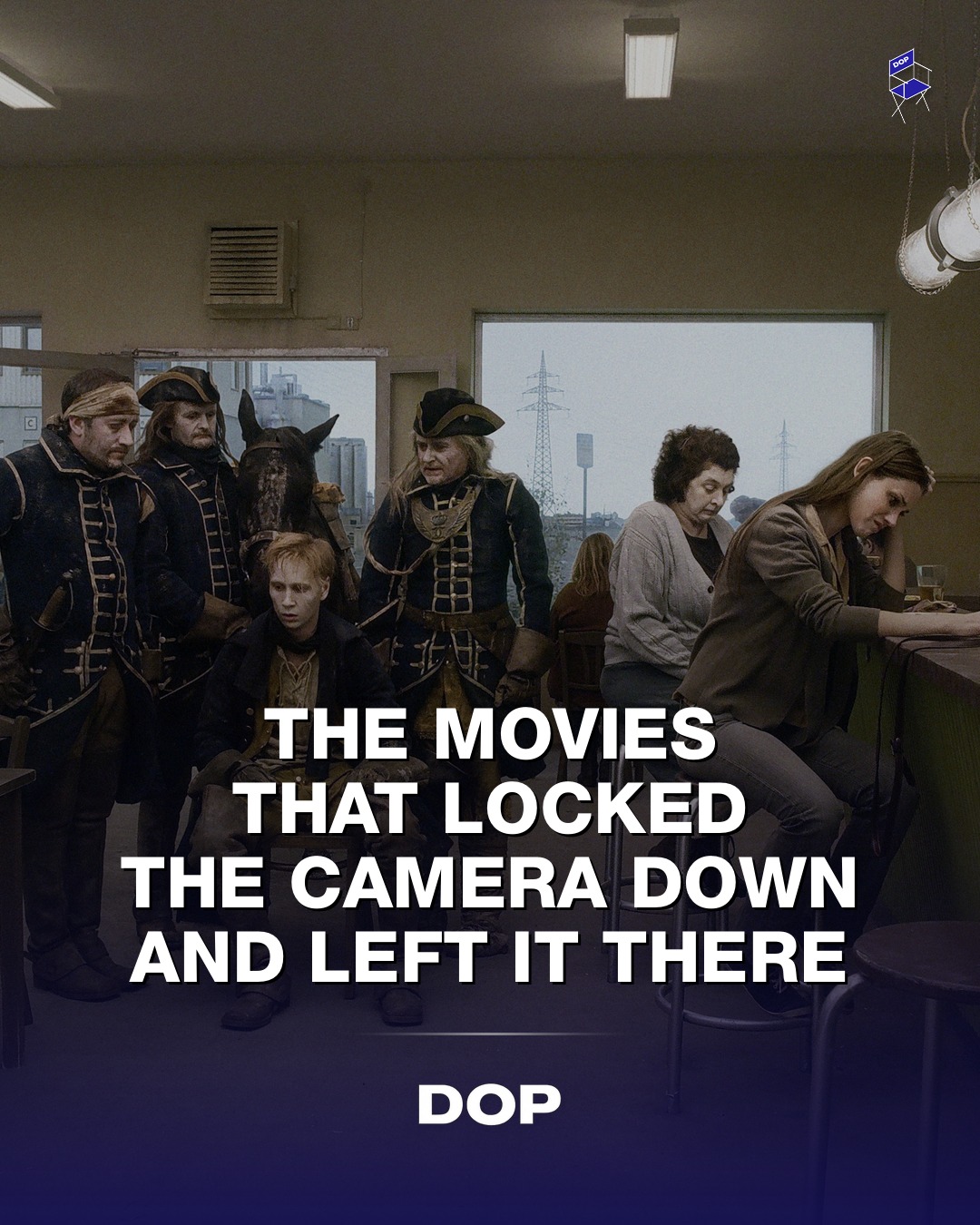
Roy Andersson, the Swedish master of deadpan absurdism, takes the locked frame to its logical extreme. Each scene in his films, such as Songs from the Second Floor or A Pigeon Sat on a Branch Reflecting on Existence, is meticulously constructed as a single, static shot. He builds complete, often elaborate, sets, like theatrical stages, and then positions his camera to capture the entire tableau in one unblinking take. The lighting, often flat and diffused, creates a painterly, almost diorama-like quality, emphasizing the artificiality and existential bleakness of his world. Andersson’s unique process, often involving extensive rehearsals and a deep focus aesthetic, makes the locked frame not just a choice, but the very foundation of his cinematic language. The large format cameras and wide lenses he favors ensure that every corner of his meticulously crafted sets are in sharp focus, inviting the viewer to explore the depth of his often-surreal compositions.
Jim Jarmusch, another proponent of minimalist filmmaking, utilized the locked frame with striking effect in Stranger Than Paradise. Cinematographer Tom DiCillo shot the film so that every scene is a single, static shot followed by a fade to black. This stark, almost episodic structure, shot on black and white 35mm film with available light, imbues the narrative with a sense of observational detachment, perfectly complementing the film's dry wit and ennui. The simplicity of the technique, far from being primitive, allowed the performances and the subtle interactions between the characters to take center stage, creating a unique rhythm and atmosphere that etched itself into the minds of its audience. The choice of black and white, paired with the locked frame, stripped away unnecessary visual information, forcing a focus on composition and character.
The locked frame, then, is not a relic of early cinema but a potent tool for contemporary storytellers. It demands discipline from the filmmaker and engagement from the audience. It’s a testament to the power of stillness, a reminder that sometimes, the most profound cinematic experiences come not from what the camera does, but from what it refuses to do. It’s about building a complete world within those four borders and trusting that the audience will lean in, look closer, and find the truth hidden in plain sight. Which locked frame, from the vast tapestry of cinema, still resonates with you, its image burned into your memory long after the credits roll?
This article contains affiliate links. We may earn a small commission at no extra cost to you. Learn more.