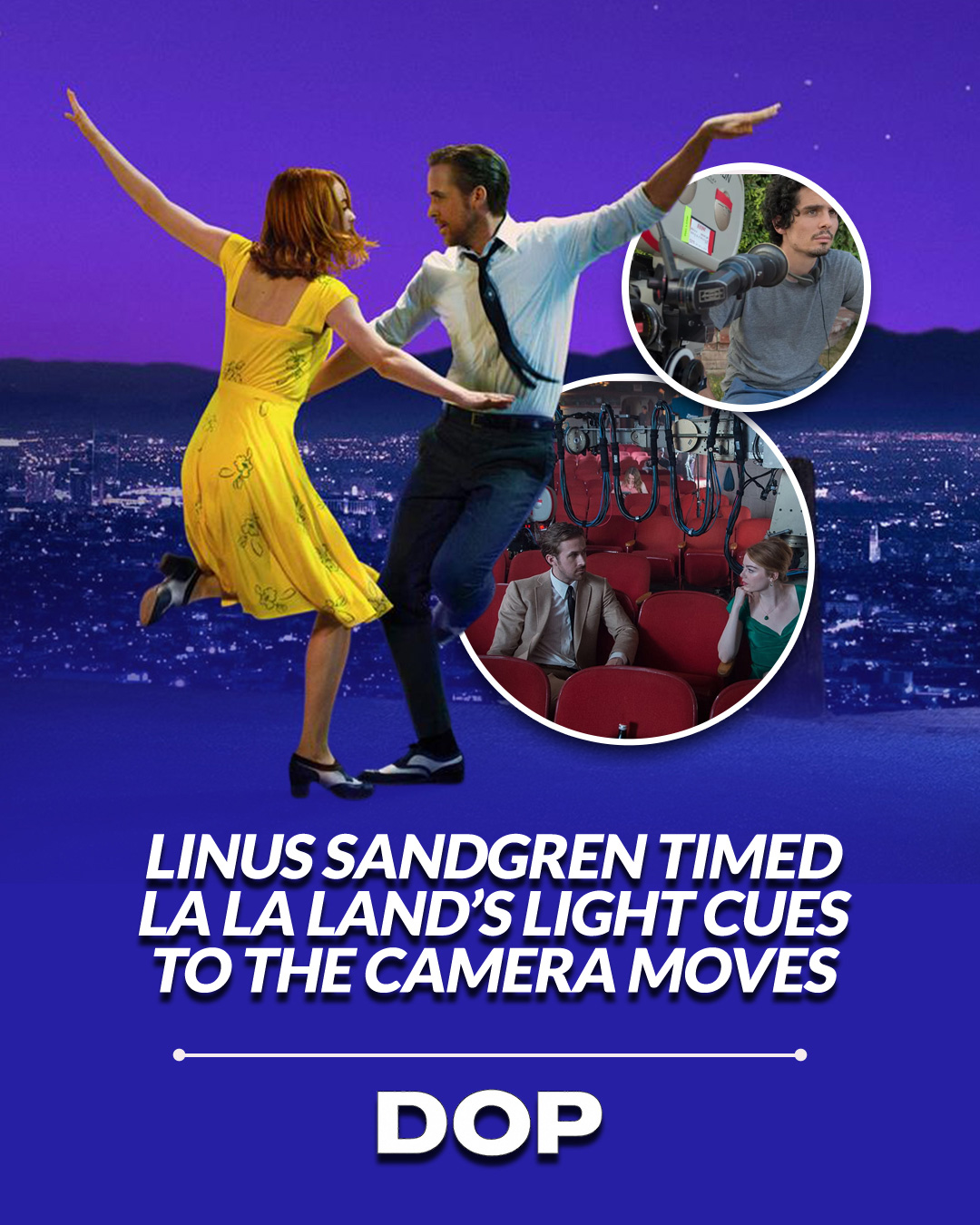
When discussing Damien Chazelle’s modern musical masterpiece La La Land, conversation naturally turns to the exuberant choreography, Justin Hurwitz’s sweeping score, or the luminous chemistry between Emma Stone and Ryan Gosling. Yet behind the lens, Director of Photography Linus Sandgren, ASC, FSF, crafted a visual language that treated lighting not as a static, pre-set exposure condition, but as a living, breathing participant in the dance. Alongside gaffer David Christiansen, Sandgren engineered a lighting strategy where real-time dimmer cues operated in absolute harmony with the camera operators and the actors on screen.
To achieve the nostalgic, rich visual texture that Chazelle envisioned, Sandgren opted to shoot on 35mm film using Panaflex Millennium XL2 cameras paired with customized Panavision C-Series and E-Series anamorphic lenses. Pushing Kodak Vision3 500T 5219 film stock yielded vibrant primary colors, deep blacks, and a painterly grain structure. However, shooting classic wide-screen anamorphic on celluloid meant there was no real-time monitor preview with digital overlays or safety nets in post-production. Every light cue, color shift, and intensity modification had to be executed live, in-camera, with flawless precision.
Synchronizing Camera Movement with Live Dimmer Cues
In traditional feature filmmaking, lighting is established before rolling, remaining fixed throughout a take while the camera moves. In La La Land, Sandgren completely inverted this paradigm. During ambitious, continuous takes, such as the iconic twilight duet in A Lovely Night or the dreamlike Planetarium sequence, the lighting setup was constantly morphing around the characters. As the camera swung around on a Technocrane or glided along dolly tracks, a lighting console operator ran complex DMX dimmer board cues in real time.
Practicals faded down as key lights swept up into theatrical spotlights, isolating the performers from realistic Los Angeles backdrops and casting them into heightened, romantic dreamscapes. Soft cyan gels gave way to saturated magenta and rich sodium-tungsten hues seamlessly within a single uninterrupted shot. Rather than relying on post-production visual effects to isolate characters or alter color temperatures, Sandgren controlled the physical photons interacting with the film emulsion on set.
For DPs, it is an argument for treating light as another moving element in the scene, not just a static condition you set before rolling, but a dynamic partner that performs alongside the cast.
The Rehearsal Process: Treating Light as an Actor
Executing this technique required treating lighting rehearsals with the same rigorous discipline traditionally reserved for actor blocking and stunt choreography. Because a single late dimmer cue would ruin a long four-minute continuous take, the gaffer and console operator had to memorize every beat, lyric, and physical mark. They performed their cues like musicians playing an instrument alongside the camera operator and dolly grip.
This philosophy of expressive, tactile camera work and lighting is a hallmark of Sandgren’s distinguished filmography. Whether capturing the stark, documentary-style handheld grit of First Man, the chaotic visual decadence of Babylon, or the rich, sun-drenched 16mm textures of Saltburn, Sandgren consistently prioritizes physical, optical in-camera expression over digital convenience. His work demonstrates that pushing celluloid to its technical limits yields an emotional resonance that digital manipulation rarely replicates.
Implications for the Modern Cinematographer
For contemporary directors of photography working in an era dominated by high-output LED panels and digital post-color grading, Sandgren’s approach in La La Land offers a vital reminder: light can be an active narrative device. Live dimming creates subtle changes in exposure, shadow quality, and color saturation that directly affect how actors react to their environment, grounding fantastical visual shifts in tangible physical reality.
By transforming the lighting board into a performance tool, Sandgren created an immersive visual experience where light doesn't merely illuminate the scene, it sings alongside the characters. Integrating real-time lighting cues into pre-production blocking empowers cinematographers to bring an unparalleled level of theatrical energy directly to the film frame.
This article contains affiliate links. We may earn a small commission at no extra cost to you. Learn more.