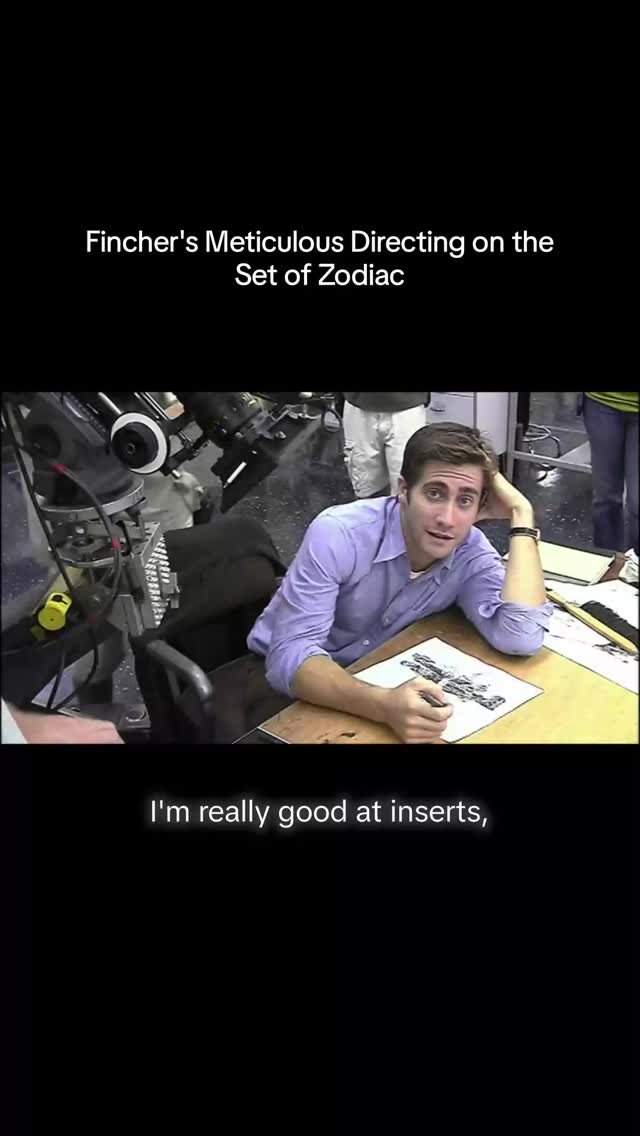
In the vast lexicon of cinematic language, few directors command the frame with the surgical precision of David Fincher. While much has been written about his signature color palettes, his unflinching psychological explorations, and his pioneering use of digital cinematography, it is perhaps his unparalleled mastery of the insert shot that truly underpins his visual storytelling. These aren't merely transitional elements; in Fincher's hands, the insert becomes a narrative linchpin, a psychological amplifier, and a testament to an almost obsessive commitment to detail.
Consider the opening of Zodiac, a film often lauded for its gritty realism and meticulous period recreation. Fincher, alongside his frequent collaborator, the late, great Harris Savides, ASC, didn't just present the 1969 Fourth of July celebrations; he dissected them. We see the glint of a car's chrome, the precise angle of a hand turning a key, the subtle twitch of an eye. These aren't throwaway moments. They are carefully choreographed beats that build tension, establish character, and immerse the viewer in a tactile, undeniable reality. The camera, often an ARRIFLEX 435 ES or a Panavision Millennium XL with anamorphic lenses, isn't just observing; it's scrutinizing.
The Psychology of the Close-Up
Fincher understands that the human eye is drawn to specificity. In a medium often criticized for its broad strokes, he leans into the minutiae. An insert of a character's hands nervously wringing, a close-up of a cryptic note being unfolded, the precise click of a camera shutter – these are not just visual cues; they are emotional anchors. They ground the performance, providing tangible evidence of internal states that dialogue alone cannot convey. Think of the meticulous construction of the bomb in Se7en, or the intricate details of the clue-solving in The Social Network. Each close-up serves a dual purpose: advancing the plot and deepening our understanding of the characters' psychological landscapes.
"Fincher doesn't just show you; he makes you feel the weight, the texture, the significance of every object, every gesture. His inserts are not just details; they are declarations."
This approach demands an incredible synergy between director, cinematographer, and production designer. The props themselves must possess a narrative weight, and the lighting must sculpt them with purpose. Fincher's DPs, from Darius Khondji, ASC, AFC (Se7en) to Jeff Cronenweth, ASC (The Social Network, Gone Girl), consistently employ precise, often hard, lighting to accentuate textures and define forms. The choice of lenses, too, plays a crucial role. Often opting for prime lenses with distinct character, such as the Cooke S4s or Zeiss Ultra Primes, they achieve a clarity and depth that elevates these small moments to cinematic events.
Technical Precision as Narrative Backbone
The technical precision behind these inserts is staggering. It's not just about framing; it's about focus, depth of field, and the subtle dance of light and shadow. A shallow depth of field might isolate a single, critical object, drawing the viewer's eye with an almost magnetic force. Conversely, a deeper focus could reveal crucial contextual information within the frame. The camera movement, if any, is deliberate and motivated, never gratuitous. This meticulous planning is often done in pre-visualization, a Fincher hallmark, ensuring that every frame contributes meaningfully to the whole.
This dedication to the insert isn't just about aesthetics; it's about narrative economy. By investing so much meaning in these brief shots, Fincher can often convey more information and emotion than pages of dialogue. It's a testament to the power of pure visual storytelling, a philosophy deeply ingrained in the craft of cinematography. For DPs and filmmakers seeking to elevate their work, studying Fincher's inserts offers a masterclass in intention, precision, and the profound impact of the seemingly small.
The next time you watch a Fincher film, pay close attention not just to the grand compositions, but to the fleeting, focused moments – the subtle gestures, the significant objects. You'll discover a world of narrative depth and technical artistry hidden in plain sight, proving that true mastery often lies in the unwavering commitment to every single detail.