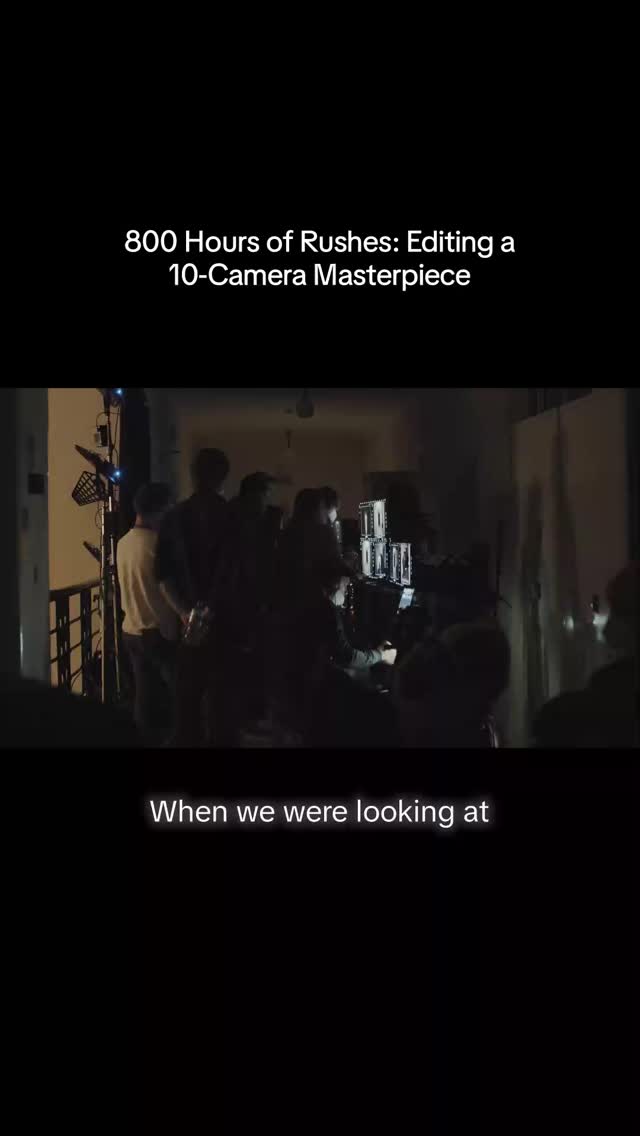
In the grand tapestry of filmmaking, we often celebrate the meticulous planning of pre-production and the kinetic energy of the shoot itself. Yet, there’s a crucial, often underestimated battle waged in the edit suite – especially when dealing with the logistical labyrinth of multi-camera productions. The Instagram post touches upon a truth that DPs, operators, and editors intimately understand: the raw footage from a 10-camera setup is a wild, untamed beast, bearing little resemblance to the polished final product. This isn't merely 'fixing in post'; it's a testament to the profound artistry and technical prowess of the post-production team, where the true cinematic magic is conjured.
Consider the sheer volume and complexity. Ten cameras, each with its own field of view, focal length, and exposure settings, simultaneously capturing a scene. While this offers unparalleled coverage and spontaneity, it also introduces a host of challenges. Lens flares from an unnoticed light source hitting a secondary camera, grip equipment inadvertently creeping into a wide shot intended for a different angle, or even the subtle variations in color temperature between different camera bodies – these are all common occurrences. For the cinematographer on set, the primary focus is often on the 'A' camera, ensuring critical coverage. The 'B,' 'C,' and subsequent cameras are often capturing backup, reaction shots, or alternative angles, sometimes with less pristine framing or lighting.
The Choreography of Cleanup and Sync
The journey from chaotic raw footage to polished narrative begins with an almost surgical cleanup process. Editors and VFX artists become detectives, meticulously identifying and isolating areas for intervention. This isn't just about removing boom mics or stray cables; it's about seamlessly erasing the very infrastructure of filmmaking from the frame. Imagine a dynamic scene in a bustling market: Camera 1 is on a dolly, Camera 2 on a crane, Camera 3 handheld, and Camera 4 is a static wide. Inevitably, the dolly tracks or the crane arm might intrude into another camera's shot. Here, paint-outs, rotoscoping, and even sophisticated AI-driven content-aware fill tools are deployed to render the scene pristine, maintaining the illusion of a singular, unobserved reality.
“The raw footage from a 10-camera setup is a wild, untamed beast, bearing little resemblance to the polished final product. This isn't merely 'fixing in post'; it's a testament to the profound artistry and technical prowess of the post-production team, where the true cinematic magic is conjured.”
Beyond visual cleanup, the synchronization of multiple camera feeds is a foundational challenge. Timecode is paramount, but even with perfectly jam-synced cameras, subtle drift can occur. Audio sync, often using scratch tracks from each camera alongside production sound, becomes a critical first step. Editors, working with tools like DaVinci Resolve or Adobe Premiere Pro, painstakingly align hundreds of clips, creating multi-cam sequences that allow for fluid switching between angles. This initial organizational phase is arguably one of the most intellectually demanding, shaping the very rhythm and flow of the narrative before any creative cutting even begins.
The Editor-VFX Synergy: Sculpting the Narrative
The relationship between the editor and VFX artist in such scenarios is less a hand-off and more a continuous, iterative dialogue. An editor might identify a problem frame, flag it for VFX, and continue cutting, knowing that the visual anomaly will be addressed. Conversely, a VFX artist might suggest a more elegant solution to a visual problem that the editor hadn't considered, perhaps by proposing a subtle camera move or a composite that blends elements from different takes. This seamless workflow is vital for maintaining momentum and artistic cohesion.
Consider the work of a DP like Roger Deakins on a film with complex action sequences, even if not strictly 10-camera setups, his meticulous lighting and framing often anticipate post-production needs. While his sets are notoriously clean, the principle holds: the more chaotic the capture, the more critical the post-production strategy. The choice of camera (ARRI Alexa, RED, Sony Venice) and lens package (Cooke S7/i, Zeiss Supreme Primes, Panavision Anamorphics) influences the initial image quality, color science, and optical characteristics, all of which must be consistently managed across multiple units and then harmonized in the grade. A multi-cam shoot might even involve different camera models, necessitating advanced color space transformations and look-up table (LUT) application to achieve a unified visual style.
The final color grade, often led by a master colorist, brings all these disparate elements into a singular, cohesive aesthetic. It’s here that the subtle differences in exposure, white balance, and lens characteristics are finessed, ensuring that the audience perceives a unified visual world, regardless of how many cameras were rolling. The growing timeline, as the Instagram caption aptly notes, transforms from a 'chaotic mess of angles' into a 'seamless narrative' through this meticulous, highly skilled process. It's a testament to the unsung heroes of post-production who, with their blend of technical expertise and artistic vision, truly bring the film to life, turning raw data into pure cinematic magic.
This article contains affiliate links. We may earn a small commission at no extra cost to you. Learn more.