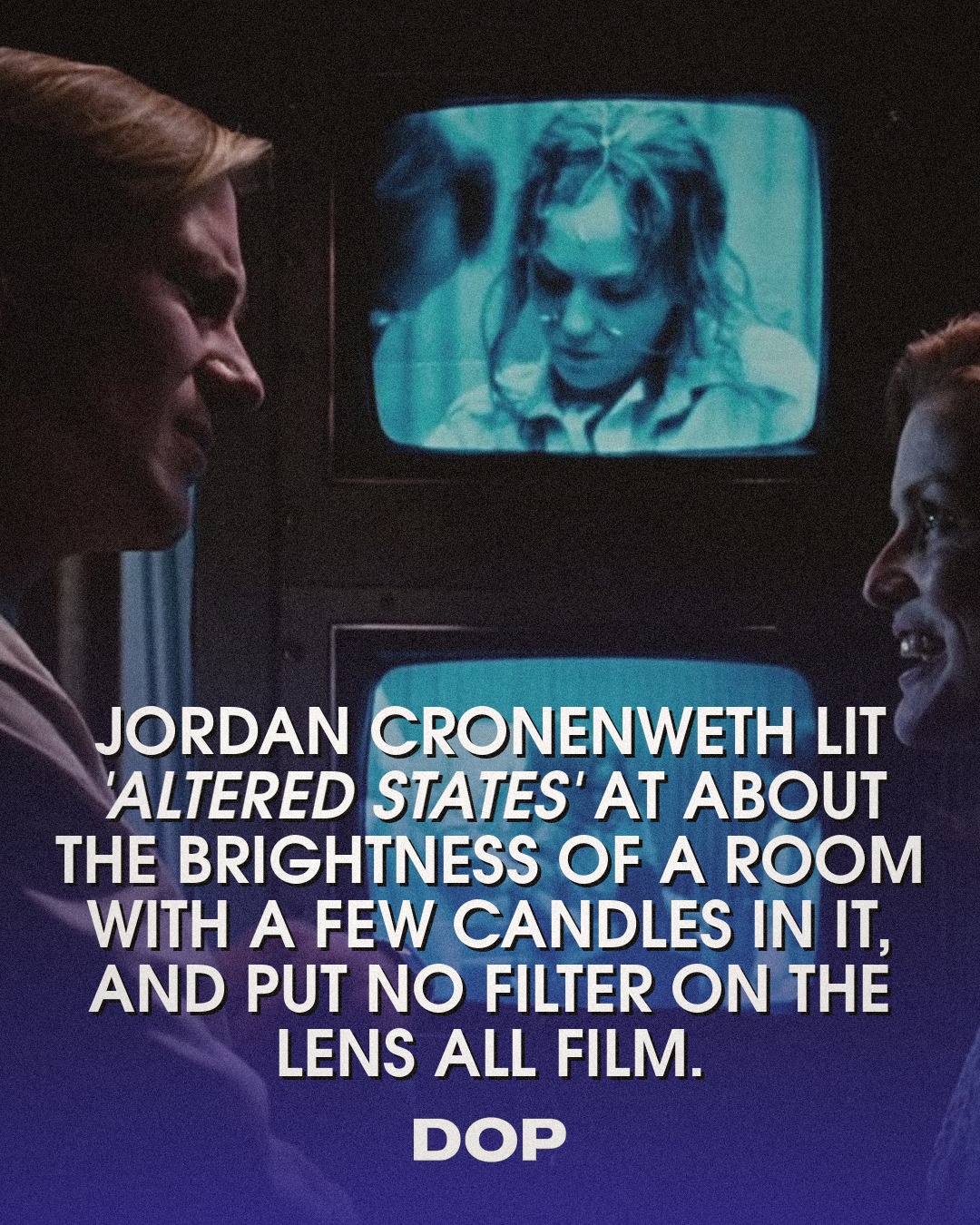
In an era where cinematographers routinely guarded their photometric secrets like trade guild arcana, Jordan Cronenweth, ASC did something unthinkable. Speaking to Herb A. Lightman for the March 1981 issue of American Cinematographer, Cronenweth casually stated his working baseline: eight to fifteen foot-candles. For reference, standard studio interiors of the late 1970s often demanded 50 to 100 foot-candles to feed the slow, grain-conscious emulsions of the day. Working at eight foot-candles meant shooting on the bleeding edge of the film stock’s toe, embracing real, tactile darkness long before high-ISO digital sensors made darkness cheap.
To achieve this, Cronenweth was not merely underexposing for mood; he was recalibrating how cinematographers thought about the physical presence of light. Shooting on Kodak Eastman Color Negative II 5247, an emulsion rated at a modest 100 ASA under tungsten, operating at eight foot-candles meant running high-speed glass wide open, often at T1.3 or T1.4, with essentially no margin for focus error. It was an audacious, high-wire act of exposure discipline.
Pure Glass and Extreme Contrast on Altered States
Nowhere was this discipline more aggressively tested than on Ken Russell’s psychedelic sci-fi masterpiece, Altered States (1980). While period contemporaries relied heavily on Mitchell diffusion, nets, or low-contrast filters to soften the harshness of modern optical coatings, Cronenweth shot the picture entirely clean. No front-of-lens filtration. No fog filters. Just pristine, unadulterated glass pointing into the shadows.
By stripping away filtration, Cronenweth preserved every quantum of micro-contrast and edge sharpness in the lower exposure zones. When light did strike a subject in his frame, it didn't bloom into a hazy wash, it sliced cleanly through the frame, delineating form against pure, deep black. The stark optical purity gave the isolation tank sequences and laboratory chambers a clinical, terrifying immediacy.
Working at eight to fifteen foot-candles wasn’t just a stylistic preference; it was a philosophical declaration that shadow is a structural element of the frame, not merely the absence of key light.
The sole departure from this low-key methodology came during the visual effects sequences. To facilitate optical composite matte extraction for the film’s hallucinatory climax, Cronenweth slammed the photochemical system in the opposite direction, pushing between 1,600 and 2,000 foot-candles of light through massive frames of bleached muslin to evenly illuminate the bluescreen backing. Navigating a range from 8 foot-candles on live-action drama to 2,000 foot-candles on VFX plates demonstrated an absolute mastery of sensitometry.
The Blueprint for Blade Runner
The technical experiments on Altered States directly laid the groundwork for Cronenweth’s magnum opus the following year: Ridley Scott’s Blade Runner (1982). Armed with anamorphic Panavision glass and an unyielding commitment to low-key lighting, Cronenweth took that same 8-to-15 foot-candle sensibility into the rain-slicked dystopia of 2019 Los Angeles.
On Blade Runner, Cronenweth translated his foot-candle minimalism into high-contrast chiaroscuro, utilizing heavy xenon searchlights, sweeping practical neon tubes, and the iconic soft backlights that bounced into actors' irises to create the famous Voight-Kampff tapetum lucidum eye glow. Because his ambient levels were so low, small light sources, a single moving spotlight, a ribbon of neon, or cigarette smoke catching a hard rim, could command the entire exposure.
Today, as modern digital sensors tempt filmmakers to lift shadows into daylight-bright clean zones, Cronenweth’s photochemical boldness remains an essential lesson. True contrast is not invented in a post-production color suite; it is carved onto the set with a light meter, a wide-open aperture, and the courage to let the darkness fall where it may.