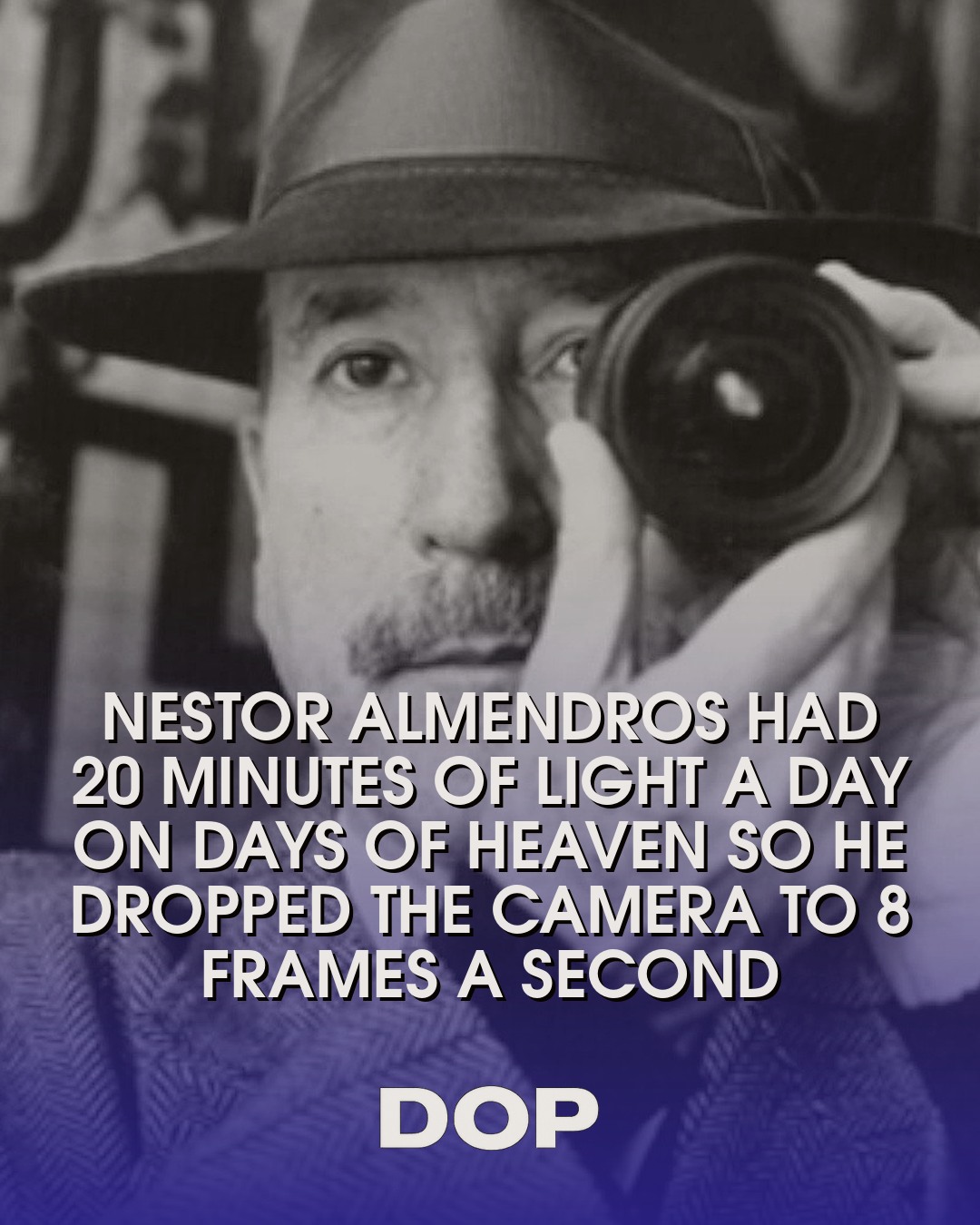
When Terrence Malick’s Days of Heaven arrived in theaters in 1978, it fundamentally disrupted the visual vocabulary of American cinema. Where contemporary Hollywood productions were characterized by heavily keyed three-point lighting setups, hard shadows, and deep-focus studio artifice, Spanish-born cinematographer Néstor Almendros offered a radical alternative: radical simplicity grounded in the unvarnished physics of natural light.
The Exposure Ladder: Squeezing Photons from Twilight
The visual mythology of the film largely revolves around its legendary golden hour photography, but in reality, Almendros was chasing something far more elusive than direct late-afternoon sun. He was hunting for the true crepuscule, the brief twenty-minute window of soft, ambient skylight that occurs after the sun dips below the horizon. Capturing this ephemeral glow required an uncompromising exposure strategy that Almendros referred to as his ladder.
Shooting on Eastman Color Negative II 5247, a stock rated at a modest 100 ASA, meant that photons were a strictly rationed commodity. To survive the dying light, Almendros engineered a precise technical sequence. First, he pushed the 5247 negative one full stop in development to 200 ASA, embracing the resulting grain structure and contrast shift. Next, as the light dropped, he pulled the Kodak 85 daylight conversion filter from the Panavision camera, instantly gaining back two-thirds of a stop of light while allowing the cool, cobalt twilight to tint the negative naturally.
The key was not adding light to mimic nature, but stripping away equipment to let nature register on the emulsion on its own terms.
Finally, Almendros mounted fast Panavision spherical primes, frequently pulling the iris wide open to T1.2 and T1.4. By combining a pushed stock, filter removal, and wide-open glass, Almendros gained roughly a stop and a half of vital exposure. This rigorous technical discipline allowed him to shoot completely without artificial fill lights, preserving the soft, omnidirectional wrap of the open prairie sky.
Choreographing Against the Clock
Working in a twenty-minute exposure window fundamentally reshapes production ergonomics. There was zero margin for standard Hollywood lighting resets or endless takes. Almendros and Malick spent entire daylight hours blocking and rehearsing camera movement and actor blocking with stand-ins. When the sun breached the horizon, the crew abandoned all discussion and rolled take after take with military precision.
By refusing conventional fill light, Almendros allowed faces to fall into soft, naturalistic underexposure, prioritizing the silhouette and the luminous background over standard cosmetic illumination. When ambient bounce was absolutely required, the team relied on simple white bedsheets or foam core rather than HMIs or tungsten units, ensuring the color temperature remained organically married to the landscape.
A Blueprint for Modern Naturalism
Though Haskell Wexler ASC contributed essential additional photography to finish the production when Almendros had prior commitments to François Truffaut, Almendros’s radical methodology earned him the 1978 Academy Award for Best Cinematography. His detailed 1979 retrospective in American Cinematographer demystified the magic, presenting a manifesto that prioritized subtraction over addition.
The technical DNA of Days of Heaven reverberates throughout modern cinema, from Emmanuel Lubezki’s wide-angle naturalism in The Revenant to Chloé Zhao’s evocative twilight framing in Nomadland. Almendros proved that visual poetry is not born from excessive grip trucks or complex rigging, but from an intimate understanding of exposure latitude, optical limits, and the patience to wait for the light to do the work.