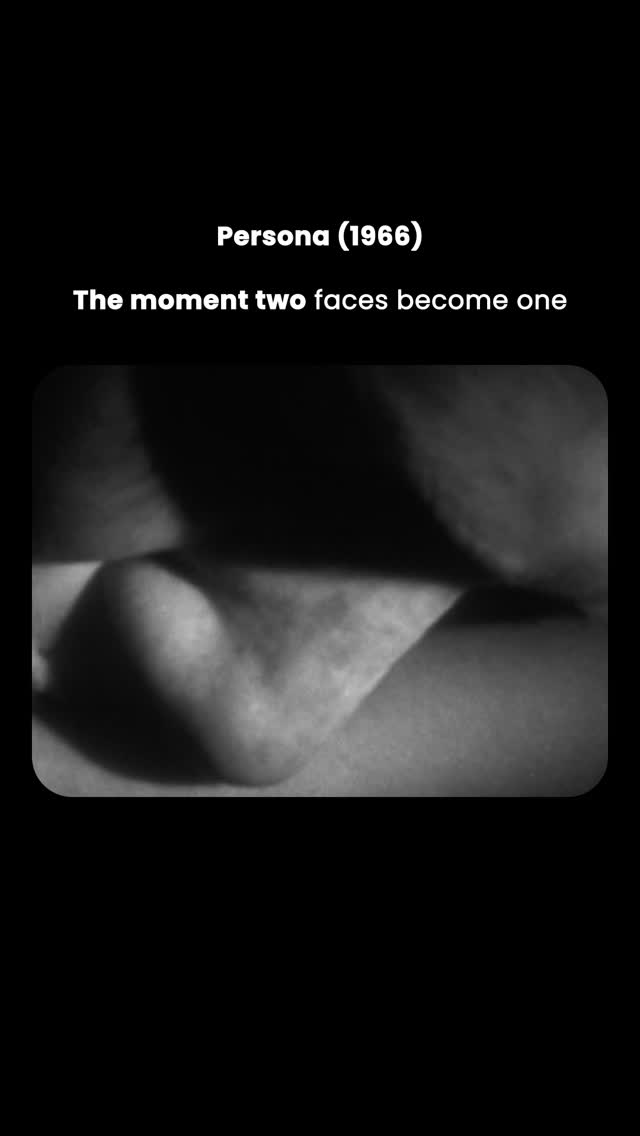
In an era dominated by digital compositing, green screens, and visual effects software, looking back at Ingmar Bergman’s 1966 masterpiece Persona feels like encountering dark optical magic. The film’s most famous sequence, where the identities of nurse Alma (Bibi Andersson) and her mute patient Elisabet (Liv Ullmann) dissolve into a single, terrifying entity, remains a watershed moment in visual storytelling. Yet, legendary cinematographer Sven Nykvist achieved this profound psychological illusion completely in-camera, without a single optical printer pass or post-production matte.
The collaboration between Bergman and Nykvist was defined by an obsessive pursuit of emotional reality through light. By the mid-1960s, Nykvist had stripped away the elaborate multi-light setups of classical Hollywood, embracing a philosophy of radical minimalism. On Persona, this subtractive approach wasn't merely an aesthetic preference; it was the fundamental architecture of the film's psychological horror.
The Geometry of Light and Spatial Flattening
To merge the two actresses into one unified visage, Nykvist bypassed traditional optical overlays in favor of precise spatial manipulation. Positioned on set, Andersson and Ullmann were placed in extremely tight physical proximity. Nykvist deployed a single, harsh key light positioned at a calculated angle to eliminate specular highlights and depth cues, effectively flattening the visual plane between the two faces.
Shooting on 35mm black-and-white Kodak Plus-X stock using Mitchell and Arriflex 35mm camera packages, Nykvist took advantage of the film's dense silver halide structure and high micro-contrast. By exposing precisely for the highlights and allowing shadow values to clip into pitch blackness, the physical boundary between the two women vanished into shadow. The key light unified their skin tones and contours, tricking the human eye into interpreting two separate human heads as one contiguous form.
Nykvist understood that psychological horror doesn't require optical distortion, it requires absolute, unforgiving spatial clarity.
Focus Pulling as Psychological Violence
The second critical half of the trick lay in the optic-mechanical control of depth of field. Using spherical prime lenses stopped down to create a dangerously shallow depth, Nykvist and his focus puller performed subtle, highly deliberate rack focuses between the two performers. As one actress drifted slightly out of the critical focal plane, the other stepped directly into sharp focus.
This technique demanded punishing physical discipline from Andersson and Ullmann. They rehearsed for hours to match their spatial alignment and eyelines to the exact millimeter. The slightest shift in posture or head angle would break the optical illusion. Because the camera captured both faces within the same physical spatial arrangement, the transition feels biological rather than mechanical, leaving the audience with an uncanny sense of claustrophobia.
The Subtractive Philosophy for Modern DPs
Nykvist’s work on Persona offers an enduring lesson for contemporary cinematographers navigating hyper-clean digital sensors and infinite post-production options. When a script calls for psychological disintegration, the natural instinct today might be to reach for split-diopters, lensbaby optics, or heavy digital manipulations. Nykvist proved that restraint often yields far more disturbing results.
By limiting himself to light direction, focal precision, and human geometry, Nykvist turned the camera into an active participant in the characters' mental breakdowns. True visual atmosphere isn't created by adding layers of digital noise or synthetic blur; it is carved out of the raw physics of light, glass, and shadow.
This article contains affiliate links. We may earn a small commission at no extra cost to you. Learn more.