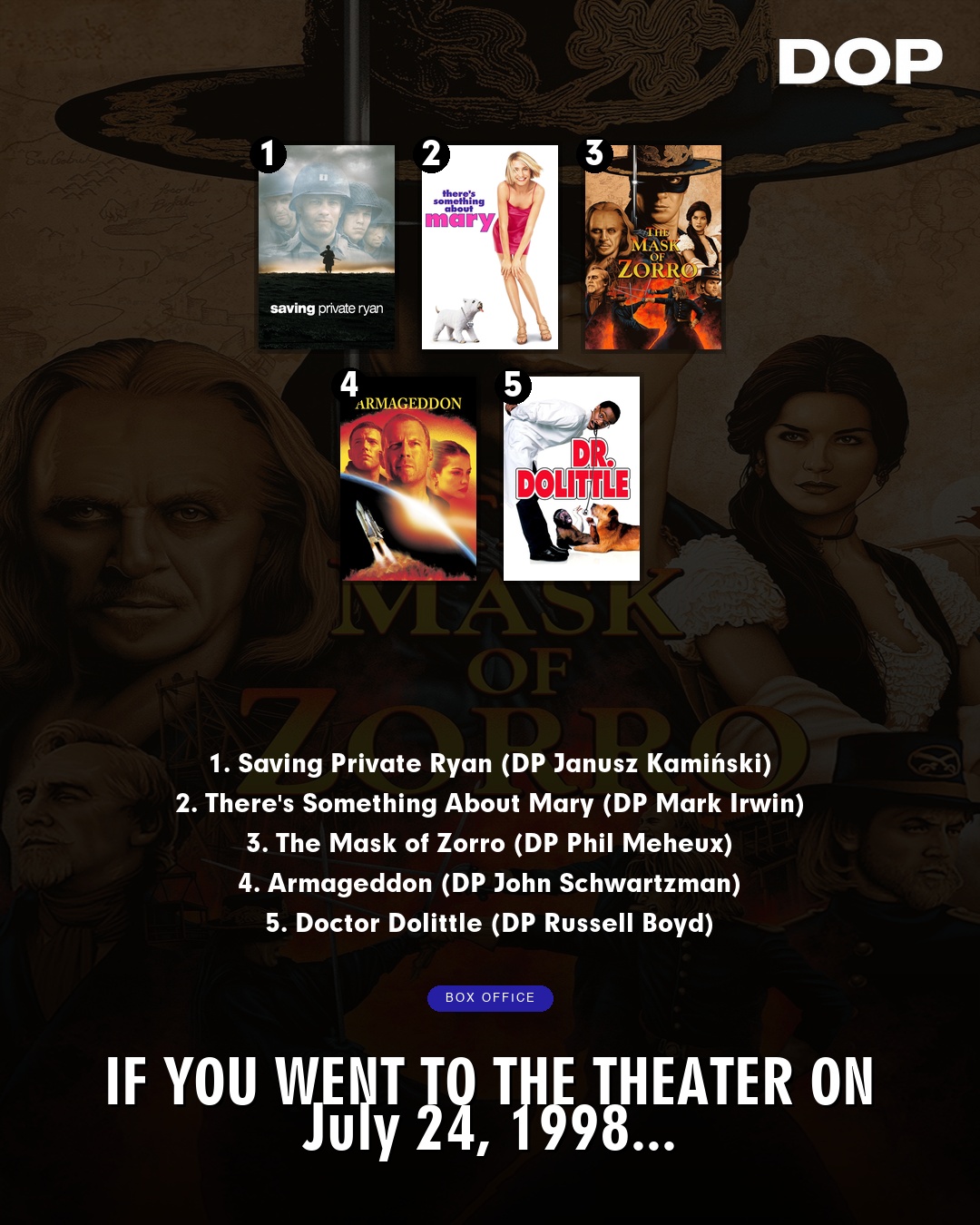
The summer of 1998 was a crucible of American culture, a period marked by political turmoil, national tragedy, and a cinematic landscape that offered both escapism and unflinching realism. While headlines screamed about the Clinton-Lewinsky scandal and a shocking act of violence at the U.S. Capitol, movie theaters provided a different kind of forum, one where master cinematographers were pushing boundaries and defining the visual language of the era. Looking back at that pivotal weekend of July 24th, the box office top five reveals not just popular films, but a fascinating cross-section of cinematographic approaches, each with its own enduring legacy.
Leading the pack, both commercially and artistically, was Steven Spielberg's Saving Private Ryan, lensed by the incomparable Janusz Kaminski. This film didn't just open; it detonated, forever altering the grammar of war cinema. Kaminski, a frequent Spielberg collaborator, eschewed the pristine, heroic imagery often associated with WWII films. Instead, he plunged audiences into the visceral horror of D-Day with a stark, desaturated palette, often employing a desynchronized shutter to create a stuttering, disorienting effect that mimicked the chaos of combat. His use of handheld cameras and a deliberate lack of image stabilization immersed viewers directly into the fray, making them active participants rather than passive observers. The film's bleached-out greens and grays, achieved through a bleach bypass process, stripped away the romanticism, leaving behind a brutal, unflinching reality that resonated so deeply it prompted the VA to set up counseling hotlines. This was not just filmmaking; it was a profound act of visual empathy.
The Art of Impact: Kaminski's Legacy
Kaminski’s work on Saving Private Ryan is a masterclass in how cinematography can serve narrative and emotional truth above all else. His collaboration with Spielberg on films like Schindler's List and Amistad had already established his prowess in historical dramas, often characterized by a stark, almost documentary-like aesthetic, yet always imbued with profound emotional depth. For Saving Private Ryan, he pushed this further, experimenting with lens coatings, film stocks, and processing techniques to achieve a look that felt both authentic and deeply unsettling. The decision to shoot much of the film with older, uncoated lenses, for instance, contributed to the flaring and softer contrast that further grounded the visuals in a gritty reality.
"Kaminski’s camera doesn't just observe; it participates, drawing us into the chaos and stripping away any romantic notions of war. It's a testament to cinematography's power to shape our understanding of history."
Contrast this with the vibrant, almost cartoonish aesthetic of There's Something About Mary, shot by Mark Irwin. Known for his work on genre films and comedies, Irwin’s cinematography here is bright, colorful, and intentionally broad, perfectly complementing the Farrelly brothers' outrageous humor. His lighting is high-key and inviting, creating a world where even the most absurd situations feel sun-drenched and accessible. While not as overtly 'serious' as Kaminski's work, Irwin’s contribution is crucial to the film's success, establishing a visual tone that allows the comedy to land without feeling cynical or dark. It’s a reminder that great cinematography isn’t always about gravitas; sometimes, it’s about perfectly capturing the spirit of a story, however lighthearted.
Diverse Palettes: From Swashbuckle to Spectacle
Then we have Phil Méheux's opulent work on The Mask of Zorro. Méheux, with a filmography that includes James Bond entries and action thrillers, brought a classical, sweeping grandeur to this adventure film. His cinematography is rich with deep shadows and golden highlights, evoking the romanticism of classic Hollywood swashbucklers while maintaining a modern sharpness. The use of wide shots to showcase the stunning Mexican landscapes, combined with dynamic camera movements during sword fights, creates a sense of epic scope and thrilling energy. The interplay of light and shadow, particularly in the iconic Zorro costume, adds to the mystique and allure of the character, a stark contrast to the gritty realism of Kaminski or the bright humor of Irwin.
John Schwartzman's lensing of Michael Bay's Armageddon, on the other hand, is pure blockbuster spectacle. Known for his high-octane, visually arresting style, Schwartzman delivers exactly what's expected: dazzling explosions, dynamic camera work, and a glossy, hyper-real aesthetic. His use of anamorphic lenses creates a widescreen canvas that emphasizes the vastness of space and the scale of the impending disaster. The lighting is often dramatic, with strong contrasts and a vibrant color palette, designed to maximize visual impact and keep the audience on the edge of their seats. While sometimes criticized for its bombast, Schwartzman's work here is undeniably effective in creating a thrilling, larger-than-life experience.
Finally, Daryn Okada’s cinematography for Doctor Dolittle offers a more whimsical, family-friendly visual approach. Okada, known for his versatile work across various genres, crafts a colorful and bright world that is inviting for younger audiences. His lighting is soft and even, creating a sense of warmth and accessibility, while the camera work is fluid and engaging, often framing Eddie Murphy's interactions with the CGI animals in a way that makes the fantastical feel natural. It’s a testament to the cinematographer’s ability to adapt their craft to the specific demands of a story, creating a visual environment that supports the narrative's tone and target audience.
Twenty-five years later, the films of July 24, 1998, offer a compelling snapshot of cinematographic diversity. From Kaminski's groundbreaking realism to Irwin's comedic brightness, Méheux's classical romance, Schwartzman's explosive spectacle, and Okada's family-friendly whimsy, each DP brought a distinct vision to the screen. What holds up, in the end, isn't just the story, but the enduring power of these visual choices, reminding us that the craft of cinematography is as varied and impactful as the human experiences it seeks to capture.
This article contains affiliate links. We may earn a small commission at no extra cost to you. Learn more.