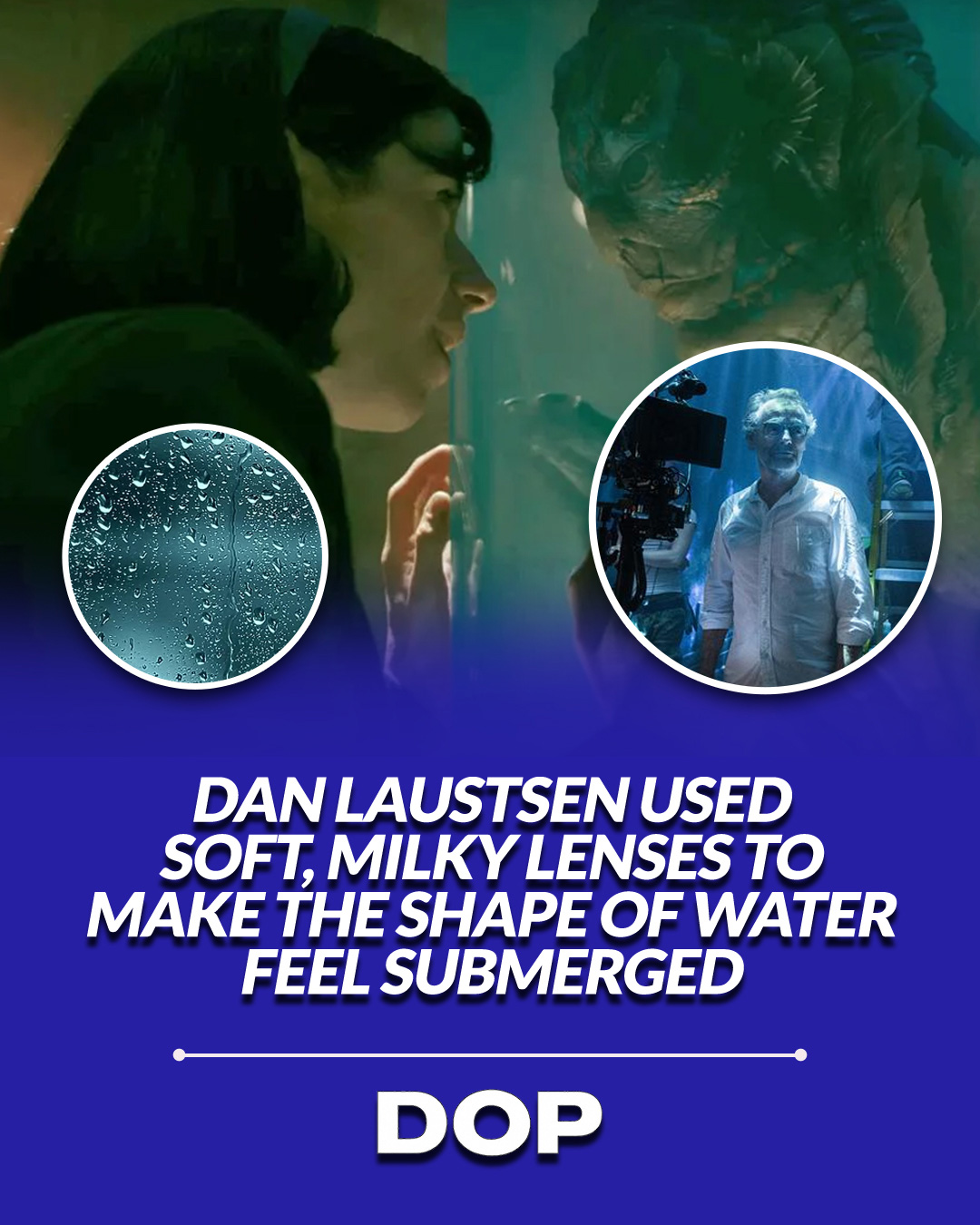
Guillermo del Toro’s dark fairy tales have always operated in a space where texture and atmosphere reign supreme. Yet in The Shape of Water, cinematographer Dan Laustsen, ASC, DFF, achieved a rare optical synergy that feels simultaneously period-accurate, hyper-stylized, and deeply organic. Rather than treating the creature’s aquatic origin as an isolated visual trick reserved for underwater set pieces, Laustsen engineered a visual language where the entire world exists within a single, damp ecosystem.
From the subterranean government facility to Elisa’s apartment situated above a decaying cinema, the imagery avoids the harsh digital sharpness that plagues modern digital cinematography. Laustsen’s frames rarely settle on absolute pure black or clinical high-contrast edges. Instead, through precise lens choices, optical filtration, and persistent atmospheric hazing, the light blooms gently, shadows stay luminous, and the screen feels coated in a thin veil of moisture and steam.
Optical Texture: Softness, Filtration, and Atmosphere
To create this tactile, submerged sensation, Laustsen paired digital sensors with customized optical treatments. While modern camera systems capture incredible clarity, that resolution can often feel unforgivingly dry. Laustsen combated this by employing vintage-style diffusion and precise camera-filtering techniques to roll off high-frequency digital detail. The goal was not to make the image blurry, but to soften the transition between light and dark, creating a gentle halo around highlights.
Atmosphere played an equally crucial role on set. Smoke, haze, and moisture were constantly maintained to lift shadow values and catch edge lights. By lifting the black floor slightly, Laustsen ensured that shadows remained transparent, filled with ambient cyan and deep teal tones rather than void-like blacks. This lifted shadow architecture allows the viewer's eye to travel through every corner of the meticulously crafted production design.
Genre tone isn't built in post-production with heavy color grades or CG tricks; it lives in your base contrast, atmospheric haze, and the way light rolls off your glass.
Color Palette and the Submerged Aesthetic
Color in The Shape of Water is fundamentally structural. Laustsen and Del Toro established a rigid chromatic ruleset dominated by cool greens, deep cyans, and oxidized copper tones. These colors evoke water, rust, and institutional decay. To keep the frames from feeling completely monochromatic or lifeless, Laustsen relied heavily on warm practical sources, tungsten lamps, amber streetlights, and candlelight, positioned specifically to kiss skin tones and maintain vitality on actors' faces.
This contrast between cool environmental tones and warm practical key lights creates a rich volumetric depth within the frame. Skin tones remain grounded and human even when enveloped by an overwhelming sea of cyan. In scenes featuring the creature, this lighting approach allows its iridescent scales to catch specular highlights without feeling overly glossy or synthetic, seamlessly blending practical suits with atmospheric lighting.
World-Building Beyond the VFX Shot
For modern cinematographers, Laustsen’s masterclass offers a crucial lesson in world-building. Too often, contemporary genre films rely on visual effects to carry the weight of world-building, leaving the camera team to shoot clean, sharp plates that can be manipulated in post. Laustsen proved that carrying narrative tone through camera-native techniques, lens diffusion, lighting contrast, and atmospheric control, creates a far more immersive cinematic universe.
By letting the aquatic aesthetic bleed into every setting, dry apartments, cold laboratories, rain-slicked city streets, the film achieves a poetic continuity. When the literal underwater sequence finally arrives, it feels like a natural extension of the world we have been inhabiting all along. It is a powerful reminder that texture, lighting philosophy, and contrast management remain a cinematographer's most potent narrative tools.