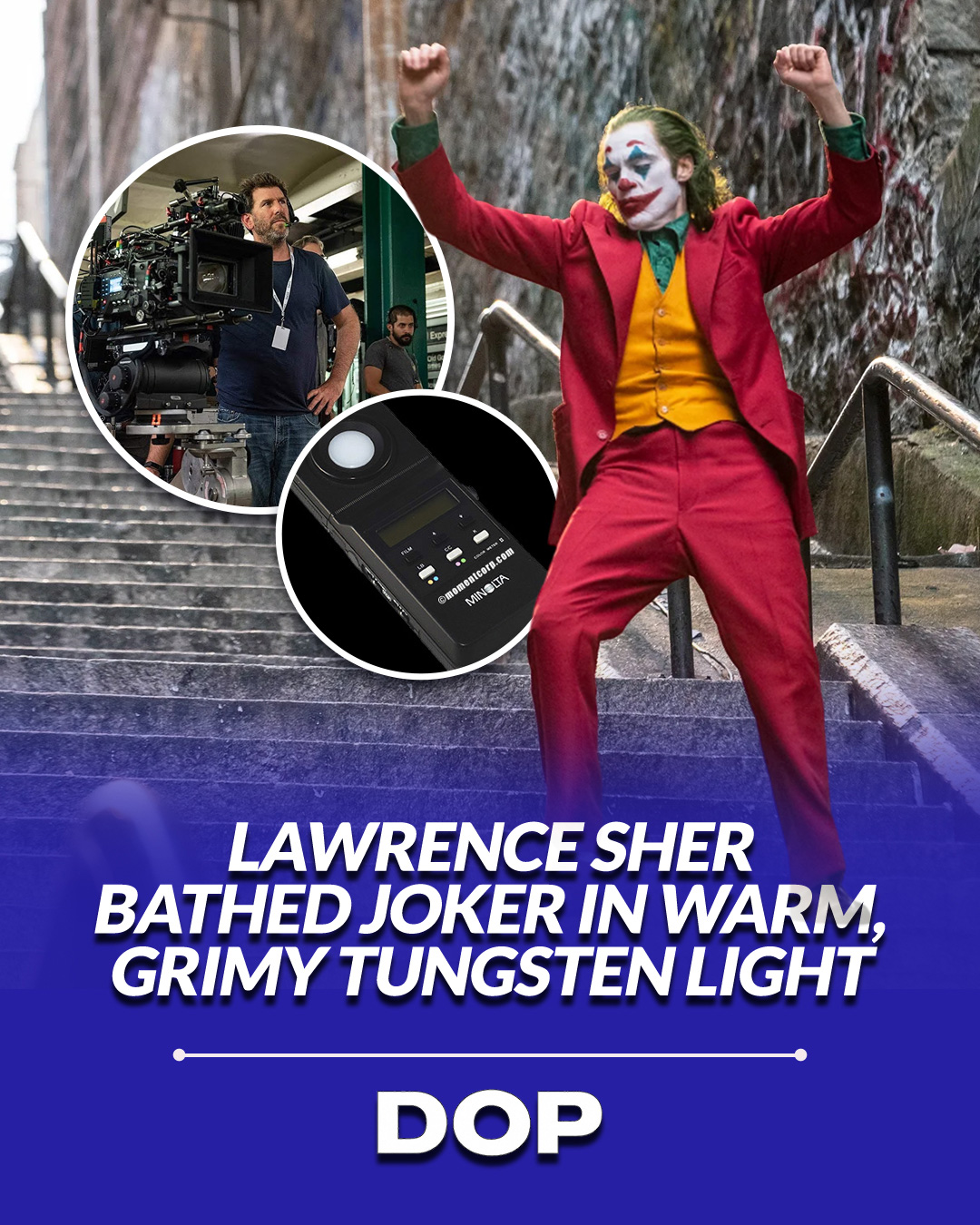
When Todd Phillips and cinematographer Lawrence Sher ASC set out to capture Gotham City for 2019’s Joker, they were not interested in the sleek, high-contrast visual language typical of modern comic book adaptations. Instead, Sher turned to the unvarnished aesthetic of late-1970s cinema, crafting a visual world anchored in grime, sweat, and psychological deterioration. At the core of this strategy was a meticulously mapped approach to color temperature, where light served as a direct reflection of Arthur Fleck’s unspooling mind.
To achieve this intimate yet grand cinematic portrait, Sher selected the large-format ARRI Alexa 65 system paired with customized ARRI DNA lenses. The medium-format sensor provided a shallow depth of field, drawing the audience into Arthur’s personal space while preserving the tactile detail of Gotham's decaying architecture. But while sensor choice established scale and texture, it was Sher's lighting philosophy, built around visible practical fixtures and conflicting color temperatures, that gave the film its signature patina.
The Palette of Psychological Decay
Sher deliberately pushed the movie’s ambient color space toward a dirty palette dominated by warm tungsten and street-level sodium vapor. In Arthur’s apartment, in late-night diners, and across the glistening asphalt of Gotham’s streets, low-Kelvin tungsten bulbs and amber streetlights blanket the frame in a heavy, stained atmosphere. These warm tones are far from comforting; they feel thick, unventilated, and suffocating, as if the air itself had been baked in industrial exhaust and nicotine.
This low-Kelvin foundation serves as Arthur’s baseline reality. Rather than relying on traditional cinematic fill, Sher relied heavily on exposed practical bulbs, sodium lamps inside subway cars, bare tungsten fixtures hanging in cramped hallways, and fluorescent tubes buzzing in cheap apartments. By allowing these visible sources to handle the heavy lifting as key sources, the visual team maintained a grounded, documentary-like immediacy.
"Color temperature in Joker isn't decorative; it's a structural psychological map. Warm light suffocates Arthur in his reality, while cold light strips away his humanity entirely."
Conversely, cool lighting is weaponized against Arthur throughout the narrative. Whenever he encounters institutions that reject or humiliate him, social services offices, corporate boardrooms, and Arkham State Hospital, Sher shifts the color temperature dramatically toward harsh, unyielding cool daylight and uncorrected cyan fluorescents. These cold spaces feel sterile, clinical, and deeply hostile, casting sharp specular highlights on Joaquin Phoenix’s gaunt frame.
Practical Illumination and Color Science
Achieving this aesthetic required precise coordination between Sher, gaffer Mark "Scruffy" Meyers, and colorist Jill Bogdanowicz at Company 3. Rather than relying solely on traditional tungsten film units, the team retrofitted actual sodium vapor bulbs and dirty fluorescent tubes into existing locations, augmenting them with modern LED fixtures like LiteGear LiteMats and ARRI SkyPanels dialed to specific chromaticities. This granted the camera crew mobility while preserving authentic color rendition directly in camera.
A critical component of this methodology was the custom LUT developed prior to production. Designed to emulate the rich grain and highlight roll-off of vintage film stocks, the look held skin tones intact even under extreme mixed-lighting scenarios. When Arthur is lit by a nauseating blend of warm sodium ambient light and cool cyan practicals, the color science preserves his flesh tones, keeping his human vulnerability front and center.
Consider the subway sequence: the interior of the train car is illuminated by overhead practical bulbs that flicker and balance between warm tungsten and harsh cyan as the train rattles through tunnels. Sher used this disorienting exposure and color shift to externalize Arthur's internal chaos, transforming an ordinary commute into an unbearable claustrophobic nightmare.
By committing to motivated practical lighting and a deliberate color-temperature framework, Lawrence Sher demonstrated how precise visual architecture can ground a psychological narrative. Joker stands as a masterclass in using light not just to expose an image, but to expose the inner workings of a character's soul.