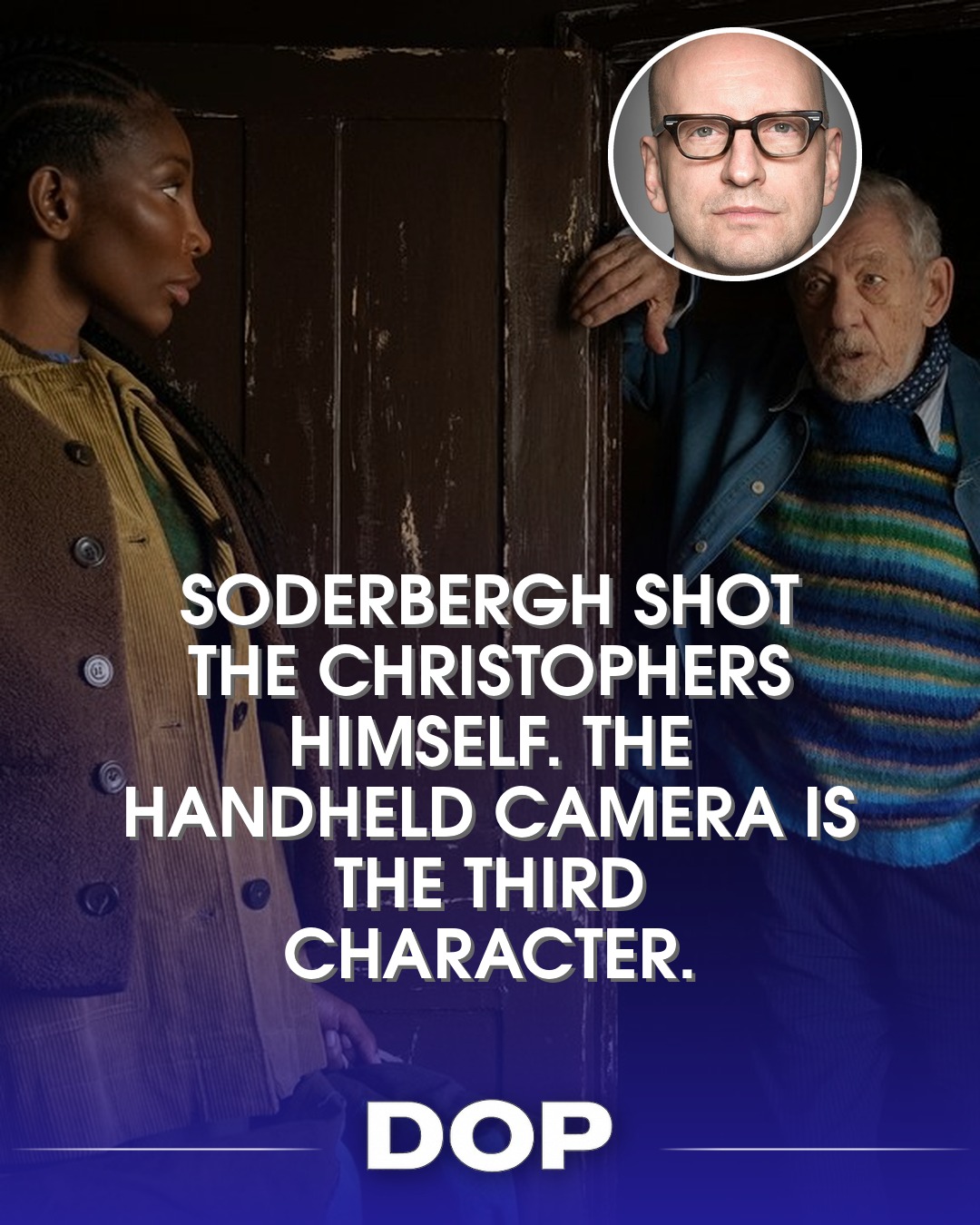
Steven Soderbergh is a filmmaker who consistently challenges the conventional divisions of labor in cinema. His commitment to serving as his own cinematographer, under the familiar alias Peter Andrews, is not merely a practical choice or a stylistic quirk; it is a profound philosophical statement about control, intimacy, and the very act of seeing. In his latest, The Christophers, a film that sees him once again donning the hats of director, cinematographer, and editor (as Mary Ann Bernard), this philosophy reaches a new, visceral zenith, particularly in its deliberate and impactful use of handheld cinematography.
The decision to go handheld in The Christophers is far from an arbitrary stylistic flourish. The Instagram caption rightly highlights its intentionality: the moment the camera crosses the threshold of Ian McKellen’s character’s front door, the visual language undergoes a dramatic shift. This isn't just about an aesthetic; it’s about a deeply considered emotional resonance. The restless, unmoored quality of a handheld camera becomes a direct conduit for the emotional instability simmering beneath the surface of the narrative. It’s a bold choice that immediately plunges the audience into the psychological landscape of the characters, transcending mere observation to become an embodied experience.
The Intimacy of the Unstable Frame
Soderbergh’s journey as his own cinematographer stretches back to Traffic in 2000, and with each subsequent film, he has refined his ability to wield the camera as an extension of his directorial vision. This direct control over framing, movement, and rhythm is critical, especially in a film like The Christophers, which, by all accounts, relies heavily on the nuanced performances of its leads, Ian McKellen and Michaela Coel. The handheld approach in this context allows for an unparalleled intimacy, capturing every subtle gesture, every fleeting expression, with an immediacy that a more static, formalized setup might miss. It’s a testament to Soderbergh’s understanding that sometimes, the most profound emotional truths are found in the slight imperfections and naturalistic sway of the human eye.
“The restless camera turns a two-hander into something physically immersive, with the visual language doing as much storytelling as the dialogue.”
Beyond the emotional implications, there’s a pragmatic brilliance to Soderbergh’s choice. The film reportedly features tight, cluttered interiors, spaces where traditional dolly setups would be impractical, if not impossible. Here, the handheld camera isn't just an artistic decision; it's a solution born of necessity, showcasing Soderbergh's resourcefulness. This blend of artistic intent and practical problem-solving is a hallmark of his approach. One can imagine him, perhaps with a compact digital cinema camera like a RED Komodo or a Blackmagic Pocket Cinema Camera 6K Pro, navigating these spaces with an agility that only a single operator with a singular vision can achieve. The absence of elaborate rigging or extensive crew allows for a fluidity that mirrors the characters' internal states, creating a seamless connection between form and content.
Soderbergh's Enduring Visual Signature
Soderbergh’s visual style has always been characterized by its adaptability and willingness to experiment. From the gritty, color-drenched realism of Traffic to the stark, almost clinical aesthetic of Contagion, and the vibrant, kinetic energy of the Ocean's films, he has consistently pushed boundaries. As Peter Andrews, he is not confined to a single look but rather tailors the cinematography to the specific demands of each story. For The Christophers, the choice of handheld is less about technical specifications of the camera and more about its inherent psychological impact. It’s about the feeling of being present, of being inextricably linked to the characters' anxieties and revelations.
The critical reception of The Christophers further validates Soderbergh’s choices, with many praising how the restless camera transforms what could have been a static two-hander into an immersive, physical experience. This ability for the visual language to carry as much narrative weight as the dialogue is the ultimate goal of any masterful cinematographer. Soderbergh, in his unique tri-fold role, achieves this with an enviable synergy. He doesn't just shoot a scene; he sculpts it, edits it in his mind as he's framing, ensuring that every visual beat contributes to the overarching emotional and narrative rhythm. This level of holistic control is rare and speaks volumes about his dedication to the craft of filmmaking in its purest, most unadulterated form.
In an era often dominated by large crews and specialized departments, Soderbergh's approach with The Christophers serves as a powerful reminder of the singular vision. It underscores the profound impact a director can have when they physically embody the role of the cinematographer, bringing an unparalleled intimacy and control to the visual storytelling. For DPs and aspiring filmmakers, it’s a masterclass in how deliberate choices in camera movement and perspective can elevate a narrative from merely being seen to being truly felt.
This article contains affiliate links. We may earn a small commission at no extra cost to you. Learn more.