When Paul W. S. Anderson and cinematographer David Johnson, BSC descended into the bowels of Berlin to shoot Resident Evil in 2001, they bypassed soundstages in favor of cold, unfinished infrastructure. The subterranean labyrinth of the Hive, the bio-weapons research bunker beneath Raccoon City, found its architectural backbone within the raw concrete vaults of the unopened Bundestag U-Bahn station. Shot on 35mm using Arriflex cameras paired with Zeiss Ultra Primes, Johnson treated the location not as science-fiction fantasy, but as an oppressive industrial crypt. Harsh, uncorrected fluorescent tubes and low-angle architectural tracks mimicked the claustrophobic dread that console gamers had navigated for years, yet translated it into pure, photochemical cinema.
A video game adaptation presents a director of photography with an unprecedented visual paradox. In standard literary adaptation, the DP is the first person to assign physical light, grain, and color to the written word. But with a game, the visual grammar already exists in the collective unconscious of millions who have spent dozens of hours actively piloting a camera through that space. The audience doesn’t just remember a story; they remember the color temperature of the save room, the hard edge of low-polygon geometry, and the unnerving static angles of early fixed-camera survival horror.
Translating Interactive Space to Authorial Gaze
The fundamental challenge lies in wrestling back authorial perspective. In early third-person games like Capcom’s original 1996 title, visual tension stemmed from deliberate mechanical limitation: Dutch tilts and high-angle security perspective shots intentionally concealed what lurked around the corner. When David Johnson stepped behind the viewfinder, he resisted the urge to mimic pure video game mechanics. Instead, he relied on disciplined, clinical camera motion, precise dolly tracks through brutalist corridors punctuated by sudden, violent handheld bursts during undead encounters. The film’s lighting package favored hard industrial sources, green-cyan fluorescent balances, and deep, impenetrable shadows that exploited the dynamic range of Kodak Vision 500T 5279 film stock.
“The game DP isn't competing with another film; they are competing with the player’s personal agency and the interactive memory of light.”
That visual translation dictates radically different methodologies depending on the material. While Anderson and Johnson stripped Resident Evil down to utilitarian metal and biological decay, other cinematographers have looked to film history to ground digital iconography in tactile reality.
Grain, Glass, and Escaping the Digital Sheen
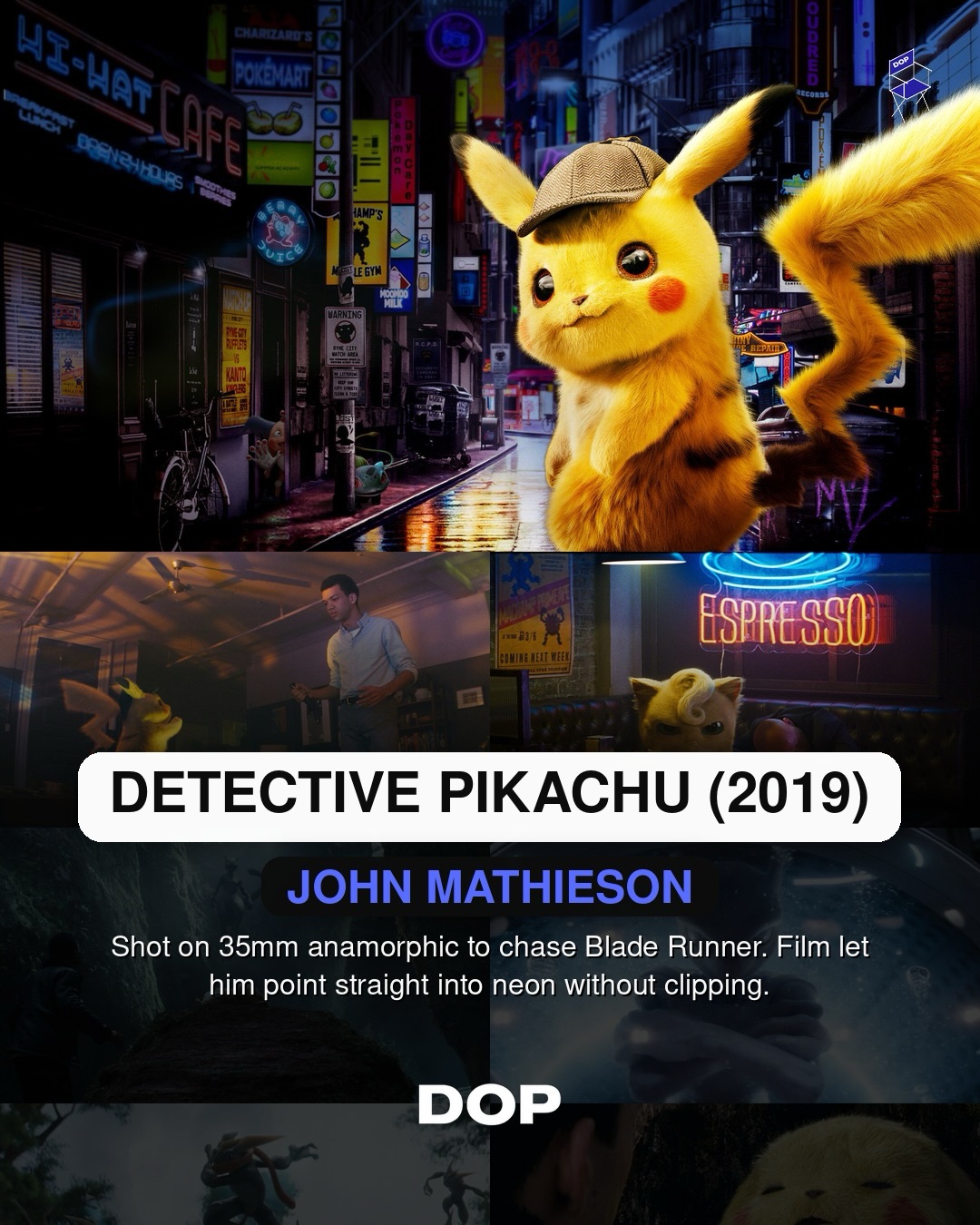
Consider John Mathieson, BSC, who faced a completely opposite aesthetic mandate on Pokémon Detective Pikachu. Given a property built on vibrant, clean anime cel-shading and glossy modern game engines, Mathieson deliberately fought against the clean digital envelope. Rather than shooting on large-format digital sensors, he mounted Panavision C-Series and E-Series anamorphic glass onto Arricam ST and LT 35mm cameras. Drawing overt visual inspiration from Jordan Cronenweth’s seminal work on Blade Runner, Mathieson drenched Ryme City in high-contrast neon, dense tungsten practicals, heavy atmospheric haze, and organic photochemical grain. By introducing optical aberrations, anamorphic flares, and emulsion breathing to characters rendered entirely in CGI, Mathieson anchored fantastical pocket monsters inside a dirty, lived-in neo-noir aesthetic.
At the opposite end of the spectrum sits Jacques Jouffret, ASC, whose approach to Gran Turismo embraced extreme digital multi-camera coverage to simulate the hyper-reality of high-end sim racing. Jouffret orchestrated fifteen simultaneous camera setups, relying heavily on Sony VENICE 2 systems tethered via Rialto extension units. By pulling the sensor block away from the heavy camera body, Jouffret’s team mounted cameras inside the claustrophobic cockpits and millimeter-tight chassis clearances of Le Mans prototypes. Coupled with FPV drone rigs executing dynamic high-speed pursuits, Jouffret translated the gamer's third-person chase-cam perspective into visceral, physical g-force on screen.
The Hive’s Enduring Architectural Ghost
Looking back at Johnson’s work on Resident Evil, what endures is the physical restraint. Before the franchise mutated into green-screen heavy, wire-fu spectacle, the original 2002 outing possessed a palpable weight. The Laser Corridor sequence, now an indelible piece of early-2000s genre iconography, succeeded precisely because the clinical white luminescence of the LED panels felt mathematically cold against the terrified flesh of the commando unit. The lighting operated as an antagonistic system, exposing the human subjects to clinical extermination under pristine foot-candles.
Cinematography in this genre will always be an ideological tug-of-war between game engine logic and filmic truth. Whether running fifteen Rialto sensors at 150 miles per hour or dragging anamorphic primes through neon puddles, the most successful game adaptations don't simply replicate an engine's render pass. They understand that to make a virtual space matter, a cinematographer must construct a lighting philosophy that honors the texture of the real world just as ruthlessly as the fantasy.
This article contains affiliate links. We may earn a small commission at no extra cost to you. Learn more.