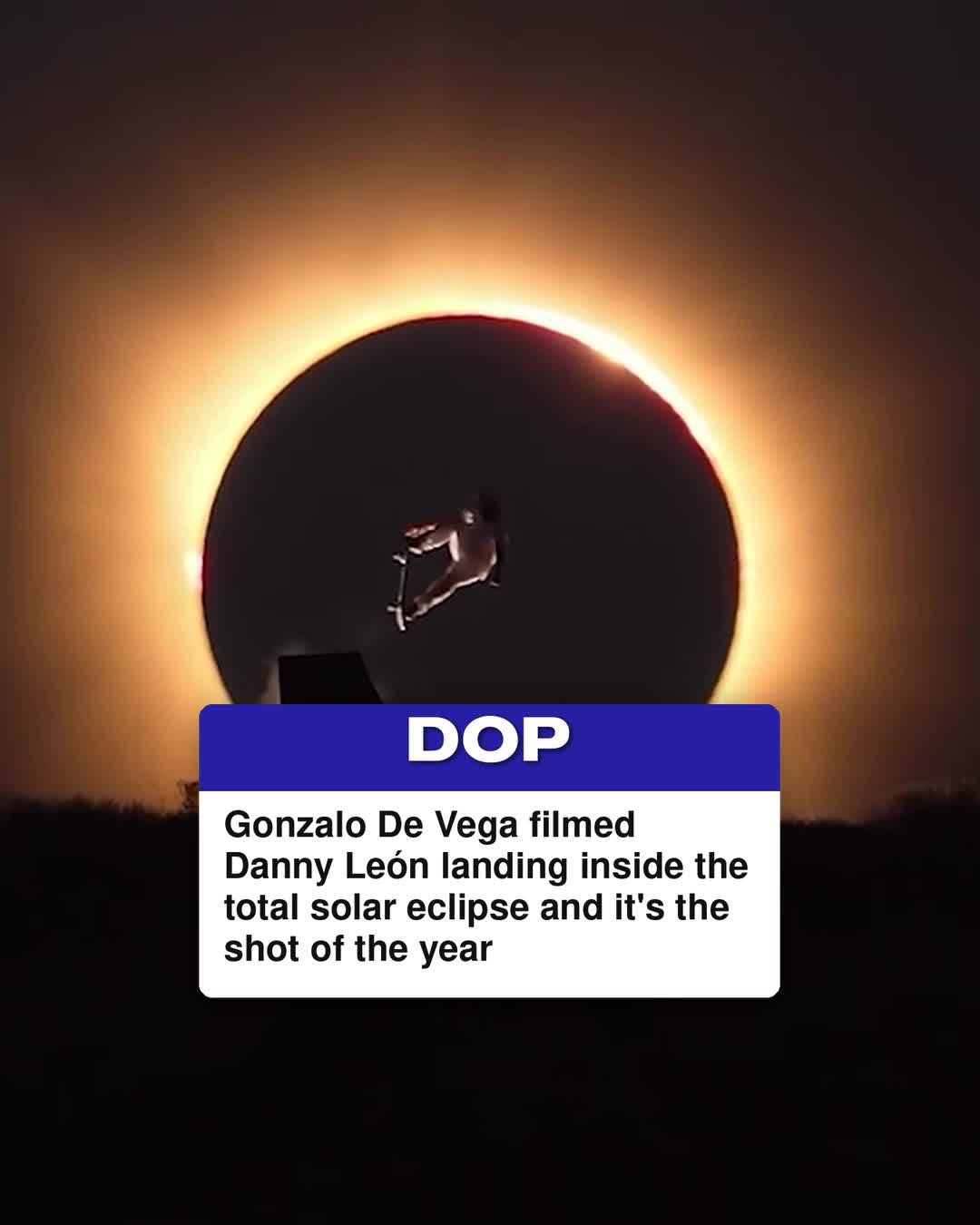
In visual storytelling, few phenomena demand as much unforgiving precision as celestial alignment. When filmmaker Gonzalo De Vega and photographer Jose Izquierdo set out to capture professional skateboarder Danny León hitting a custom quarterpipe against the backdrop of Europe’s first total solar eclipse since 1999, they entered a domain where physics, sports timing, and raw optical geometry collide. Totality is measured in mere minutes, and the light does not negotiate.
The Geometry of Extreme Telephoto Compression
To frame an athlete dead-center against the silhouette of an eclipsed sun, focal length selection dictates everything. Achieving an apparent scale where the solar disc dwarfs or frames a human subject requires massive telephoto compression, typically demanding focal lengths between 800mm and 1200mm, often achieved with cinema zooms coupled with 2x optical extenders or dedicated high-end telephoto primes.
At these focal lengths, the distance between the camera position, the skater, and the horizon spans hundreds of yards. Every variable multiplies: atmospheric haze, heat shimmer, ground vibrations, and above all, hyper-precise spatial alignment. If the ramp is off by a matter of inches, the optical trajectory fails completely.
Totality does not wait. There is no second take when the sky turns black and the corona ignites.
Managing the Impossible Exposure Envelope
Cinematographers shooting solar transitions face one of the most hostile exposure environments in optics. Prior to totality, the direct sun requires substantial neutral density filtration, often specialized 16-stop to 20-stop solar filters, to protect modern high-latitude digital sensors from sensor burn and unrecoverable highlight clipping. However, the instant totality hits, luminance drops instantaneously by over ten stops, revealing the delicate, gossamer structure of the solar corona.
De Vega’s approach required an instantaneous exposure transition: pulling ND filters, locking off iris values to maintain sufficient depth of field across the athlete’s plane of movement, and leaning into the native ISO and dual-gain architectures of modern cinema sensors to retain shadow detail across León’s silhouette without introducing sensor noise into the deep chromatic gradients of the daytime twilight sky.
Single-Take Precision Under Corona Light
Focus pulling at extreme telephoto distances adds another layer of tension. With a razor-thin depth of field at high magnification, keeping León tack-sharp at the apex of his air requires millisecond coordination between the skater’s drop-in and the camera operator’s cue. There is no rehearsal at actual eclipse luminance.
By harmonizing high-speed action sports timing with rigid astronomical calculations, De Vega and Izquierdo delivered a visual artifact that bridges extreme sports documentation with high-concept cinematic mastery. It stands as a testament to what happens when deep technical preparation meets an ephemeral, once-in-a-generation window of natural light.