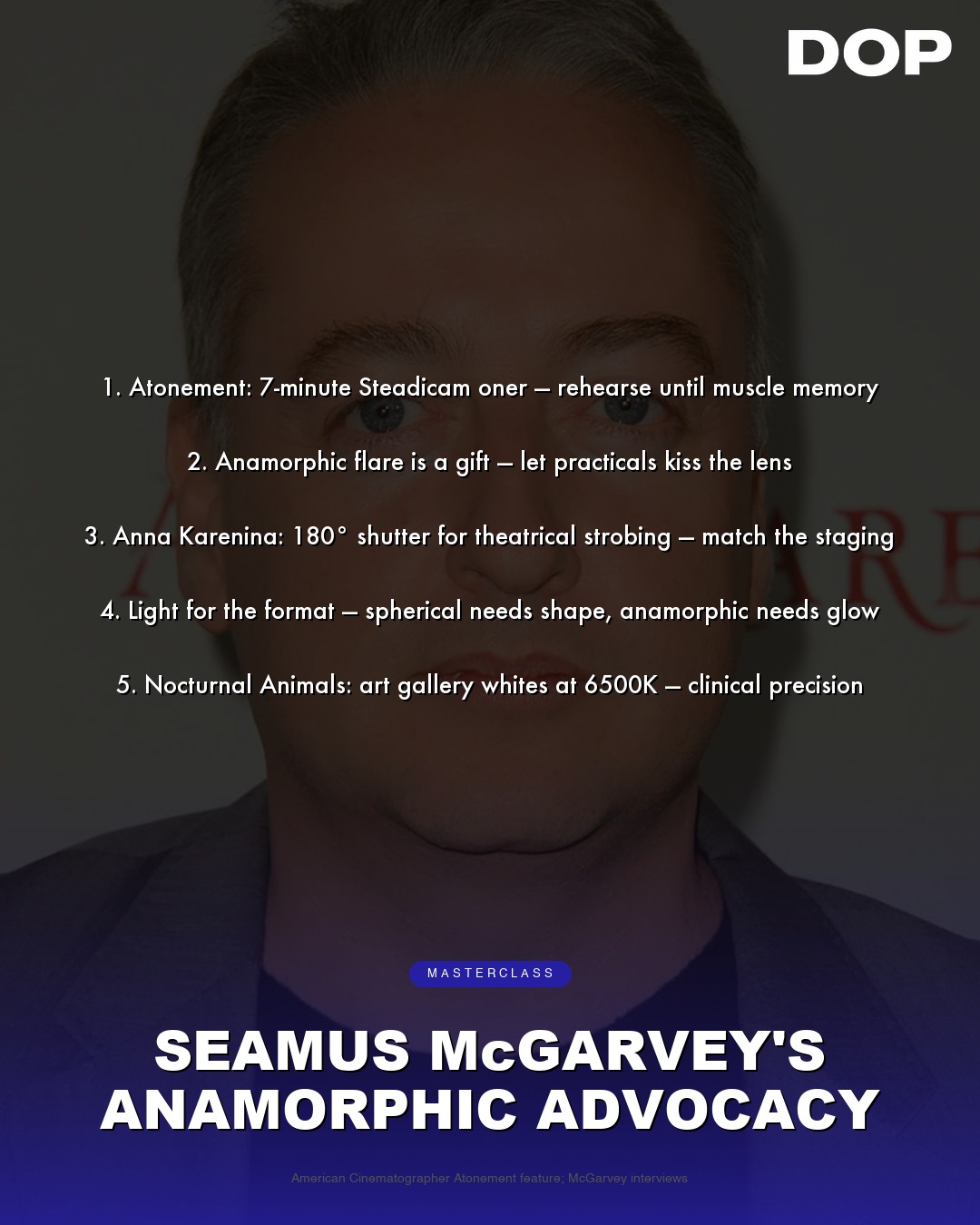
Seamus McGarvey, BSC, ASC, is a name synonymous with visual poetry and audacious technical mastery. From the sweeping landscapes of The Greatest Showman to the intimate, haunting beauty of Atonement, his work consistently elevates the photographic language of cinema. Recently, McGarvey offered a glimpse into his distinct approach, particularly his ardent advocacy for anamorphic capture, revealing a master craftsman's perspective that transcends mere technical specification to embrace the emotional core of visual storytelling.
His insights begin with a nod to arguably one of the most celebrated Steadicam shots in modern cinema: the seven-minute Dunkirk beach oner from Atonement. This sequence, a ballet of choreographed chaos and silent horror, wasn't born from spontaneity but from relentless dedication. McGarvey’s wisdom here is profound yet simple: “rehearse until it becomes muscle memory.” This isn't just about the operator; it's about the entire crew moving as one, anticipating the light, the actors, and the emotional beats. For McGarvey, such a shot is not a gimmick but a narrative device, pulling the audience into the visceral present, demanding their sustained attention without the reprieve of a cut. It embodies a philosophy where technical prowess serves the story, not the other way around.
The Gift of Anamorphic Flare
Perhaps McGarvey's most passionate advocacy lies in his embrace of anamorphic lenses. In an era where some DPs strive to mitigate lens artifacts, McGarvey reveres them. “Anamorphic flare is a gift,” he states unequivocally, urging cinematographers to “let practicals kiss the lens with intent.” This isn't about uncontrolled light leaks; it’s a deliberate dance with light sources, allowing them to stretch and streak across the frame, imbuing the image with a palpable sense of atmosphere, nostalgia, or even threat. Think of the neon-streaked nights in Godzilla, or the dreamlike quality in Anna Karenina; these flares add character, texture, and a unique visual signature that spherical lenses simply cannot replicate. It’s a bold artistic choice that defines much of his signature look.
“Anamorphic flare is a gift – let practicals kiss the lens with intent.” – Seamus McGarvey, BSC, ASC
His approach to anamorphic extends beyond the aesthetic. McGarvey often employs a technique of 1.33 extraction from the anamorphic negative, opting to “crop in post to find your frame.” This speaks to a profound understanding of the anamorphic squeeze and de-squeeze process. By capturing a wider image and then digitally extracting a narrower aspect ratio, he gains flexibility and control over composition in the edit. This method can sometimes offer a cleaner, sharper image by utilizing the 'sweet spot' of the anamorphic glass while still retaining the distinctive oval bokeh and horizontal flares. It’s a testament to his meticulous planning and his ability to push the boundaries of traditional capture methods.
Bokeh as Emotional Language
Beyond the technical, McGarvey delves into the emotional impact of optical characteristics. He views “bokeh as emotional language,” particularly how “shallow focus separates the present from the past.” This is a masterclass in using depth of field as a narrative tool. The creamy, oval-shaped bokeh characteristic of anamorphic lenses, when paired with shallow focus, can isolate a character, emphasize a detail, or create a dreamlike state. In Atonement, for instance, the soft, painterly backgrounds often serve to underscore Cecilia Tallis's internal world or the fragile nature of memory. It creates a visual metaphor for psychological distance and emotional focus, drawing the viewer's eye with an almost magnetic pull.
Finally, McGarvey’s philosophy on camera movement is equally nuanced: “Handheld tension, Steadicam grace – choose your movement grammar per scene.” This isn't about adhering to a single style but about serving the story's emotional demands. Handheld work, with its inherent instability and organic feel, can inject urgency, intimacy, or chaos. Think of the raw energy in The Avengers, where the camera feels like it's in the thick of the action. Conversely, Steadicam offers a floating, almost omniscient perspective, lending elegance, smoothness, or a sense of impending doom, as seen in the aforementioned Atonement sequence. McGarvey understands that camera movement is a language in itself, with distinct dialects for different narrative purposes. The choice of camera, lens, and movement is never arbitrary; it is always a deliberate, artful decision aimed at deepening the audience's emotional connection to the film.
Seamus McGarvey's insights remind us that cinematography is far more than technical execution. It is an art form driven by intention, emotion, and a deep understanding of how light, movement, and optical aberrations can sculpt meaning. His advocacy for anamorphic isn't just about a lens choice; it's about embracing character, imperfection, and the unique visual vocabulary that can elevate a film from mere imagery to unforgettable cinematic experience.