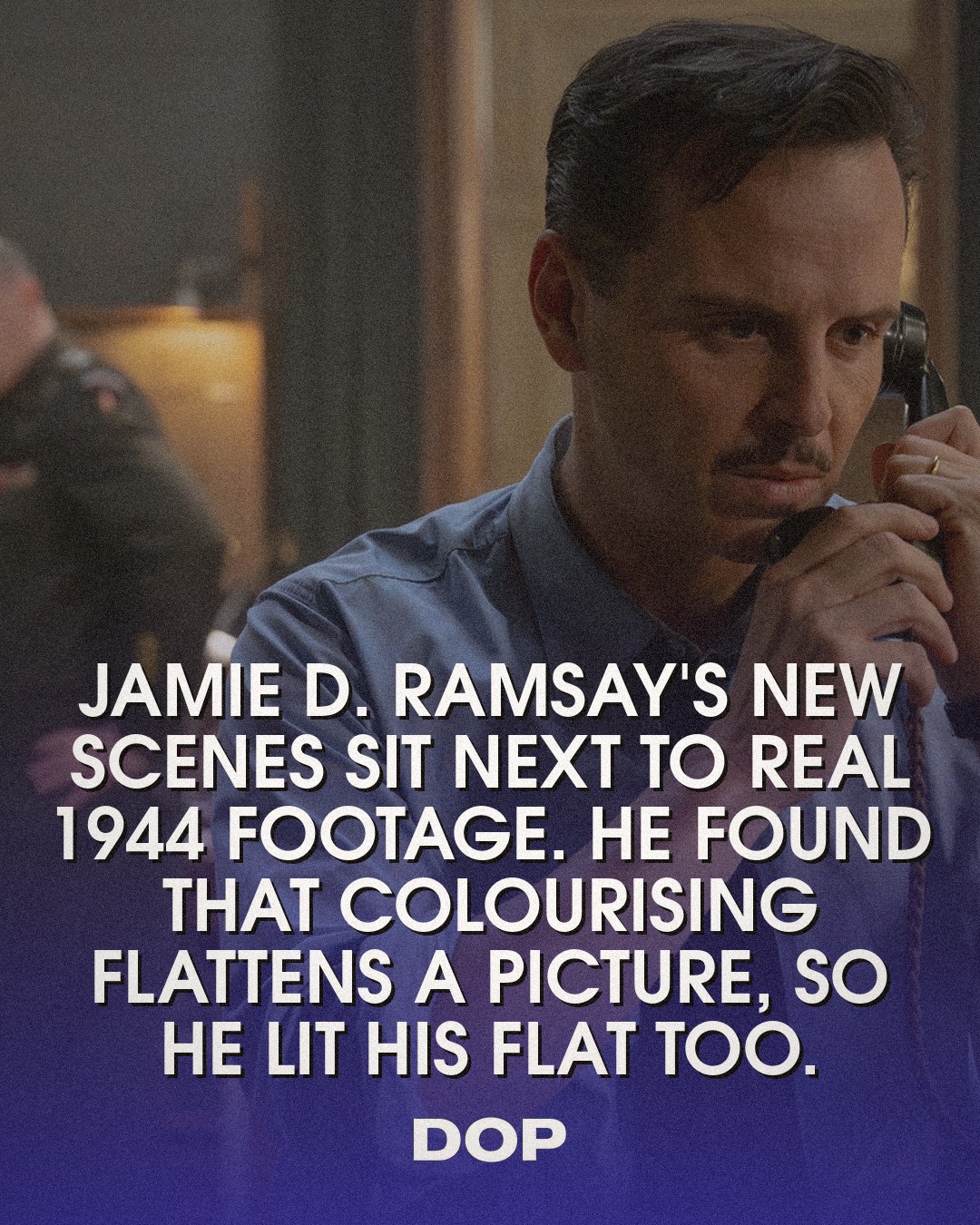
When rendering a pivotal historical turning point on screen, the temptation for modern cinematographers is often to lean into heavy stylistic artifice, bleach bypass emulations, hyper-stylized grain profiles, or aggressive handheld work designed to manufacture visceral chaos. For director Anthony Maras’s historical drama Pressure, which tracks the high-stakes, nerve-fraying 72 hours leading up to the D-Day landings, director of photography Nick Ramsay took a radically disciplined counter-approach: absolute optical cohesion between newly staged drama and restored period actuality.
The Midtone Architecture of Restored Actuality
The foundational visual mandate of Pressure was simple yet technically daunting: you should never be able to detect the seam where archival newsreel ends and digital production begins. As Ramsay audited dozens of hours of meticulously restored, colorized wartime footage from the Imperial War Museum and national archives, an unexpected technical pattern emerged. Unlike the high-contrast, crushed-black aesthetic frequently associated with vintage black-and-white prints, the modern photochemical restorations and colorized transfers exhibited an abundance of open, communicative midtones.
"Archival material doesn’t live in deep shadows or pristine highlights; its emotional and textural weight is carried entirely inside the midtones."
To honor that dynamic, Ramsay opted for the ARRI Alexa Mini, prioritizing its legendary highlight rolloff and organic color science. Rather than carving out moody, neo-noir pockets of impenetrable shadow across the film’s subterranean war rooms and meteorological stations, Ramsay and his gaffer lit the sets generously across the meat of the sensor’s exposure curve. Key-to-fill ratios were kept intentionally narrow, ensuring skin textures, wool uniforms, and brass barometers remained legible without looking flat or over-lit.
Functional Cameras and the Newsreel Mindset
Achieving a seamless historical blend demanded more than just careful photometric calibration; it required adopting the kinetic vocabulary of the operators who actually stood on the frontlines in June 1944. Ramsay and Maras studied the physical mechanics of wartime combat cameramen wielding hand-cranked Eyemos and Newman-Sinclairs. These operators were governed by pragmatic necessity rather than precious aesthetics: deep focus to guarantee sharpness under stress, and camera placements chosen strictly for functional sightlines rather than dramatic flare.
On set, this philosophy translated into stopping down the lenses to preserve contextual depth. Ramsay resisted the contemporary obsession with paper-thin depth of field, working at deeper T-stops so that background charts, ticking clocks, and weather maps remained tethered to the psychology of the commanders. The camera moves were motivated by journalistic observation rather than cinematic sweep, maintaining an objective, unvarnished distance that matched the archival inserts shot on the choppy waters of the English Channel.
Street Photography as a Naturalist North Star
While newsreels dictated camera posture, the atmospheric quality of light drew inspiration from the pioneering mid-century street photography of Saul Leiter and Vivian Maier. Both photographers possessed an extraordinary knack for unearthing lyrical, atmospheric light through condensation, grime, rain-slicked pavement, and layered architectural frames.
Ramsay channeled this visual grammar across the film's tense interior spaces. Light was bounced through textured window panes, diffused across wet glass, and broken up by practical desk lamps and overhead fluorescents without the aggressive contrast of a modern thriller. The result is a film where the boundary between archival record and contemporary fiction completely evaporates, a technical tour de force that serves history rather than distracting from it.
This article contains affiliate links. We may earn a small commission at no extra cost to you. Learn more.