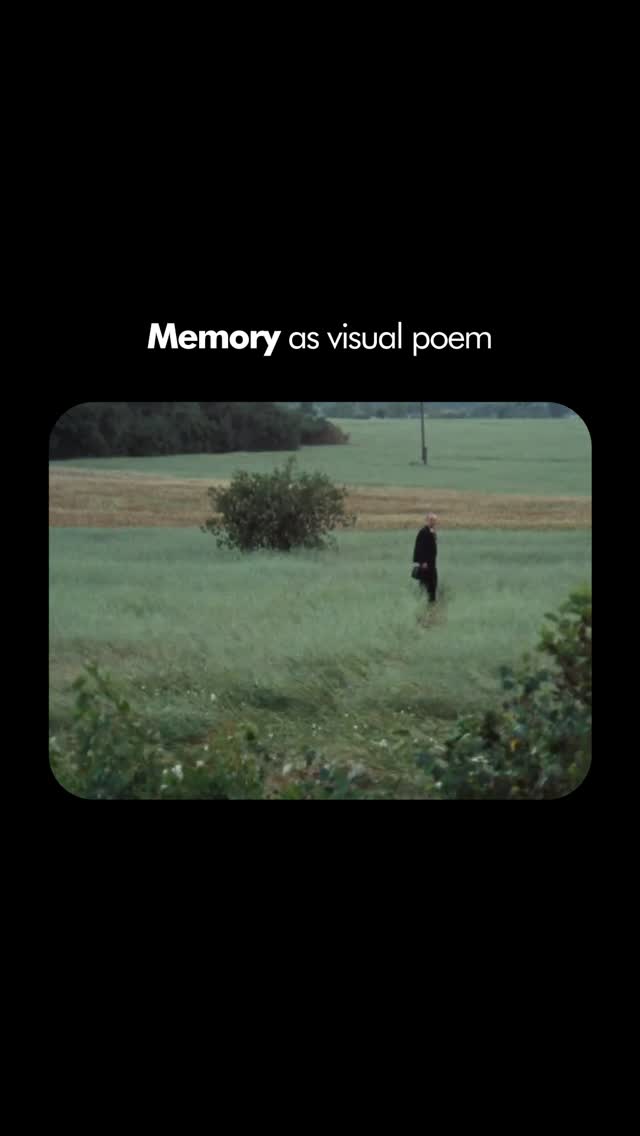
Andrei Tarkovsky’s Mirror (1975) remains one of cinema's most radically personal masterpieces, a hypnotic meditation on memory, guilt, and Soviet history. Yet, much of the film’s breathtaking visual transcendence belongs to cinematographer Georgy Rerberg. Rerberg, whose tempestuous collaboration with Tarkovsky produced some of the most haunting imagery in film history, approached the camera not merely as a recording device, but as a vessel for interior consciousness.
To translate Tarkovsky’s fragmented recollections into light, Rerberg rejected classical narrative visual logic. Instead, past and present seamlessly dissolve into one another, anchored by Margarita Terekhova’s dual performance as both the protagonist’s mother and wife. The camera glides through space with effortless fluidity, rendering childhood memories with the exact visual texture of a fever dream.
Capturing the Texture of Memory
Achieving this dreamlike state required a delicate approach to color science and film stocks. Rerberg navigated the technical limitations of Soviet Sovcolor and imported Kodak film stocks, intercutting vibrant color sequences with high-contrast black-and-white and muted sepia tones. The transition between these stocks was not arbitrary; it dictated the emotional temperature of time itself. B&W sequences feel grounded in historical reality, while color captures the hyper-vivid, subjective nature of childhood perception.
Lighting in Mirror is almost entirely motivated by natural elements. Rerberg eschewed heavy studio key lights in favor of soft, diffused window light, bounce boards, and long-exposure natural daylight. Indoors, practical light sources, burning oil lamps, shafts of sunlight breaking through wooden slatted walls, create deep chiaroscuro, illuminating moist textures of peeling wallpaper, damp wood, and pooled water.
The Practical Poetry of Element and Motion
Rerberg did not simply illuminate a set; he rendered time tangible, treating light and wind as physical extensions of the inner psyche.
Tarkovsky’s concept of sculpting in time found its ultimate expression in Rerberg's patient lens. Nowhere is this clearer than in the iconic scene where a sudden breeze sweeps across a field of buckwheat toward the camera. In an era long before digital visual effects, this was not a mechanical trick. Rerberg and Tarkovsky waited hours on set for the atmosphere to shift naturally, capturing the real wind as it rippled through the landscape like a spirit moving across the earth.
Similarly, the film's famous levitation sequence relies on pure practical craft and precise framing. Without relying on obvious wire removals or modern optical trickery, Rerberg used subtle camera tracking and elevated rig mechanics, combined with soft overhead lighting, to render the levitation deeply physical yet totally unexplainable. The restraint in camera movement leaves the audience suspended in awe alongside the subject.
A Masterclass in Visual Rhythm
The camera movement in Mirror is deliberate, slow, and hypnotic. Operating primarily with spherical lenses on 35mm formats, Rerberg maintained a shallow depth of field during close-ups while opting for deep focus during expansive exterior shots. His slow tracking shots, moving slowly past rain-slicked trees, burning barns, and quiet domestic spaces, allow the viewer’s eye to wander and absorb every detail of the frame.
Though Rerberg and Tarkovsky ultimately clashed during the initial attempt at filming Stalker, their work on Mirror remains an extraordinary benchmark in cinematic history. Rerberg’s mastery of organic lighting, texture, and visual pacing set a standard that continues to inspire modern masters like Emmanuel Lubezki, Roger Deakins, and Robert Richardson. To watch Mirror is to see memory itself rendered in 35mm grain.
This article contains affiliate links. We may earn a small commission at no extra cost to you. Learn more.