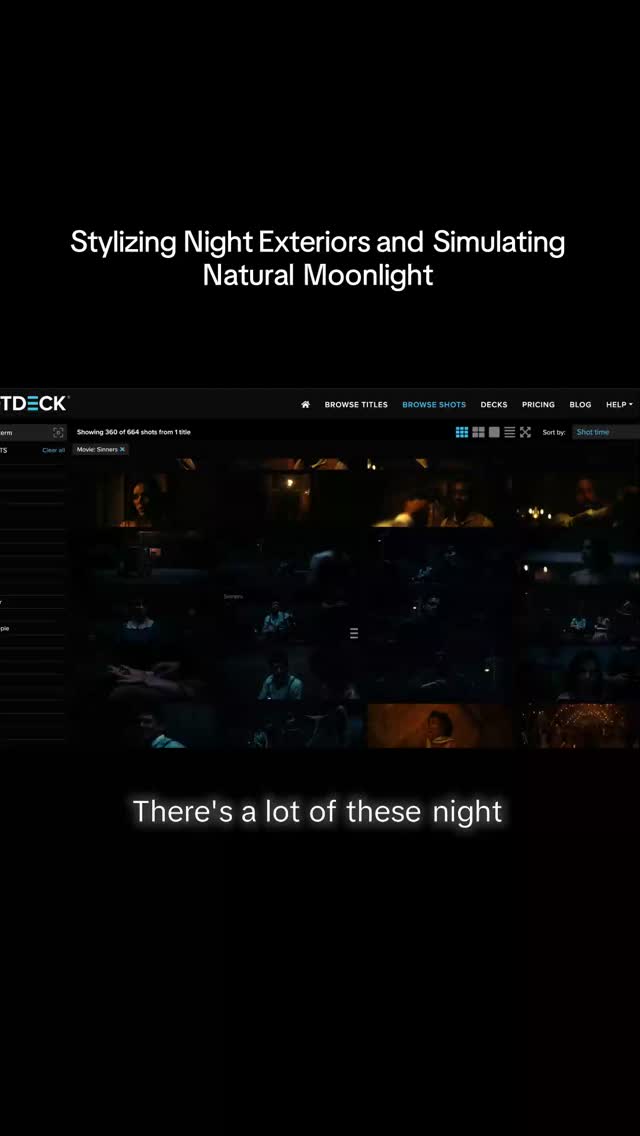
Executing a night scene that feels anchored in reality while maintaining visual elegance is one of cinematography’s ultimate tests. For decades, the industry defaulted to the classic high-contrast blue backlight, a stylized convention that quickly signaled "night" to audiences, even if it bore little resemblance to natural human vision. Today’s cinematographers are moving far beyond those artificial conventions, embracing a sophisticated balance of organic ambient bases and deliberate, character-driven lighting accents.
The shift toward hyper-naturalistic night exteriors has been accelerated by modern sensor technology. Cameras like the ARRI ALEXA 35 and the Sony Venice 2 offer extraordinary dynamic range and clean exposure latitude at higher ISOs. This enables Director of Photography to treat moonlight not merely as a decorative rim light from behind, but as the true, wrapping key source of the frame.
Engineering the Lunar Key: Rigs and Color Temp
Constructing a believable moonlit environment across a large location requires immense structural logistics. To avoid the harsh point-source shadows of single hard fixtures, gaffers and DPs build massive overhead softboxes, often suspending 20x20 or 40x40 diffusion frames housing banks of ARRI SkyPanel S360-Cs or Creamsource Vortex8 units from 100-ton construction cranes. By diffusing the output from a high altitude, the light drops off naturally across the landscape, wrapping talent in a soft, non-directional glow.
Color temperature strategy is equally critical. Rather than pushing fixture output to an unnatural 6000K daylight blue, many cinematographers dial their ambient rigs closer to 4000K or 4300K. When balanced against warm tungsten practicals, such as gas lamps, campfires, or interior practical bulbs set to 2200K, this subtly desaturated cool base creates a painterly color contrast without feeling artificially tinted.
True night photography isn’t about showing everything in the frame; it’s about choosing precisely what the audience is allowed to discover in the dark.
Embracing the Obscured: Texture and Negative Fill
In period pieces or atmospheric thrillers, the natural impulse to illuminate a actor's face must often be suppressed. Cinematographers like Bradford Young and Roger Deakins have demonstrated the psychological power of letting shadows take control. By utilizing heavy negative fill, flooring the set with solid black duvetyn to soak up ambient bounce, light can be carved away, deliberately obscuring a character's eyes or casting entire profiles into silhouette.
This texture creates an immediate narrative intimacy. When an audience is forced to lean in and read an actor’s performance through subtle body language or the glint of a single eye-light, the scene gains emotional weight. The shadows become an active character in the frame, reflecting internal conflict, isolation, or impending danger.
Optical Character and Color Science in Low Light
Optics play an indispensable role in how night scenes render on screen. Shooting wide open on vintage glass, such as Cooke Speed Panchros or high-speed Leica Summilux-Cs, introduces subtle spherical aberrations, flare characteristics, and focus falloff that soften the digital edge of modern sensors. These optical imperfections mimic how the human eye perceives low-light environments, adding a tactile, organic grain to dark frames.
Ultimately, executing memorable night cinematography relies on artistic restraint. By combining industrial-scale lighting rigs with an unwavering commitment to negative space, cinematographers transform simple low-light exposures into immersive, highly textured visual worlds.
This article contains affiliate links. We may earn a small commission at no extra cost to you. Learn more.