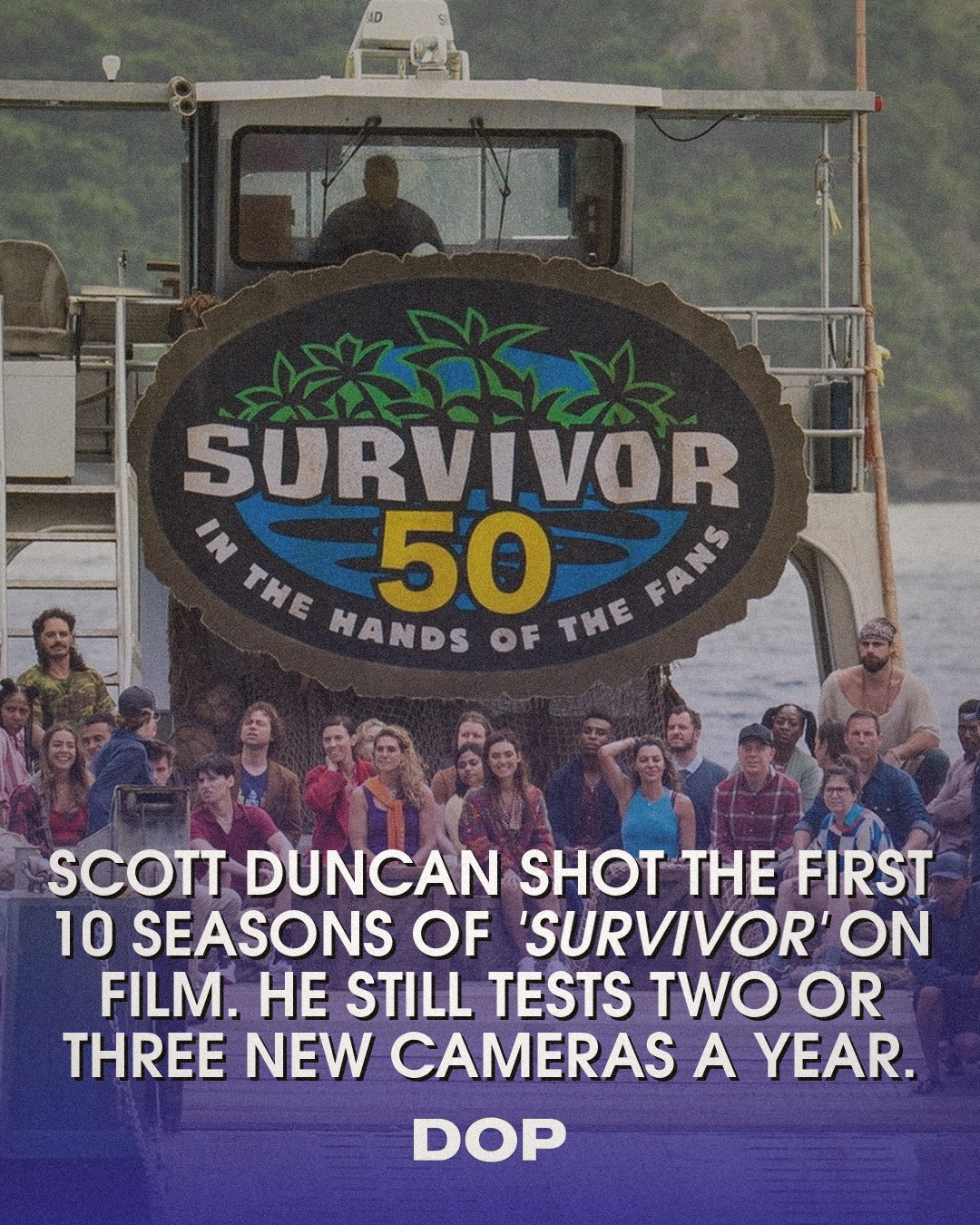
When unscripted television first entered the cultural consciousness at the turn of the millennium, it rarely carried the visual pedigree of prestige narrative drama. Scott Duncan changed that calculus almost immediately. Earning an Emmy nomination for Survivor 50, Duncan has spent over a quarter of a century pioneering a cinematic aesthetic in one of the most unforgiving production environments on television. His journey from running 16mm and 35mm film stock on tropical beaches to deploying state-of-the-art large-format digital sensors represents a masterclass in visual endurance and technical evolution.
From Motion Picture Stock to Digital Pioneer
During the seminal first decade of Survivor, Duncan committed to celluloid to establish a visual language that felt mythic rather than disposable. Handheld 16mm cameras like the Aaton XTR and Arriflex 16SR series were routinely subjected to salt spray, torrential rain, and blazing equatorial sun. The inherent grain structure, organic highlight roll-off, and photochemical color response lent the series an archival, documentary weight that separated it from the sterile multi-cam broadcasts of its era.
As digital cinema sensors matured, Duncan refused to treat the shift as merely a logistical convenience. Instead, he treated digital adoption as an evolving laboratory. Balancing the high dynamic range required for unforgiving mid-day tropical sun with the extreme sensitivity needed for pitch-black night challenges necessitated constant optical and sensor evaluation.
Every year, I try to bring two or three new cameras to test, even if it's going to be three or four seasons before I start actually using them.
The Perpetual R&D of Island Cinematography
Duncan’s ritual of bringing upcoming camera bodies into the field years before their formal deployment is what keeps the production visually ahead of the curve. Testing camera systems under real-world thermal stress, high-humidity salt air, and sudden tropical deluges reveals performance realities no studio benchmark can replicate. Whether evaluating the dual-native ISO performance of modern Sony CineAlta cameras or stress-testing the dual-gain output of ARRI sensors, Duncan looks for organic color science that flatters varied skin tones under shifting ambient conditions.
Lens choices are equally calculated. Duncan pairs modern sensors with glass that softens clinical digital sharpness, relying on premium cinema zooms with robust weather sealing alongside vintage primes modified for field operation. The goal remains consistent with his film roots: preserving micro-contrast and rich chromatic rendition while taming harsh, specular tropical highlights.
Painting with Fire: The Blood Moon Tribal Council
Perhaps nowhere is Duncan’s cinematographic signature more evident than in the show’s legendary Tribal Council sequences. Unlike the dynamic run-and-gun daylight challenges, Tribal Council operates as a tightly controlled, mood-driven drama. Balancing genuine torchlight, burning at roughly 1800K to 2200K, against modern, low-profile LED fixtures requires precise exposure and color temperature orchestration.
For the acclaimed Blood Moon Tribal Council on Survivor 50, Duncan dialed in a striking crimson palette that pushed the visual language beyond naturalism into operatic tension. By pairing subtle optical filtration with custom show LUTs calibrated specifically for deep shadow retention and chromatic separation in the red channel, Duncan elevated a reality elimination into pure visual theater. It stands as a testament to a cinematographer who, twenty-six years in, refuses to stop experimenting.