Since their earliest collaboration on 1996’s Bottle Rocket, cinematographer Robert Yeoman, ASC, and director Wes Anderson have forged one of the most rigorously stylized partnerships in modern cinema. From the muted, nostalgic 35mm frames of The Royal Tenenbaums to the pastel dioramas of The Grand Budapest Hotel and the sun-bleached desert expanses of Asteroid City, their signature visual grammar is immediately identifiable. Yet behind the whimsical symmetry and locked-off tableaus lies an exacting, almost architectural approach to cinematography that leaves zero room for error.
The Calibrated Discipline of Planimetric Framing
Achieving Anderson’s iconic planimetric framing is not a matter of casual compositional intuition; it is an exercise in applied geometry. On set, Yeoman and his camera team routinely pull physical tape measures from the film plane and the matte box to the far corners of the practical set to guarantee that the camera sits dead center along the room’s geometric axis. Crosshairs on monitors and physical tape markings on matte boxes guide operators down to the millimeter, ensuring the optical axis bisects the frame with absolute mathematical parity.
This pursuit of symmetry dictates lens selection and camera platform discipline. While Yeoman has historically favored 35mm film stock, frequently relying on Kodak Vision3 200T 5213 and 500T 5219, the glass choice must balance optical character with geometric rectilinearity. When shooting spherical, Yeoman often reaches for Cooke S4 or Master Prime lenses to prevent edge-to-edge optical distortion that would otherwise bend the hard vertical lines of production designer Adam Stockhausen’s meticulously built sets.
“We run tape from the matte box to the exact corners of the architecture. In Wes’s frame, there is no such thing as an approximate center.”
The Mechanics of the 90-Degree Pan
Movement within this visual system is just as calculated as stillness. Anderson’s narrative transitions famously rely on hard lateral tracking moves and instantaneous whip pans that must stop dead on a specific narrative subject. These shots are not corrected in post-production; they are physically executed in-camera. Sets are constructed around the optical throw of the lens, matching the focal length so that a rapid 90-degree gear-head swing lands precisely with a practical window or doorway framing the subject.
This requires immense physical coordination between Yeoman’s camera operators, dolly grips, and focus pullers. Operating on gear heads rather than fluid heads provides the mechanical repeatability required to hit hard end-stops without bouncing the frame. Focus pullers work with pre-measured witness marks corresponding to the geometric grid of the set, pulling focus through rapid spatial shifts without the luxury of hunting or depth-of-field forgiveness.
Diplomacy, Stardom, and the Politics of Light
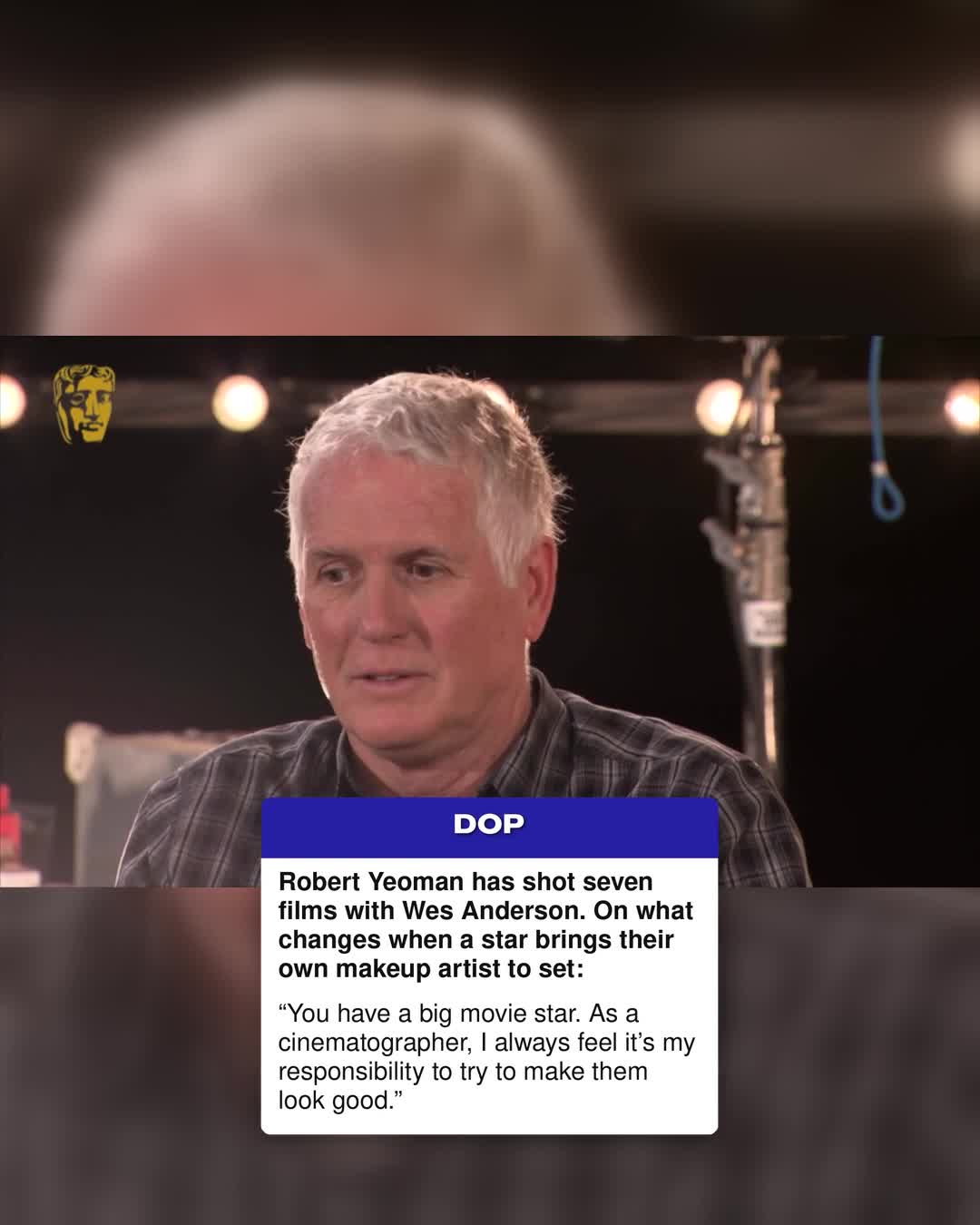
Yet for all the mechanical rigor of Anderson’s diorama-like sets, filmmaking remains an inherently human and unpredictable medium. When high-profile ensemble casts step into these hyper-controlled environments, the clinical precision of the frame intersects with the realities of star portraiture. A legendary actor arriving with an entrenched personal makeup entourage changes the diplomatic calculus on set, demanding that lighting setups subtly adapt to soften aging features without breaking the director's strict visual schema.
Yeoman approaches these moments not with frustration, but with the quiet professionalism of a veteran master. Balancing Anderson’s preference for high-key, planar lighting, often achieved through large diffused overhead softboxes and bounce sources, with flattering facial portraiture requires nuanced micro-adjustments. Yeoman deftly tucks subtle eye lights, unbleached muslin bounces, or low-profile LED ribbons just outside the active frame line to wrap light gently around an actor's face, preserving their screen presence while maintaining the director’s pristine architectural contrast.
The Quiet Master Behind the Frame
What makes Robert Yeoman’s work so enduring is not merely his ability to execute an exacting visual mandate, but his capacity to infuse rigid technical systems with warmth and human texture. In an era increasingly dominated by virtual production and digital post-stabilization, Yeoman’s tactile, tape-measured discipline serves as a masterclass in the power of physical in-camera craft.
This article contains affiliate links. We may earn a small commission at no extra cost to you. Learn more.