Few visual languages in contemporary cinema are as immediately recognizable, or as ruthlessly unforgiving, as the one forged by director Wes Anderson and cinematographer Robert Yeoman, ASC. From the scrappy, wide-angle 16mm origins of Bottle Rocket to the pastel-baked, anamorphic deserts of Asteroid City, their multi-decade collaboration has reshaped how the industry thinks about composition. Yet behind the pristine, dollhouse prosceniums lies an extreme operational discipline that pushes camera crews, gaffers, and actors to their absolute mechanical limits.
The Mechanics of Strict Geometry
Achieving Anderson’s hallmark dead-center symmetry is not a casual post-production crop; it is an agonizing optical reality achieved on set. Yeoman’s camera package, frequently centering on the Arricam Studio and Lite 35mm bodies paired with Cooke S4 primes or custom Master Anamorphic glass, is subjected to millimeter-accurate calibration before a single foot of Kodak stock rolls. Camera assistants physically mark matte boxes with tape crosshairs, using laser levels and plumb bobs to align the optical axis precisely with the vanishing point of production designer Adam Stockhausen’s sets.
This architectural synchronization extends directly into camera movement. Unlike traditional setups where blocking dictates the frame, Yeoman’s camera movement is hard-wired into the carpentry. Dolly tracks are laid on milled timber and leveled with machinist precision. Whip pans are not intuitive flourishes; they are rehearsed mechanical arcs calibrated so the shutter lands dead-stop on an exact window pane, door frame, or character’s eyeline without an ounce of drift.
"Every whip pan lands on a millimeter; every frame is a balance between geometric perfection and the organic realities of human performance."
To execute the 90-degree perpendicular tracking shots that define their visual grammar, Yeoman relies heavily on mechanical gear heads over fluid heads, ensuring that rotational axes remain strictly locked at right angles. This formalist rigidity means that even a fraction of an inch of camera sag destroys the optical illusion, demanding endless micro-adjustments from the key grip and A-camera operator.
The Diplomatic Art of Practical Lighting
Yet the hardest challenge on a Wes Anderson set isn’t always the geometry, it is the lighting politics. When working with sprawling ensemble casts composed of Hollywood royalty, the DP must navigate an inevitable friction between high-concept visual formalism and traditional vanity lighting. Anderson famously favors flat, pictorial, naturalistic source lighting, frequently bouncing powerful HMI units through massive muslin frames or utilizing large arrays of practical overhead bulbs to create an evenly illuminated, painterly canvas.
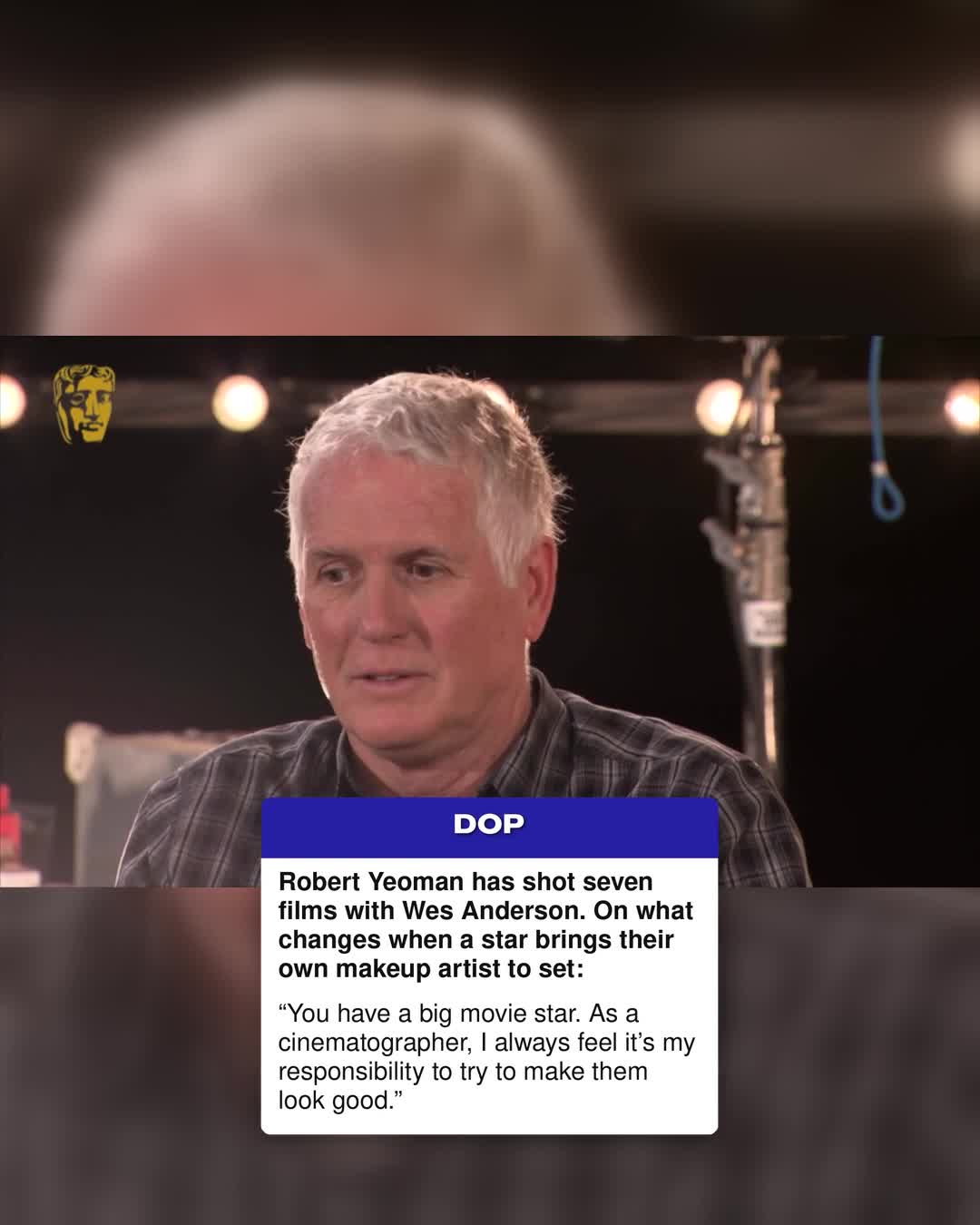
However, when an A-list star arrives with an entourage and a personal makeup artist scrutinizing every shadow and micro-wrinkle from behind the video village, the DP’s job shifts from pure technician to set diplomat. Hard-edged stylistic choices must subtly bend. Yeoman approaches these moments not with artistic indignation, but with the pragmatic calm of a seasoned master.
Soft beauty fills, subtle eye-lights, and localized diffusion frames are seamlessly worked into the rigorous framing without corrupting the broader architectural illumination. A tiny LiteGear LED ribbon tucked invisibly beneath a desk edge or a custom chimera feathered off a practical lamp becomes the silent compromise that protects both the performer’s silhouette and the director’s uncompromising world.
The Craft Beneath the Curio
In an era dominated by handheld cameras, loose coverage, and safety nets built into digital sensor latitude, Robert Yeoman’s methodology remains a testament to deliberate, single-camera intent. Every setup is a commitment. There is no B-camera capturing stray coverage to fix the pacing in post. The frame you see on screen is the only frame that exists.
Ultimately, Yeoman’s genius lies not merely in his ability to center an optical axis or match a color palette, but in his capacity to absorb the immense chaos of human production into a world of absolute, unyielding order. It is cinema built on millimeters, patience, and the quiet mastery of a cinematographer who knows exactly where the tape goes.
This article contains affiliate links. We may earn a small commission at no extra cost to you. Learn more.