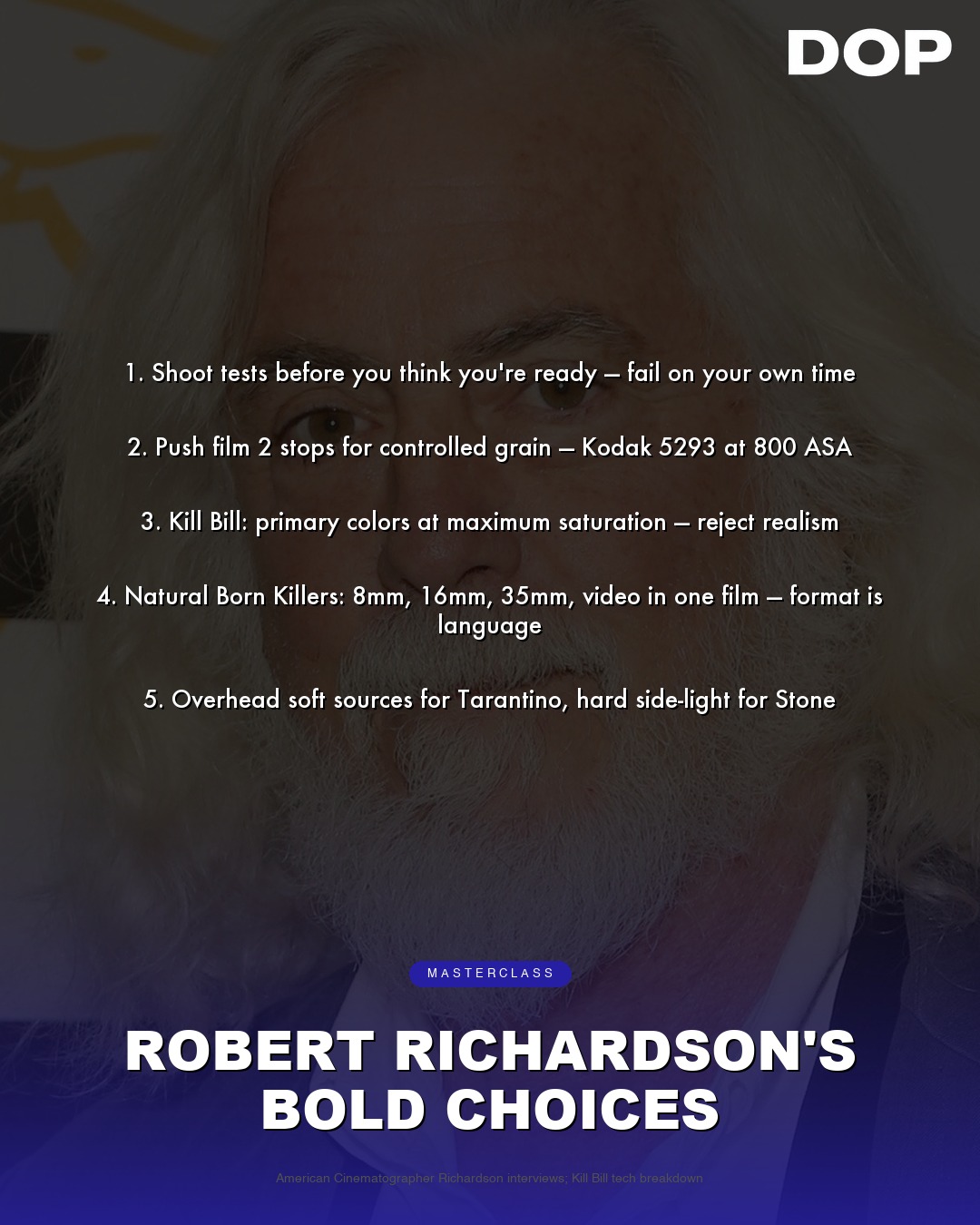
Robert Richardson, ASC, is not just a cinematographer; he is an architect of light and shadow, a master of visual rhetoric whose work consistently challenges and redefines the boundaries of cinematic expression. His filmography reads like a syllabus of modern filmmaking, from the stark monochrome of JFK to the opulent hues of The Aviator, the visceral grit of Platoon to the neo-noir cool of Kill Bill. When Richardson speaks, cinematographers listen, not just for technical tips, but for philosophical insights into the very act of seeing. His recent masterclass wisdom, distilled into five potent points, offers a rare glimpse into the mind of a true visionary, a framework for understanding not just how he shoots, but why.
The first dictum, "Shoot tests before you think you're ready - fail on your own time," is a profound endorsement of experimentation and proactive problem-solving. In an industry often dominated by tight schedules and even tighter budgets, the temptation is to cut corners, to trust in established methods. Richardson, however, advocates for deliberate failure. This isn't about aimless tinkering; it's about controlled exploration. It's about taking that new lens, that unfamiliar lighting fixture, or that unconventional camera movement, and pushing it to its limits in a low-stakes environment. A cinematographer's eye is honed through countless hours of observation and execution, but true mastery comes from understanding not just what works, but the precise conditions under which it might fail. This pre-production rigor ensures that when the pressure is on, every decision made on set is informed by prior, personal experience, not by hopeful conjecture.
The Art of Grain and Contrast
Richardson’s second point, "Push film 2 stops for controlled grain - Kodak 5293 at 800 ASA," immediately transports us to a bygone, yet enduring, era of analog cinematography. While digital has its undeniable merits, Richardson remains a steadfast proponent of film for many projects, understanding its unique textural qualities. Pushing film stock, particularly a classic like Kodak 5293 (now 5219, perhaps, but the principle remains) by two stops, isn't just about gaining sensitivity in low light; it's a deliberate aesthetic choice. It introduces a coarser, more pronounced grain structure, imbuing the image with a raw, tactile quality. This isn't accidental noise; it's sculpted texture, a visual signature that can evoke a specific mood, period, or emotional state. It speaks to a cinematographer who wields the very imperfections of the medium as tools for artistic expression, transforming perceived limitations into stylistic strengths. This technique, often paired with his favored large format cameras and anamorphic lenses, creates a dimensionality that digital often struggles to replicate without extensive post-production.
"Extreme contrast is a position - JFK and Aviator live at opposite ends of the dial."
This statement encapsulates Richardson's philosophy on visual storytelling. Contrast, for him, isn't merely a technical parameter; it's a narrative stance. JFK, with its stark black and white, its jarring cuts, and its often aggressively high-contrast photography, mirrors the film's relentless pursuit of truth amidst conspiracy. The visual language is confrontational, challenging the viewer to scrutinize every shadow, every highlight. Conversely, The Aviator, a vibrant, meticulously color-graded spectacle, uses its rich, often saturated palette and deliberate, sometimes lower, contrast to evoke the Golden Age of Hollywood and Howard Hughes's increasingly opulent yet fractured reality. The choice of film stocks (often Kodak Vision3 series) and processing, coupled with his masterful use of filtration and carefully controlled lighting ratios, allows him to dial in the precise level of contrast needed to serve the story. He understands that the dynamic range of a camera, whether film or digital, is merely a canvas for his expressive intent.
Color as Conflict, Eyes as Soul
Richardson's insight, "Mixed color temperatures as conflict - warm and cool fighting in the same frame," reveals his nuanced understanding of color theory as a dramatic device. Many cinematographers strive for color harmony, but Richardson often embraces discord. The clashing of warm tungsten light against cool practicals, or the steely blue of moonlight against the amber glow of a distant lamp, isn't accidental. It creates a visual tension, a subtle unease that can underscore emotional conflict, psychological turmoil, or even literal danger within a scene. This technique is particularly effective in films like Inglourious Basterds or Shutter Island, where the visual environment actively participates in the characters' internal struggles. It’s a sophisticated application of color science, moving beyond mere mood-setting to active narrative contribution, often achieved through meticulous gelling of units and careful consideration of ambient sources.
Finally, the most profound and perhaps most essential piece of advice: "Light the eyes, not the face - if the eyes don't read, nothing else matters." This isn't just a technical directive; it's a credo for empathetic cinematography. The eyes are the windows to the soul, the primary conduit for human emotion. A perfectly lit face with dead, unreadable eyes is a wasted effort. Richardson, whether working with the harsh, direct light of a prison cell or the soft, diffused glow of a romantic encounter, prioritizes catching that crucial glint, that spark of life in the subject's gaze. This often involves intricate kicker lights, carefully placed reflectors, or even the subtle bounce from an actor's wardrobe. It’s a testament to his understanding that ultimately, cinematography serves character and story. Without that connection to the human element, all the technical prowess in the world is moot. This ethos is evident across his oeuvre, from the piercing stares in Born on the Fourth of July to the haunted gazes in The Hateful Eight.
Robert Richardson's masterclass wisdom is more than a list of techniques; it's a philosophy of filmmaking. It's an invitation to be bold, to experiment, to understand the emotional resonance of every technical choice, and to always, always prioritize the human story. His work, consistently shot on a variety of cameras from Arri to Panavision, and with lenses ranging from Cooke to Panavision glass, always maintains a distinctive visual fingerprint because it's rooted in these fundamental principles. For aspiring DPs and seasoned veterans alike, these five points serve as a powerful reminder that true mastery lies not just in knowing the tools, but in understanding the profound impact of their deliberate, artistic application.
This article contains affiliate links. We may earn a small commission at no extra cost to you. Learn more.