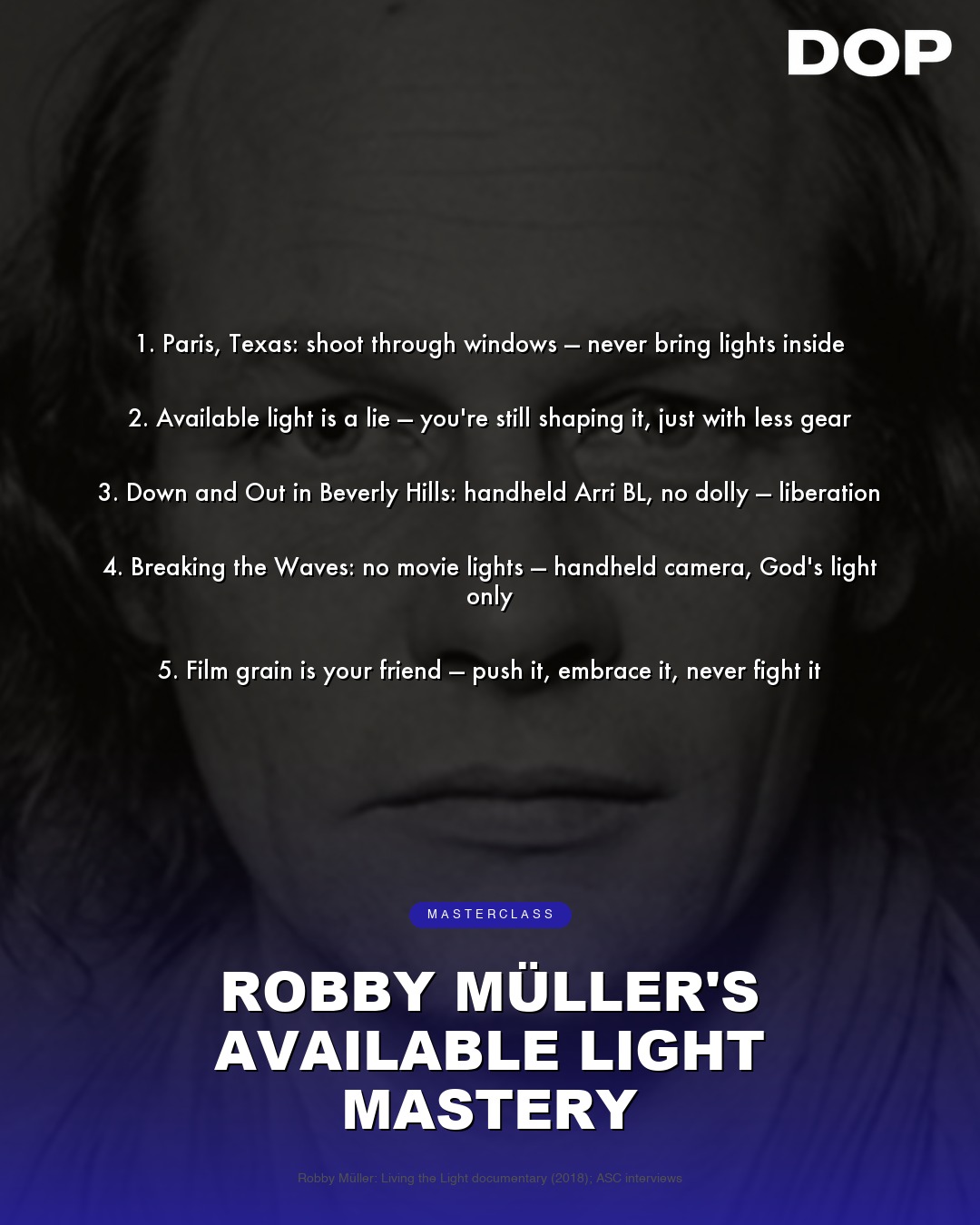
In the pantheon of cinematographic legends, Robby Müller stands as a titan, a master whose work with directors like Wim Wenders, Jim Jarmusch, and Lars von Trier forged an indelible visual language. His approach, often characterized by its profound naturalism and seemingly effortless beauty, was far from accidental. It was the result of a deeply philosophical engagement with light, space, and the very act of seeing. An Instagram post recently distilled some of Müller's 'masterclass wisdom,' offering a tantalizing glimpse into the mind of a cinematographer who consistently pushed the boundaries of what was considered possible with available light. For the DPs and ardent cinephiles among us, these five tenets are not mere aphorisms; they are profound insights into a craft elevated to art.
The Art of 'Available' Light: More Than Meets the Eye
Müller's first dictum, 'Paris, Texas: shoot through windows - never bring lights inside,' immediately challenges conventional wisdom. In a world often dominated by elaborate lighting setups and massive grip trucks, Müller advocated for a radical simplicity. This wasn't laziness; it was a deliberate choice to honor the inherent qualities of a space. Shooting through windows for films like Paris, Texas (1984) meant embracing the natural directionality and quality of exterior light. The resulting light often feels more organic, more integrated into the scene's emotional fabric. It's a testament to his belief that the environment itself holds the key to authentic illumination, a philosophy that informed his work with Wenders on films like The American Friend (1977) and Wings of Desire (1987), where urban landscapes and natural light sources became active participants in the visual narrative.
"Available light is a lie - you're still shaping it, just with less gear."
This brings us to Müller's second, and perhaps most revealing, statement: 'Available light is a lie - you're still shaping it, just with less gear.' This isn't a cynical dismissal of the concept but a sophisticated acknowledgment of the cinematographer's role. Even when working with existing light, the DP is an active participant, manipulating reflections, blocking unwanted sources, or adding subtle bounces to sculpt the light to their will. It's a dance of observation and subtle intervention. Think of his work on Jarmusch's Down by Law (1986), where the stark prison interiors and murky Louisiana swamps were rendered with a painterly precision, often using minimal units to augment or redirect the existing ambient light rather than overpower it. This philosophy emphasizes understanding light's properties rather than simply creating it from scratch. It's about being a conductor, not just a composer.
Embracing the Unconventional: Overcast and Off-Center Truths
Müller's third piece of advice, 'Overcast is an asset - diffused sky is the largest softbox ever built,' is a rallying cry for embracing conditions often dreaded by less experienced DPs. While many crave the dramatic chiaroscuro of direct sunlight, Müller saw the inherent beauty and utility in an overcast sky. This natural diffusion provides an incredibly soft, even, and flattering light that wraps around subjects, minimizing harsh shadows and creating a sense of serene realism. For a film like Dead Man (1995), shot in stark black and white, the soft, melancholic light of an overcast sky would have been invaluable, providing a consistent, atmospheric base that allowed the textures and subtle tonal gradations to sing.
The fourth tenet, 'Edge of frame is where truth lives - don't center everything, let the edges breathe,' speaks to a deeper understanding of composition and human perception. Müller was not afraid of negative space, of allowing elements to fall partially out of frame, or of placing subjects off-center. This technique creates a more dynamic and believable frame, mimicking how we naturally experience the world. Our gaze is rarely fixed squarely on a single subject; our peripheral vision and the surrounding environment constantly inform our understanding. This compositional philosophy imbues his films with a sense of observational realism, inviting the audience to actively engage with the frame rather than passively consume a perfectly balanced, often artificial, image. Consider the wide, unvarnished landscapes of Paris, Texas, where characters are often small figures within vast, expansive frames, their struggles amplified by the sheer scale of their surroundings.
The Power of Patience and Observation
Finally, Müller’s fifth and perhaps most profound piece of wisdom: 'Patience over power - wait for the light to become what the scene needs.' This encapsulates the essence of his approach. In an industry often driven by speed and the immediate gratification of 'fixing it in post,' Müller championed a more contemplative, almost meditative process. It's about observing, understanding the natural rhythms of light, and recognizing that sometimes the most powerful tool a cinematographer possesses is the willingness to wait. This patience allows for moments of serendipitous beauty, for light that feels utterly authentic because it is authentic to that time and place. This isn't about being passive; it's about being acutely attuned to the environment and having the foresight to anticipate and harness its natural gifts.
Robby Müller’s legacy is not just in the beautiful images he captured but in the philosophy he espoused. His work, often shot on film with cameras like the Arriflex 35BL and a preference for naturalistic lens choices, demonstrates a profound respect for the medium and the world it captures. He proved that sometimes, the most sophisticated cinematography is achieved not by adding more, but by understanding what’s already there and shaping it with intention, patience, and an unwavering artistic vision. His 'available light mastery' wasn't about avoiding work; it was about working smarter, deeper, and with an artist's soul, leaving us with a body of work that continues to inspire and challenge our perceptions of cinematic possibility.