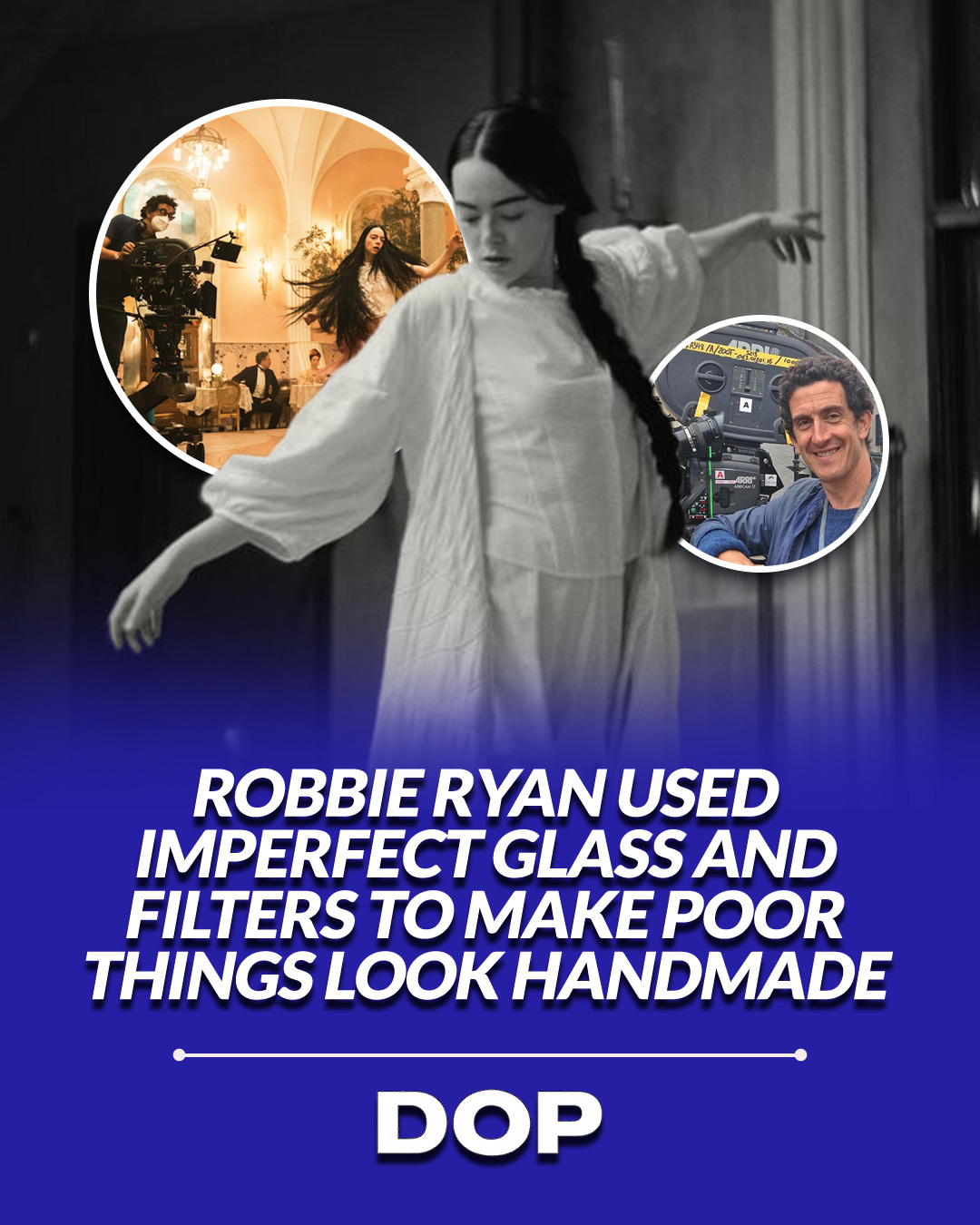
In an era dominated by hyper-sharp digital sensors and immaculate post-production cleanup, cinematographer Robbie Ryan, BSC, ISC, chose a radically different path for Yorgos Lanthimos' Victorian gothic fantasy, Poor Things. Following their acclaimed collaboration on The Favourite, Ryan and Lanthimos pushed the boundaries of visual expressionism by turning optical flaws into their primary narrative driver. Rather than relying on digital visual effects to construct a surreal universe, Ryan leaned heavily into extreme lens character, film emulsion, and in-camera aberrations.
The visual language of Poor Things is defined by its refusal to be clean. Ryan utilized a eccentric cocktail of vintage glass, including modified Petzval lenses customized by Vantage, an extreme Optex 4mm fisheye, and Lomography optics adapted for 35mm film cameras. These lenses introduce pronounced field curvature, extreme edge-vignetting, and a swirly, disorienting bokeh that physically bends the world around the protagonist, Bella Baxter. As Bella’s mind expands, the optics respond, mirroring her psychological awakening with dramatic visual texture.
Embracing the Flaws of the Glass
For DPs raised on pristine modern prime sets, Ryan’s approach is a thrilling provocation. The Petzval lenses, originally designed in the 19th century for portraiture, create a razor-thin plane of focus at the center while smearing the edges into a halo of chromatic aberration and blooming highlights. Bright practical lights don't just register on the negative; they bleed, halate, and glow with a tactile warmth that digital filtration rarely replicates authentically.
Instead of treating lens aberrations as mistakes to be corrected in post, we let the glass dictate the boundary between sanity and surrealism.
To capture this, Ryan shot on 35mm film using ARRICAM ST and LT bodies, incorporating Kodak Vision3 500T 5219 and 250D 5207 stock alongside reversible Kodak Ektachrome 100D, which was cross-processed in E-6/C-41 chemistry for intense color saturation and stark contrast. This commitment to committing the look directly to the camera negative ensured that the tactile, physical nature of the optic was locked in forever, stripping away the safety net of secondary color grading manipulation.
Constructing Reality Through the Viewfinder
The interaction between lens choice and set design in Poor Things offers a crucial lesson in world-building. Shipped onto massive stages at Origo Studios in Budapest, the grand, theatrical sets were illuminated using traditional tungsten fixtures and large soft sources to maintain a theatrical atmosphere. When framed through an extreme wide or distorted lens, the painted backdrops and sculpted architecture feel less like artificial movie sets and more like a feverish, storybook pop-up world.
Rather than hiding the constructed nature of Lanthimos' universe, Ryan's framing and optical choices celebrate it. The optical vignetting creates a natural iris effect, reminiscent of silent cinema techniques, locking the viewer into Bella's immediate point of view. It serves as a reminder that world-building is not simply a matter of scale or CGI fidelity, but of texture, texture, and perspective.
For contemporary cinematographers, Robbie Ryan’s work on Poor Things is a masterclass in optical storytelling. It proves that characterful glass, physical film stocks, and a willingness to embrace optical chaos can craft a world far more immersive and emotionally resonant than any clean, digitally manipulated frame could ever dream to be.