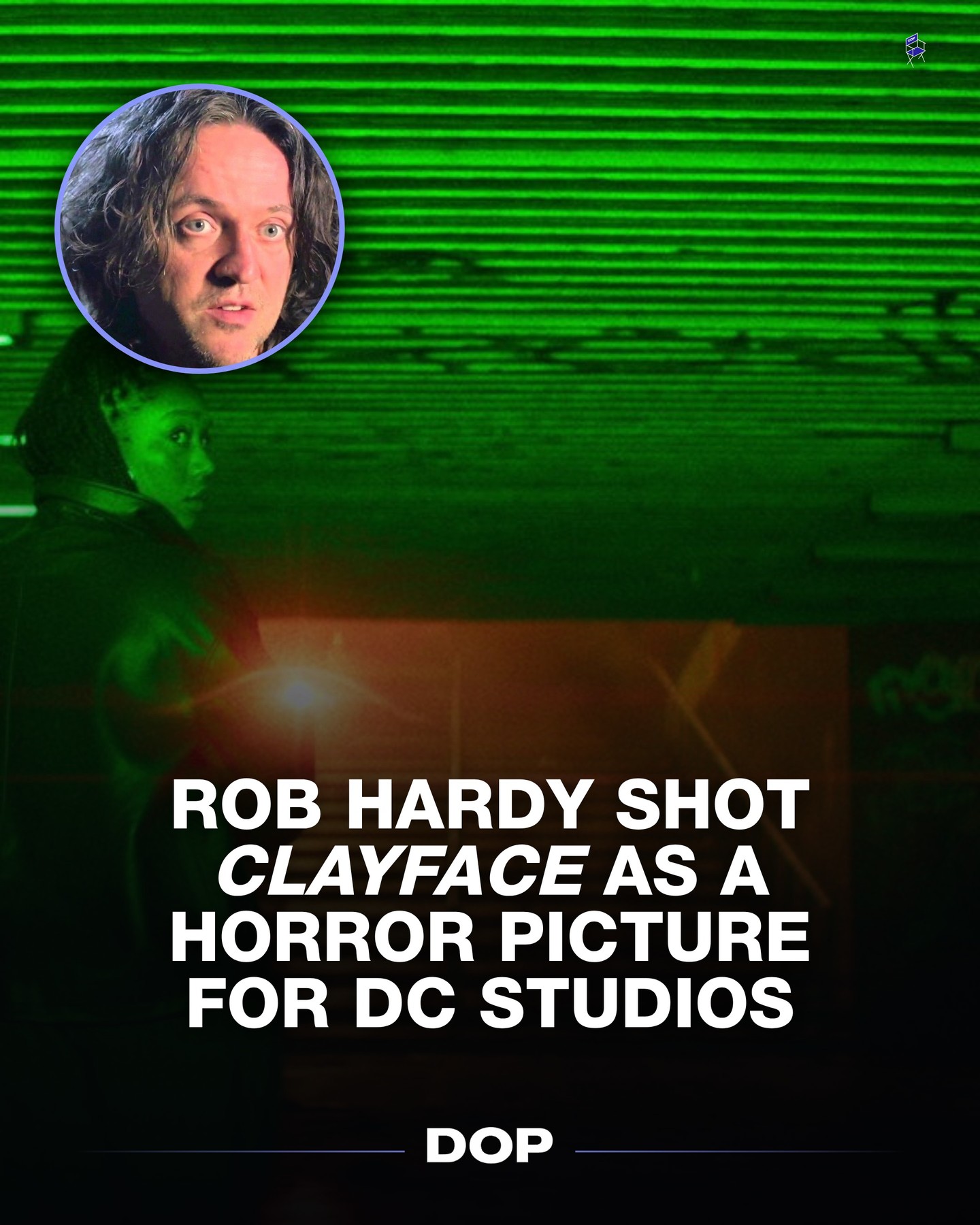
When DC Studios announced that its first explicit horror outing would tackle the tragic, grotesque lore of Clayface, visual storytellers immediately began wondering what visual language could possibly anchor such a malleable monstrosity. Now confirmed to be directed by James Watkins from a screenplay co-written by modern horror titan Mike Flanagan and Hossein Amini, the production has tapped veteran cinematographer Rob Hardy BSC, ASC to construct its psychological and visceral framework.
Hardy’s inclusion signals an uncompromising visual ambition. Known for his masterclasses in controlled tension and tactile, psychological dread, from the clinical geometric paranoia of Ex Machina and the shimmering biological terror of Annihilation to the blistering kineticism of Mission: Impossible, Fallout and Alex Garland's Civil War, Hardy is uniquely equipped to handle a narrative that James Gunn characterized as deeply psychological, grounded, and unapologetically gross body horror.
The Holy Trinity of Influences: Scorsese, De Palma, and Raimi
Watkins has revealed that he and Hardy spent pre-production deep-diving into the cinematic vernacular of Martin Scorsese and Brian De Palma, alongside the unmistakable imprint of Sam Raimi. This is far from casual namedropping; it is an aesthetic blueprint that tells us precisely how the camera will behave in relation to space, character psychology, and terror.
A De Palma influence inevitably points toward aggressive focal dynamics, think deep-focus compositions, split-diopter setups that force two distinct psychological planes into sharp tension, and unhurried, voyeuristic tracking shots. Married with the kinetic, whip-smart energy of Scorsese’s prime camera mobility and Raimi’s unhinged subjective POV tracking, Hardy’s camera will not merely observe the monster; it will participate in the psychological unraveling. The camera itself becomes an active instrument of body horror.
Body horror lives or dies on the tactile interaction between lighting specularities and practical physical textures, demanding a lens package that favors organic grit over digital perfection.
Texture, Viscosity, and the Camera Package
While an official camera and lens package has yet to be published from the stages, Hardy’s previous work offers a fascinating preview of how he approaches organic decay and shifting physical states. Hardy has often leaned on large-format digital sensors, frequently the ARRI ALEXA LF, ALEXA Mini LF, or Sony VENICE, paired with glass that subverts clinical digital sharpness, such as customized Panavision C-Series, T-Series anamorphics, or detuned Tribe7 Blackwing7 primes.
Capturing the tactile nature of Clayface requires a deep understanding of specular highlights, wet surfaces, and prosthetic skin textures. Hardy’s signature lighting approach often balances heavy, motivated practical sources with soft, negative fill and hard, grazing directional accents. On a character whose entire form shifts and melts, grazing edge lights become essential for carving out silhouette and defining the viscous boundaries of flesh in shadow.
Rather than relying on flat, high-key digital illumination often seen in superhero studio output, Watkins and Hardy are likely to lean into deep shadow falloff, textural contrast, and rich color separation. By prioritizing in-camera practical interaction and framing the actor's physical deterioration against harsh environmental architecture, the visual syntax will elevate the character beyond a digital effect into a tragic, tangible nightmare.
Reframing Comic Book Cinema Through Pure Craft
For a studio ecosystem seeking to redefine its cinematic identity under new leadership, hiring a director-cinematographer duo committed to 1970s and 1980s auteur-driven visual techniques is a massive statement. Clayface represents a rare collision where high-concept genre meets uncompromised visual grammar, promising that when the film debuts in October 2026, the real terror will be delivered entirely through the power of the frame.
This article contains affiliate links. We may earn a small commission at no extra cost to you. Learn more.