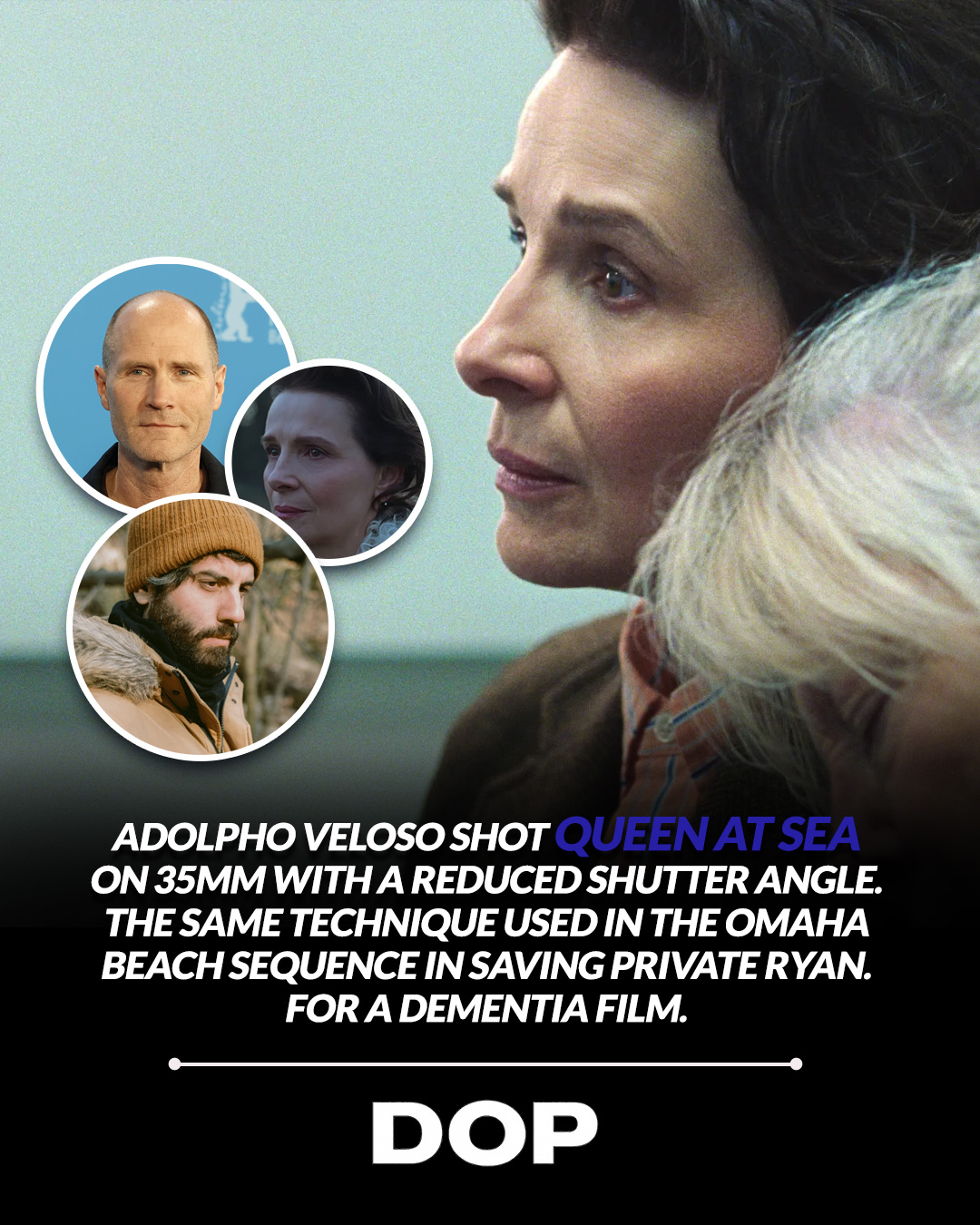
When Adolpho Veloso’s name surfaces in conversation among cinematographers, it’s often accompanied by a nod of recognition for his audacious visual storytelling. His recent triumph, Queen at Sea, winner of the Silver Bear Jury Prize at Berlinale 2026, solidifies his reputation as a master craftsman who isn't afraid to push technical boundaries in service of narrative depth. The film, starring Juliette Binoche as a woman grappling with her mother's dementia, is a masterclass in how precise technical choices can amplify emotional resonance, particularly through Veloso’s deliberate use of a reduced shutter angle.
The decision to shoot Queen at Sea on 35mm film, in itself a statement in an increasingly digital landscape, provided Veloso with a rich, organic canvas. But it’s his application of a reduced shutter angle that truly sets the film apart. This technique, famously employed by Janusz Kaminski in the visceral Omaha Beach sequence of Saving Private Ryan, is typically associated with heightening the intensity of action, creating a staccato, almost disorienting motion blur. To apply this to a film about dementia, as Veloso has done, is an inspired subversion of expectation. As Variety astutely observed, this 'jittery motion blur reduction' makes 'Leslie's interactions with the outside world feel like startling impositions.' It’s a brilliant conceptual leap, translating the internal disquiet and fractured perception of dementia into a tangible visual language.
The Shutter as a Window into Perception
For DPs, the shutter angle is more than just a technical setting; it's a fundamental tool for controlling the depiction of time and motion. A standard 180-degree shutter creates natural motion blur, mimicking how our eyes perceive movement. Reducing that angle, say to 90 or even 45 degrees, shortens the exposure time for each frame, resulting in less motion blur and a sharper, more distinct image for each individual frame. When played back, this creates a slightly strobing, almost hyper-real effect – a jarring quality that can evoke anxiety, urgency, or, in the case of Queen at Sea, the unsettling sensation of a mind struggling to process reality. Veloso doesn't just apply this technique; he weaponizes it, making the audience feel, rather than just observe, the protagonist's fractured experience.
"Veloso doesn't just apply this technique; he weaponizes it, making the audience feel, rather than just observe, the protagonist's fractured experience."
The choice to pair this with 35mm film is crucial. The inherent grain and broader dynamic range of film stock would have softened the potentially harsh edges of the reduced shutter effect, preventing it from feeling overly clinical or digital. Instead, it likely imbues the jarring motion with a certain organic texture, grounding the unsettling visuals in a rich, cinematic aesthetic. We can only speculate about the specific film stocks and lenses Veloso employed, but knowing his meticulous approach, it’s certain they were chosen to complement and enhance this primary visual strategy.
A Multi-Generational Visual Tapestry
What truly elevates Veloso's work in Queen at Sea is not just the brilliance of a single technique, but his overarching visual philosophy for the film. He built 'three distinct visual strategies for three generations in a single London family,' a testament to his deeply analytical and narrative-driven approach to cinematography. This isn't merely about aesthetic variety; it's about using the camera as a character, as an interpreter of internal states across different ages and perspectives.
For the oldest generation, the camera is described as 'predominantly static,' 'like a piece of furniture witnessing routine.' This implies a patient, observational gaze, perhaps with deeper depth of field to emphasize the unchanging surroundings, or a more restrained color palette reflecting a life lived. In stark contrast, the youngest generation is depicted with 'handheld and vivid' cinematography. This suggests a dynamic, energetic visual approach, perhaps employing wider lenses to capture their expansive world, or a more saturated color grade reflecting youthful exuberance. This intentionality, with each technique 'chosen before the first day of shooting,' speaks volumes about Veloso’s preparation and his collaboration with director Lance Hammer. It's a method that allows the visual language to be as integral to the storytelling as the script itself.
Adolpho Veloso, the first Brazilian nominated for an Oscar for Best Cinematography for his work on Train Dreams (also 2026), continues to prove that technical mastery, when wielded with profound artistic intent, can elevate a film far beyond its narrative confines. His work on Queen at Sea is a powerful reminder that cinematography is not just about beautiful images, but about crafting a visual experience that mirrors the complex tapestry of human emotion and perception. It’s a film that will undoubtedly be studied for years to come, offering valuable lessons in how to use the full cinematic toolkit to explore the most challenging of human conditions.
This article contains affiliate links. We may earn a small commission at no extra cost to you. Learn more.