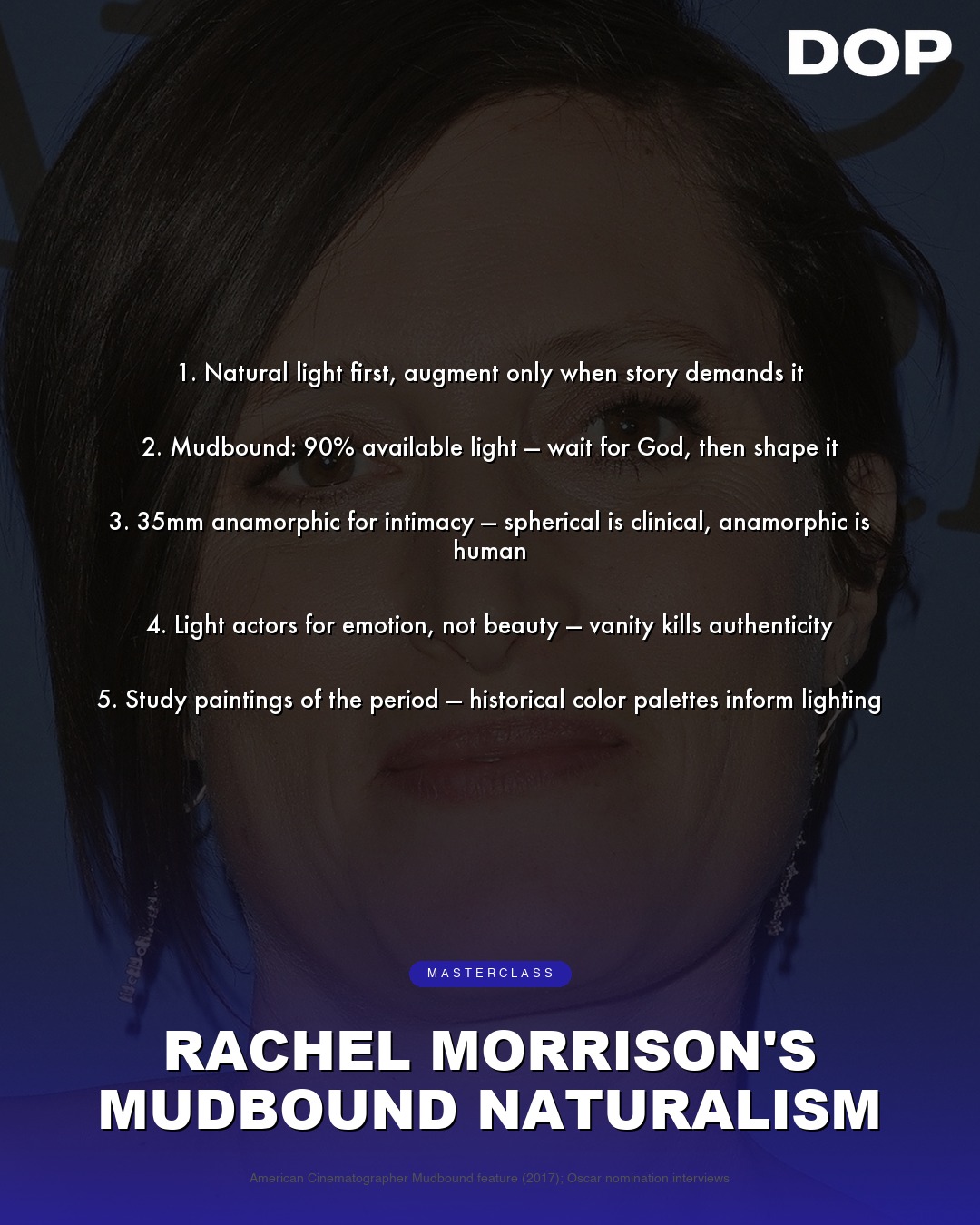
Rachel Morrison, ASC, stands as a titan in contemporary cinematography, her filmography a testament to a deeply humanistic and often raw visual approach. From the sun-drenched, intimate frames of Fruitvale Station to the expansive, visceral landscapes of Black Panther, Morrison consistently imbues her work with an authenticity that resonates. Her insights, particularly regarding her groundbreaking work on Dee Rees's Mudbound, offer a masterclass in leveraging naturalism to elevate narrative, principles that every aspiring and established DP would do well to internalize.
At the heart of Morrison's philosophy, especially evident in Mudbound, is an unwavering commitment to natural light. Her mantra, 'Natural light first, augment only when story demands it,' isn't merely a preference; it's a profound artistic statement. In an era where DPs often battle the elements with an arsenal of powerful units, Morrison champions observation and patience. For Mudbound, a film drenched in the oppressive beauty of the Mississippi Delta, she famously declared that 90% of the film was shot with available light. This wasn't a limitation but a liberation, a deliberate choice to 'wait for God, then shape it.' It speaks to a deep respect for the environment, allowing the sun, the sky, and the natural reflections to dictate the mood, creating an organic realism that artificial sources, no matter how skillfully placed, often struggle to replicate.
The Art of Organic Movement and Exposure
Morrison's approach extends beyond light into the very mechanics of camera operation. Her distinction between 'handheld intimacy versus tripod authority' is a powerful reminder that camera movement is not just a technical decision but a profound narrative one. Handheld work, often associated with a sense of immediacy and character perspective, allows for a visceral connection, pulling the audience into the emotional core of a scene. The subtle sway, the human breath behind the lens, can transform a static moment into a lived experience. Conversely, the deliberate, often majestic movements afforded by a tripod or dolly can establish grandeur, authority, or a more detached, observational tone. Morrison's mastery lies in her ability to wield these choices with surgical precision, ensuring that the camera's presence always serves the emotional and thematic demands of the story.
"Latitude over perfection - expose to protect information, not to deliver a grade. Every source in the scene should feel like it belongs there."
Another cornerstone of Morrison's methodology, particularly crucial for the challenging conditions of Mudbound, is her emphasis on 'latitude over perfection.' This speaks directly to the technical craft of exposure. In a world increasingly obsessed with pristine, 'perfect' images, Morrison advocates for a more pragmatic and intelligent approach: expose to protect information, not to deliver a grade. This means understanding the capabilities of your sensor – in Mudbound's case, often the ARRI Alexa XT – and utilizing its dynamic range to capture maximum detail in both highlights and shadows. It's about preserving the nuances of reality, knowing that the final 'look' will be sculpted in post-production. This philosophy prevents blown-out whites or crushed blacks, ensuring that the visual story remains intact even in extreme lighting scenarios, providing the colorist with the richest possible canvas.
The Community of Light and Visual Authenticity
Morrison's concept of a 'community of light' is particularly insightful. She stresses that 'every source in the scene should feel like it belongs there.' This isn't just about avoiding anachronistic lighting; it's about creating a cohesive, believable world where light sources interact harmoniously. Whether it's the warm glow of a kerosene lamp, the dappled sunlight filtering through a window, or the stark illumination of a bare bulb, each source must contribute to the overall visual tapestry without drawing undue attention to itself. This requires meticulous planning, a keen eye for practicals, and an understanding of how light behaves in a given environment. It's the difference between lighting a scene and making a scene feel authentically lit.
For Mudbound, shot on the ARRI Alexa XT with Panavision anamorphic lenses, this meant embracing the inherent character of the glass and the sensor's ability to render skin tones beautifully under challenging, often low-light conditions. The anamorphic format itself lent a sweeping, epic quality to the landscapes while simultaneously creating an intimate, almost voyeuristic feel in close-ups, blurring the line between the personal and the panoramic. The choice of anamorphic also influences depth of field and bokeh, contributing to the film's distinct visual texture.
Rachel Morrison’s work on Mudbound is a masterclass in restraint, observation, and intentionality. It reminds us that the most powerful images often emerge not from an abundance of gear, but from a profound understanding of light, movement, and the story’s emotional core. Her principles serve as a guiding light for cinematographers seeking to craft images that are not just beautiful, but deeply authentic and resonant.