Rodrigo Prieto, ASC, AMC, is not merely a cinematographer; he is a visual philosopher whose filmography reads like a masterclass in cinematic language. From the intimate human dramas to the sprawling historical epics, Prieto consistently demonstrates a profound understanding of how every technical decision—from color to aspect ratio, film stock to lens choice—can serve as a powerful narrative engine. The wisdom he imparts isn't just about achieving a beautiful image; it's about imbuing that image with meaning, emotion, and psychological weight.
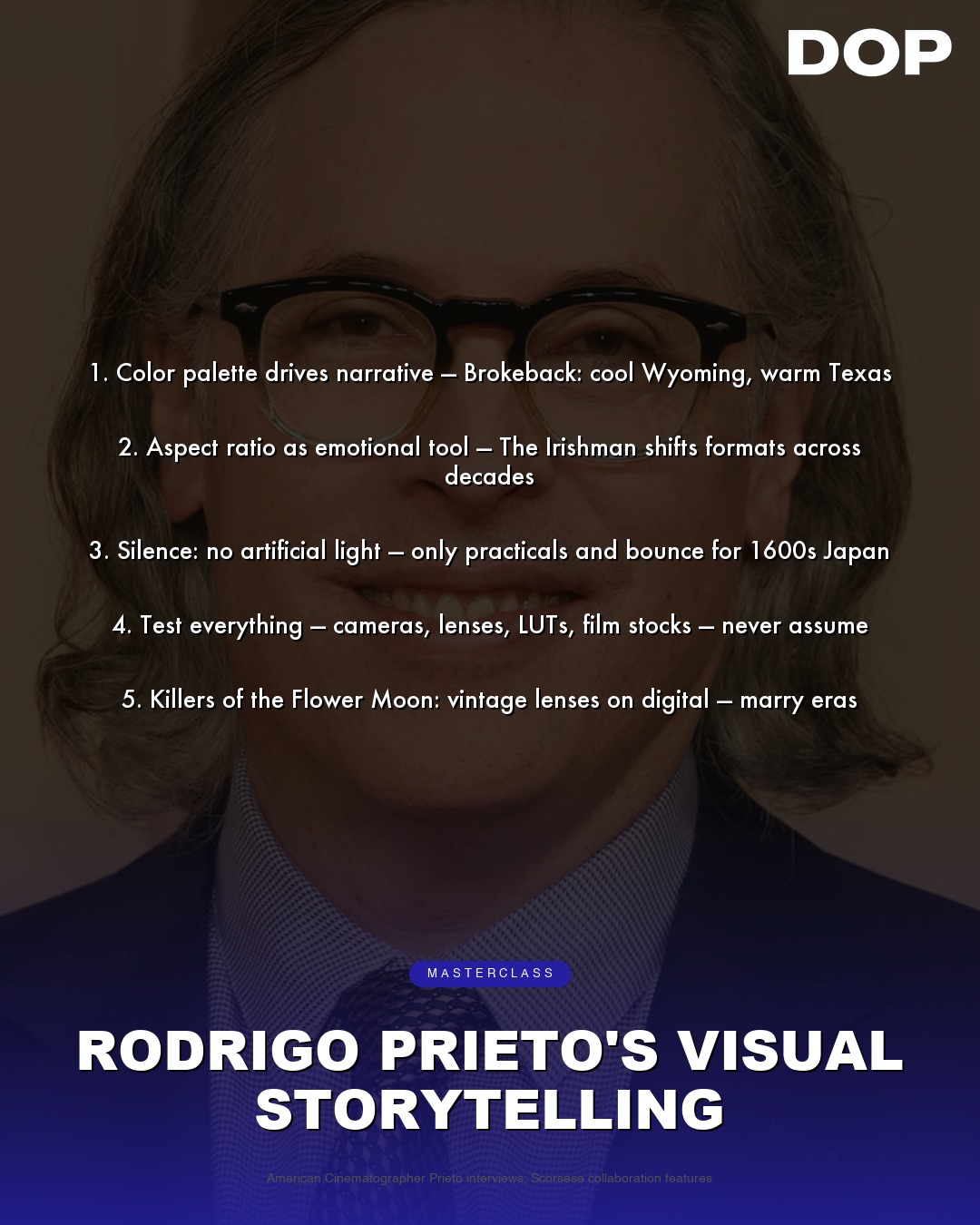
One of Prieto's most striking tenets is the deliberate use of color palette to drive narrative. Consider his seminal work on Ang Lee's Brokeback Mountain. The stark, cool blues and desolate grays of the Wyoming landscapes are not just geographical markers; they are emotional descriptors for the characters' repressed desires and the harsh realities of their existence. Contrast this with the warmer, more inviting hues of the Texas sequences, which, while offering a semblance of domesticity, still carry an undercurrent of unspoken longing. This isn't accidental or arbitrary; it's a meticulously crafted visual vocabulary that speaks volumes without a single line of dialogue. Prieto understands that color is not just aesthetic; it's an emotional temperature gauge for the story.
The Architecture of Aspect Ratio and Texture
Prieto's genius extends to his manipulation of aspect ratio as an emotional tool. His work on Martin Scorsese's The Irishman stands as a groundbreaking example. The film's ambitious narrative spans decades, and Prieto boldly shifts aspect ratios to demarcate these temporal and psychological shifts. The narrow 1.33:1 ratio for the earliest memories evokes a sense of nostalgia, confinement, and a bygone era, almost like peering into old photographs. As the story progresses and the characters' lives expand (or perhaps, constrict in different ways), the frame opens up, culminating in wider ratios that reflect their present-day realities and the scope of their reflections. This isn't a gimmick; it's an architectural choice that sculpts the audience's perception of time and memory.
“Film stock, for Prieto, is not just a recording medium; it’s a character in itself, each grain structure and color rendition carrying a distinct psychological footprint.”
Equally compelling is Prieto's philosophy regarding film stock as a character. In an era dominated by digital acquisition, his thoughtful integration of various film formats—8mm, 16mm, 35mm—underscores a deep appreciation for the inherent textural qualities each brings. An 8mm sequence, with its inherent imperfections and nostalgic grain, instantly transports the viewer to a specific memory or a subjective, dreamlike state. 16mm offers a grittier, more raw immediacy, often employed for documentary-style realism or to convey a sense of urgency. 35mm, the workhorse of cinema, provides a more polished, classical aesthetic. Each choice is a deliberate brushstroke, contributing to the film's psychological tapestry, imbuing scenes with different layers of authenticity and emotional resonance.
Illuminating the Night and Defining Perspective
Prieto's approach to night exteriors is another testament to his narrative-driven cinematography. He advocates for protecting practical sources, allowing them to define the scene's light, while letting the sky go black. This isn't merely about realism; it's about creating a sense of isolation, mystery, or foreboding. By letting the ambient light fall away, the characters become isolated within their illuminated pockets, enhancing their vulnerability or highlighting their clandestine activities. It's a pragmatic and poetic approach to lighting that prioritizes atmospheric storytelling over generic fill light.
Finally, the choice of lens, for Prieto, is paramount to establishing point of view. A wide lens, traditionally used to show expansive environments, can also be employed to convey vulnerability, distorting features and emphasizing the character's smallness within their world. Conversely, a telephoto lens, often associated with surveillance or detachment, can compress space, isolating characters and drawing the viewer into their intimate moments, sometimes uncomfortably so. Think of the way Prieto uses longer lenses to observe characters from a distance, creating a sense of voyeurism that mirrors the narrative's themes of observation and judgment.
Rodrigo Prieto's work is a masterclass in intentionality. Every decision, from the most overarching creative choice to the minutest technical detail, is filtered through the lens of narrative and character. He reminds us that cinematography is far more than simply capturing images; it is about sculpting meaning, evoking emotion, and ultimately, telling a story in the most profound and impactful way possible. His legacy is a constant challenge to cinematographers to think beyond the frame, to consider the psychological weight of every pixel, every grain, every shadow.