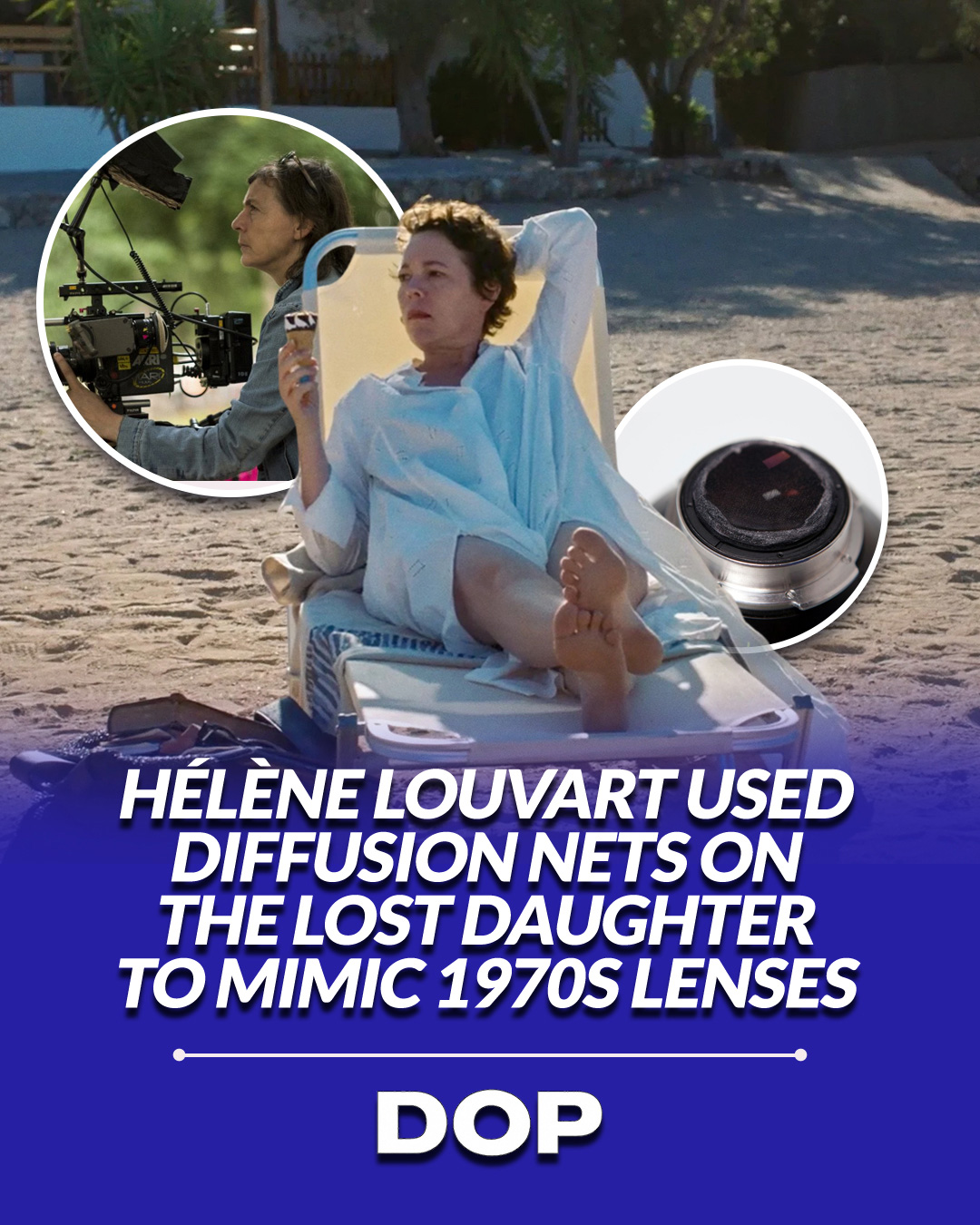
In an era dominated by pristine digital sensors and hyper-sharp resolution, director of photography Hélène Louvart, AFC opted for a decidedly tactile, imperfect aesthetic on Maggie Gyllenhaal’s directorial debut, The Lost Daughter. Rather than relying on modern post-production plugins to take the edge off a clean digital image, Louvart crafted the film’s dreamlike, psychologically fraught atmosphere right where light meets camera: directly inside the optical path.
Adapted from Elena Ferrante’s novel, the film demands a visual language that feels as exposed and sun-bleached as its Greek island setting, while remaining deeply tied to the unreliable nature of memory and internalized guilt. Louvart achieved this by pairing modern digital capture with vintage glass and a classic, underutilized technique: rear-element lens netting.
The Physics of Rear-Element Diffusion
While front-mounted diffusion filters like Pro-Mist or Classic Soft remain staples on set, rear netting, stretching fine materials like silk, nylon stockings, or vintage mesh over the back element of the lens, yields an entirely different optical fingerprint. When light passes through the lens before hitting the net, the diffusion interacts with the optical convergence point. Highlights bloom gently into shadow areas without destroying midtone contrast, and point light sources acquire a subtle, dreamy halation that modern digital glass actively eliminates.
By opting for netting behind the lens on key setups, Louvart created a visual falloff that recalls the golden age of 1970s European art-house cinema. Edges roll off gracefully, skin tones take on a creamy, organic texture, and the background bokeh blooms with a uniquely soft, geometric structure inherent to the mesh pattern.
Real optical texture isn't just about reducing resolution; it's about how light bends, blooms, and breathes across physical glass.
Why In-Camera Glass Beats Post-Production Processing
For cinematographers, the temptation to shoot clean and add texture in post is ever-present, often pushed by workflow safety nets. However, The Lost Daughter serves as a masterclass in why committing to optical degradation in-camera yields superior visual storytelling. Post-production gaussian blurs, blur maps, and digital glow effects act uniformly across pixels; they cannot replicate the way high-luminance highlights physically bleed into adjacent shadow details on an optical plane.
Louvart’s approach ensures that focus transitions remain three-dimensional and natural. As characters move in and out of the depth of field, the netting creates a soft, tactile transition rather than the harsh, cutout separation often seen on ultra-sharp digital cinema lenses.
Lighting the Imperfect Image
This optical philosophy extends directly into Louvart’s lighting strategy. Working with harsh Mediterranean daylight, she utilized large, soft bounce sources and negative fill to maintain high-contrast shapes while allowing the netted glass to soften the hard clipping of the sun. The combination of intense ambient light and delicate rear diffusion gives the images a sun-baked, memory-stained quality that feels physically lived-in.
Throughout her distinguished filmography, including work on Happy as Lazzaro, Beach Rats, and Never Rarely Sometimes Always, Louvart has demonstrated an exceptional sensitivity to naturalism and human texture. In The Lost Daughter, her choice to build softness directly into the optics stands as a powerful reminder: when a narrative calls for visual imperfection, the most convincing solutions are almost always found right at the lens.