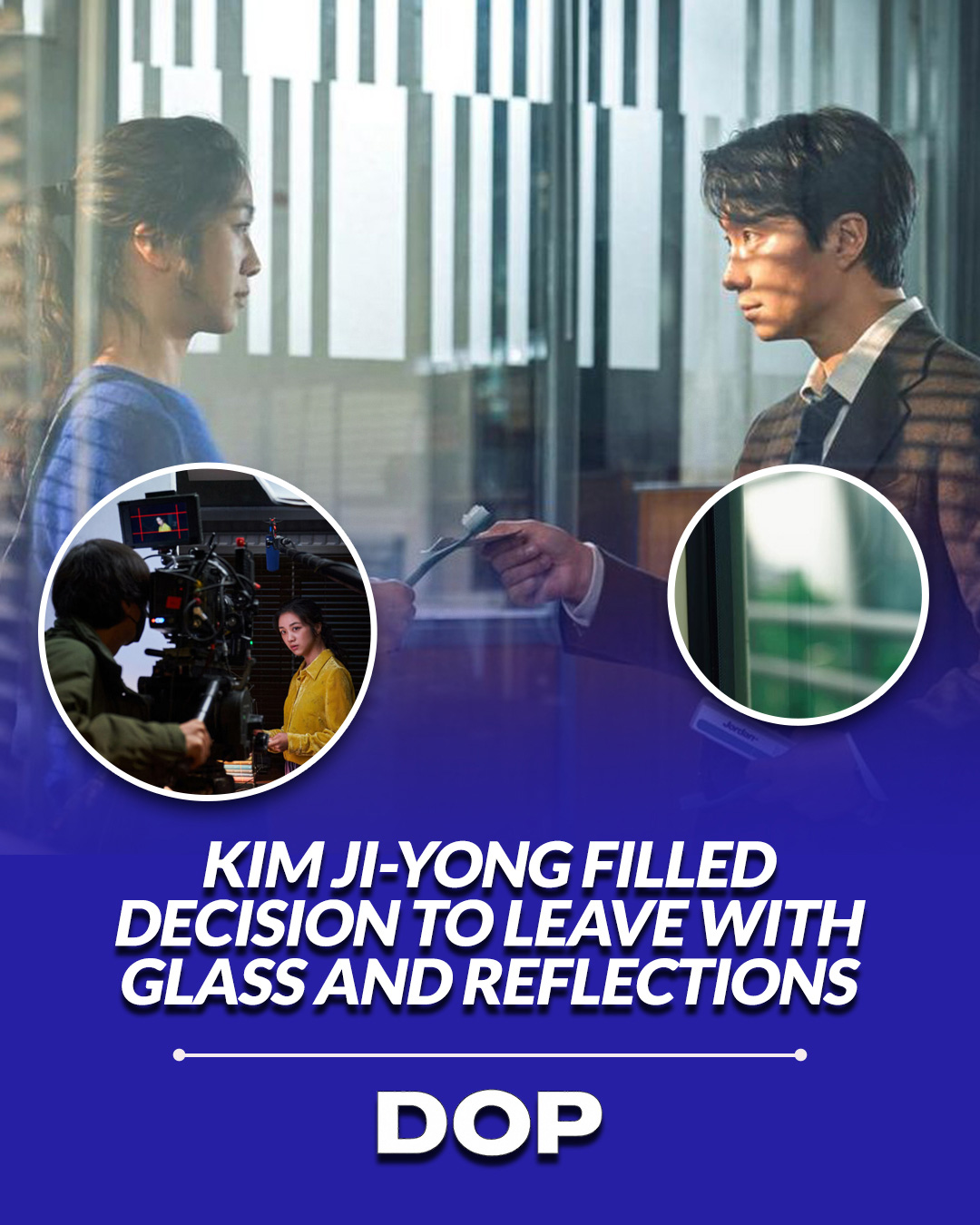
In Park Chan-wook’s hypnotic neo-noir Decision to Leave, the frame is rarely singular. Directed with surgical precision, the film relies heavily on the visionary eye of cinematographer Kim Ji-yong, whose previous work on atmospheric thrillers like The Age of Shadows and A Bittersweet Life demonstrated his mastery over low-key lighting and textured world-building. With Decision to Leave, Kim elevates optical abstraction from a simple visual flourish into the primary structural engine of the film's psychological romance.
The film follows Hae-jun, an insomniac detective who becomes dangerously consumed by Seo-rae, a mysterious widow suspected of murdering her husband. Rather than relying solely on traditional shot-reverse-shot dynamics to convey their budding obsession, Kim builds a visual vocabulary rooted in physical barriers, specifically glass. Car windshields, interrogation room two-way mirrors, smartphone displays, and rain-slicked apartment windows constantly bisect, mirror, and overlay the characters' faces, creating a realm where seeing clearly is inherently impossible.
The Architecture of Glass and Reflection
Working primarily with ARRI ALEXA cameras paired with customized optics, Kim Ji-yong approached reflective surfaces not as exposure challenges to be controlled with polarizing filters, but as physical layers of image composition. In many key sequences, the camera is positioned outside vehicles or through glass partitions, allowing exterior ambient highlights to bleed directly across the subjects' eyes and mouths. This technique forces the audience to navigate multiple depth planes simultaneously: the physical glass surface, the reflection of the observing character, and the subject sitting beyond it.
By deliberately avoiding circular polarizers (CPLs) in these setups, Kim allowed the natural environment to invade the frame. The reflection of passing streetlights, neon signs, and rainy vistas blend with Seo-rae’s enigmatic expressions. This visual density reflects Hae-jun’s fractured mental state; he is a man whose objective distance as an investigator is constantly compromised by the visual noise of his own desire and projection.
Lighting the Distortion and Subjective Reality
To make these reflections punch through without washing out the dark, mood-laden interiors, Kim employed a sophisticated approach to directional lighting. Soft, high-contrast exterior light sources, frequently diffused LED arrays balanced to daylight or cool moonlight hues, were positioned at grazing angles against the glass. This created hot spots of reflection that sharply contrasted with the warm, tungsten-balanced practical light illuminating the interior of the rooms or vehicles.
Reflective surfaces in Decision to Leave are not merely decorative elements; they function as a structural canvas for the characters' shared visual and emotional distortion.
In the interrogation room scenes, where power dynamics shift fluidly between detective and suspect, the lighting package was designed to allow delicate foot-candle adjustments on either side of the glass. By dimming the key light on Hae-jun while slightly elevating the exterior ambient illumination, his reflection superimposes onto Seo-rae’s face. The physical boundary of the two-way mirror dissolves, symbolizing their blurring identities and shared culpability long before either character admits it verbally.
The Voyeur’s Lens and Color Science
Color plays an equally vital role in how these optical layers resolve on screen. Working with a nuanced color grade that oscillates between ocean greens and deep slate blues, Kim Ji-yong tailored the color science to separate the reflected world from the transmitted world. Warm interior skin tones are constantly framed within cool, reflective sheens. This separation reinforces the distance between the two leads, even when they are in close physical proximity, they remain isolated inside distinct color temperatures and optical fields.
Kim’s choice of focal lengths also contributes significantly to this spatial ambiguity. By shooting medium close-ups on longer lenses compressed against glass, the depth of field collapses. The background, foreground reflection, and midground subject exist nearly on the same visual plane. It is a stunning display of craft that honors the legacy of classic cinema voyeurism while pushing modern camera technology to deliver unprecedented texture.
Ultimately, Kim Ji-yong’s work on Decision to Leave serves as a masterclass for contemporary cinematographers. It proves that camera placement and light shape are not merely tools to capture action, but are powerful psychological instruments capable of externalizing the hidden, unspoken obsessions of the human heart.
This article contains affiliate links. We may earn a small commission at no extra cost to you. Learn more.