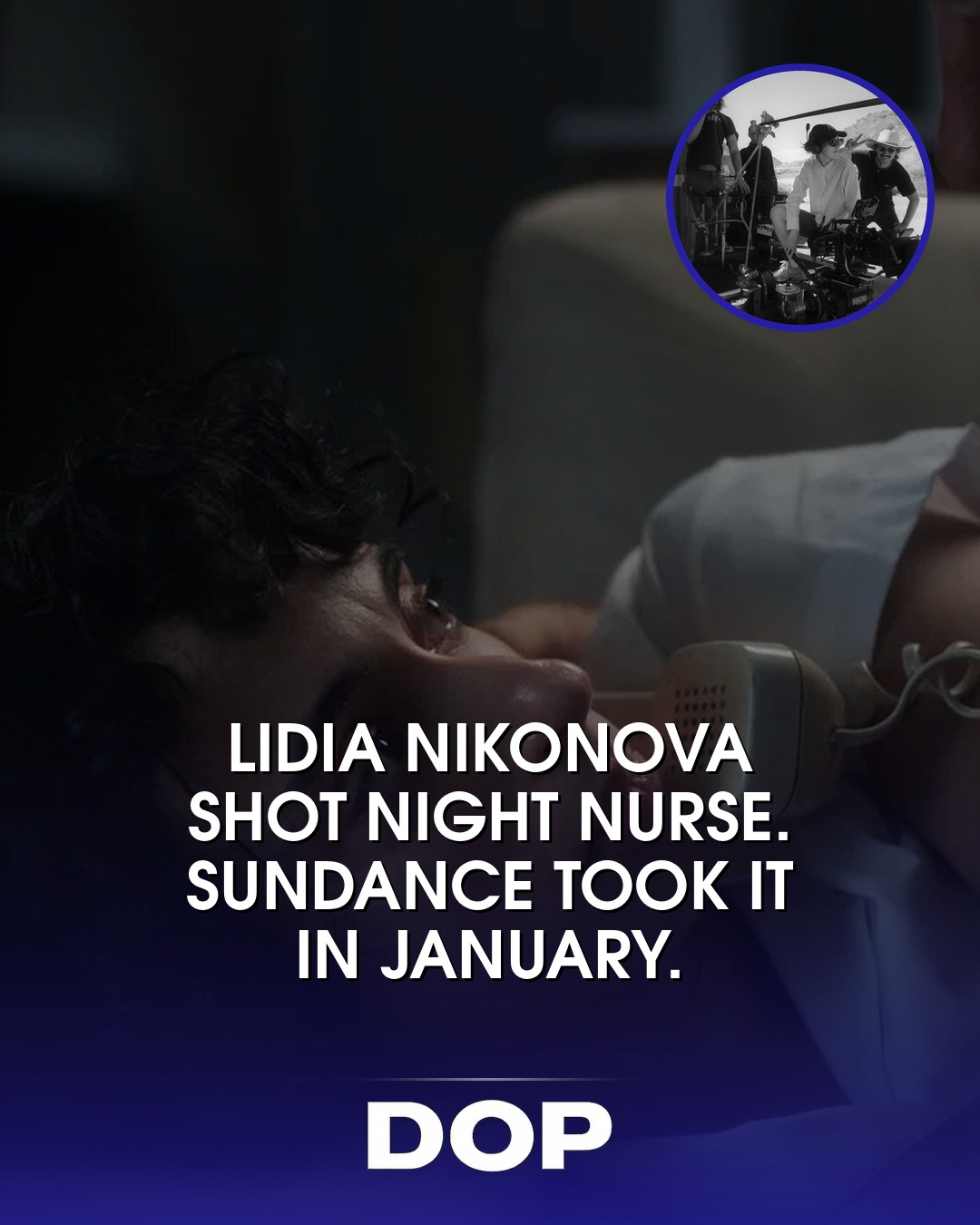
The 2026 Sundance Film Festival’s NEXT section often serves as a crucible for emerging talent, and this year, Lidia Nikonova’s cinematography for Georgia Bernstein’s directorial debut, Night Nurse, has firmly placed her on the industry’s radar. Far from a conventional thriller, Nikonova’s visual approach transforms the film into a masterclass in tension, intimacy, and the art of seeing.
Nikonova, an alumna of AFI’s prestigious cinematography program, brings a sophisticated blend of technical prowess and theoretical understanding to her craft. Her earlier narrative feature debut, the critically acclaimed Family Portrait (2023), which garnered the Golden Boccalino Award at Locarno, already hinted at a distinctive visual language. With Night Nurse, she doubles down on her commitment to visual storytelling that prioritizes mood and psychological depth over mere exposition, crafting a world where light and shadow are as much characters as the actors themselves.
The Hypnotic Gaze of the Probe Lens
The film opens with an audacious 4.5-minute macro shot, a sequence that immediately signals Night Nurse is not playing by conventional rules. Executed with a robotic arm and a 24mm probe lens, this isn't just a technical flourish; it's a deliberate act of visual seduction, drawing the audience into the film's intimate, often unsettling, world. The probe lens, with its ability to navigate impossibly tight spaces and render extreme close-ups with a unique sense of scale distortion, becomes a voyeuristic tool. It forces viewers to confront textures, pores, and micro-expressions, establishing a pervasive sense of unease and hyper-awareness right from the start. This choice speaks volumes about Nikonova's willingness to push boundaries and harness specialized tools not for gimmickry, but for profound narrative impact.
“The probe lens, with its ability to navigate impossibly tight spaces and render extreme close-ups with a unique sense of scale distortion, becomes a voyeuristic tool.”
Beyond the technical wizardry of the opening, the shot’s slow, hypnotic zooms are key. They build tension incrementally, forcing the audience to linger, to observe, to feel the creeping intimacy that defines the central relationship. This isn't a quick cut to grab attention; it's a deliberate, sustained gaze that sets the tone for the entire film. It's a bold statement, effectively saying, 'Lean in, because every detail matters here.'
Chiaroscuro in the Windy City
Set against the backdrop of Chicago, Night Nurse eschews the city's iconic panoramas for a more claustrophobic, interior world. Nikonova’s mastery of chiaroscuro lighting—the stark contrast between light and shadow—is the film’s defining visual characteristic. This isn't just about creating a moody aesthetic; it's a fundamental aspect of the film’s psychological landscape, mirroring the moral ambiguities and hidden agendas of its characters. Shadows are not merely absences of light; they are active participants, concealing secrets, distorting perceptions, and amplifying the escalating tension between the nurse and her patient.
One can imagine Nikonova and her gaffer meticulously sculpting light, using hard sources to carve out faces from darkness, allowing pockets of deep shadow to swallow details, forcing the audience to infer and imagine. This approach is reminiscent of classic film noir, yet feels entirely contemporary in its application. It’s a testament to Nikonova’s ability to draw from historical cinematic techniques while infusing them with a fresh, modern sensibility, particularly within the context of an erotic thriller where the interplay of what is seen and unseen is paramount.
The Philosophy of Intimacy and Suspense
Working with a small independent crew, Nikonova’s choices are often dictated by resourcefulness as much as artistic vision. This constraint, however, seems to have liberated her to focus intensely on the essential elements of visual storytelling. The film's focus on the intensifying relationship between the nurse and patient, embroiled in a scamming business, is perfectly amplified by Nikonova's intimate lensing and stark lighting. The camera often feels like an extension of the characters' gazes, lingering on expressions, gestures, and the subtle shifts in power dynamics.
Nikonova’s academic background in film theory from the University of Sydney, combined with her practical training from AFI, NYU Tisch, and Central Saint Martins, provides her with a unique perspective. She understands that cinematography is not just about making beautiful images, but about constructing meaning, eliciting emotional responses, and serving the narrative at its deepest level. Night Nurse stands as a powerful testament to this philosophy, showcasing a cinematographer who is not afraid to experiment, to be bold, and to create a visual grammar that is as compelling as the story it tells. Her work here solidifies her position as a significant emerging voice, one whose future projects will undoubtedly be keenly watched by all who appreciate the art of cinematography.