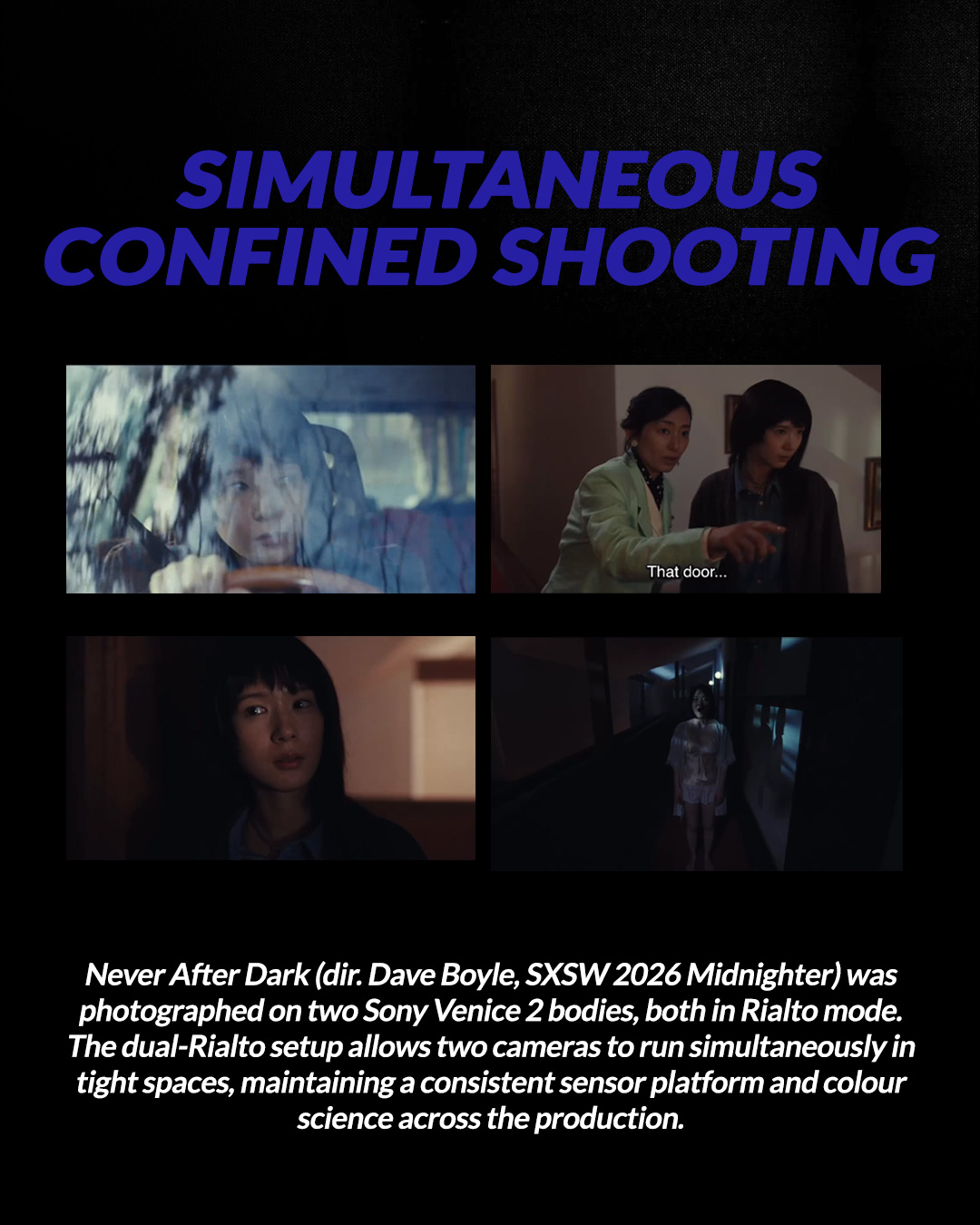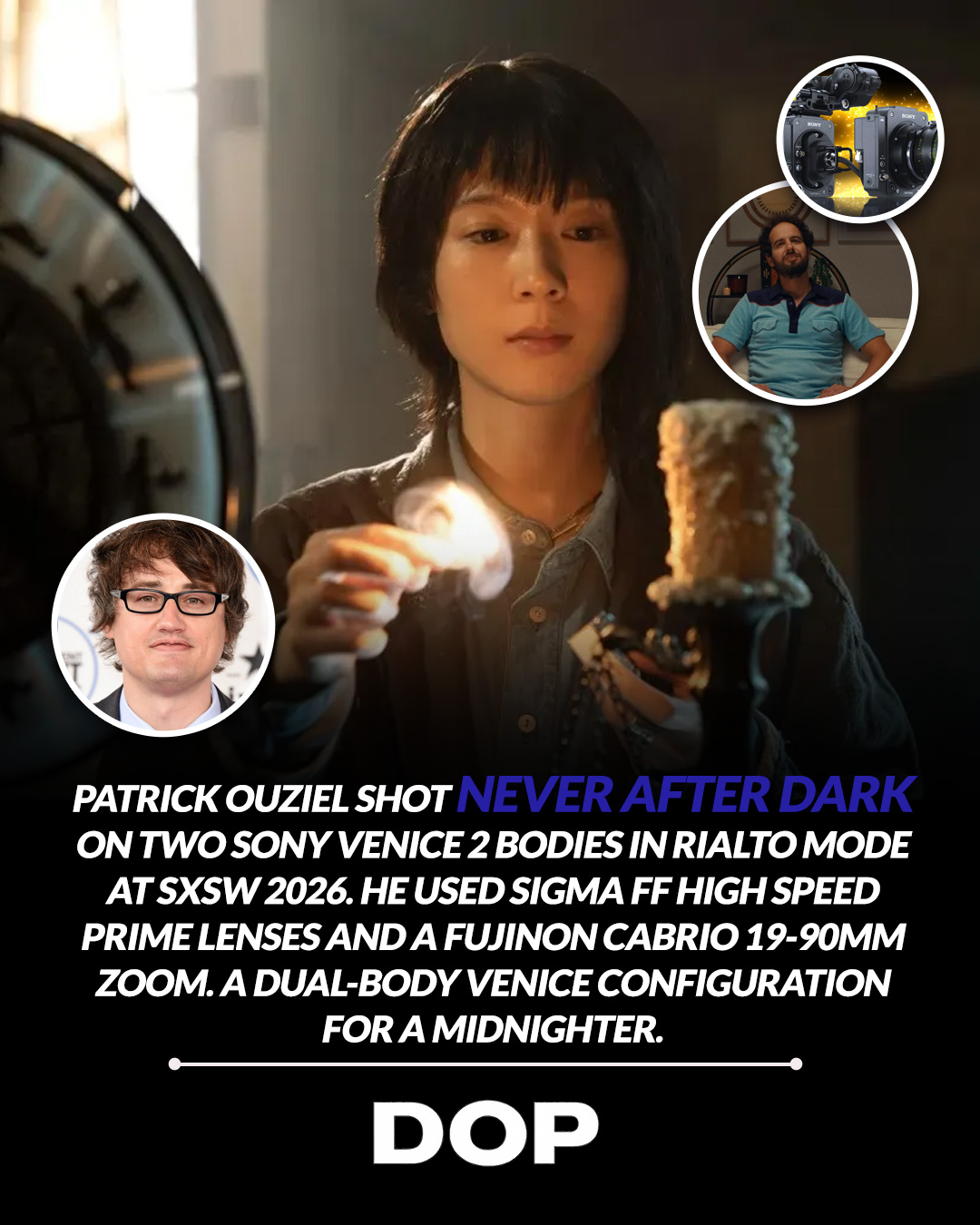
The Midnighter section at SXSW 2026 often serves as a crucible for bold, boundary-pushing cinema, and Patrick Ouziel's cinematography for Dave Boyle’s NEVER AFTER DARK certainly lived up to that reputation. What immediately captivated the attention of fellow DPs and serious cinephiles wasn't just the film's chilling narrative, but Ouziel's audacious technical approach: a dual-camera configuration employing two Sony Venice 2 bodies, both operating in Rialto mode. This wasn't merely a choice for redundancy; it was a deliberate, strategic deployment designed to conquer the unique challenges of low-light horror, maximizing both visual fidelity and operational agility.
The Sony Venice 2, with its full-frame sensor and impressive dual base ISOs of 800 and 3200, has rapidly become a favorite for projects demanding exceptional low-light performance and dynamic range. For NEVER AFTER DARK, where atmosphere and dread are inextricably linked to the play of shadows and minimal illumination, the Venice 2 was, by Ouziel's own account, the foundational choice. Its ability to capture clean, detailed images in near-darkness without resorting to excessive artificial lighting allowed the production to lean into practical, motivated light sources, enhancing the film's gritty realism and claustrophobic tone. This is where the camera truly shines, providing a painter's palette for darkness, rendering subtle gradients and textures that would be lost on lesser sensors.
The Rialto Advantage: Unlocking Spatial Freedom
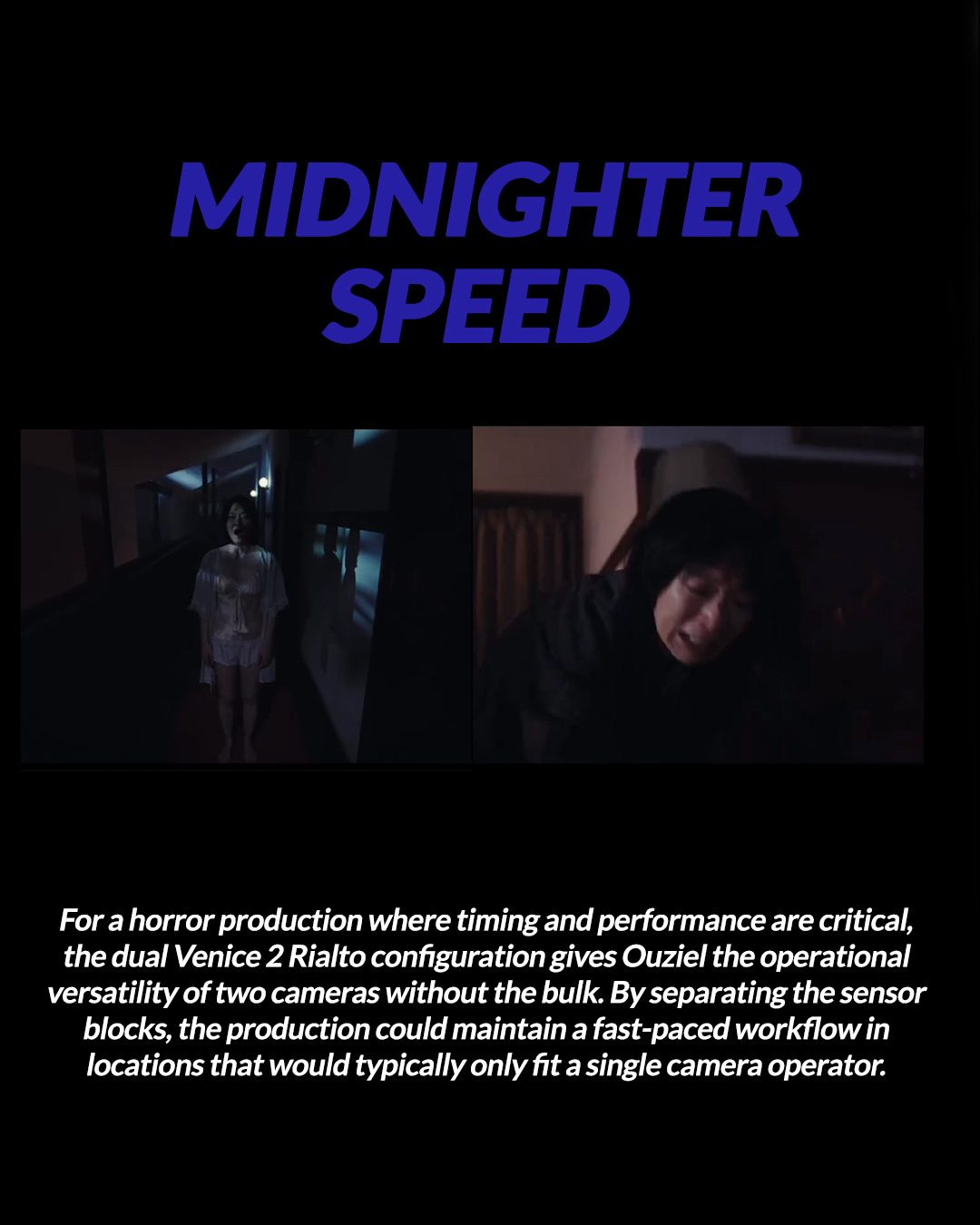
The true genius of Ouziel's setup, however, lay in the deployment of the Venice 2's Rialto extension system. This modular configuration, which separates the sensor block from the main camera body, allowed for unparalleled flexibility. Imagine the intricate, confined spaces typical of horror, a cramped attic, a narrow corridor, a car interior, where placing a full-sized camera body is often a logistical nightmare. With Rialto, the compact sensor block, tethered by a robust cable, could be maneuvered into positions that would otherwise be impossible, enabling unique perspectives and dynamic camera movements that intensify the audience's sense of unease. The decision to use two Venice 2s in Rialto mode simultaneously is particularly noteworthy, providing two distinct angles or coverage options from tight spots without the time-consuming process of repositioning a single camera.
"The dual-Rialto setup allowed us to maintain consistent sensor characteristics and color science across two cameras in situations where conventional bodies simply couldn't go. It was about visual consistency meeting operational necessity."
This dual-Rialto strategy isn't just about fitting into small spaces; it's about maintaining a consistent visual language. By using the same sensor platform, Ouziel ensured that the color science, dynamic range, and overall image characteristics remained uniform across all footage, regardless of the camera's physical configuration. This seamless integration is crucial for maintaining immersion in a genre where visual continuity is paramount to suspending disbelief and building sustained tension. The audience should never be pulled out of the film by a sudden shift in image quality or aesthetic. Furthermore, the inherent versatility of the Rialto system facilitated rapid setup changes, a critical factor for horror productions where time is often compressed and atmosphere must be captured swiftly.
Lenses for Low Light and Speed: Sigma Primes & Fujinon Zoom
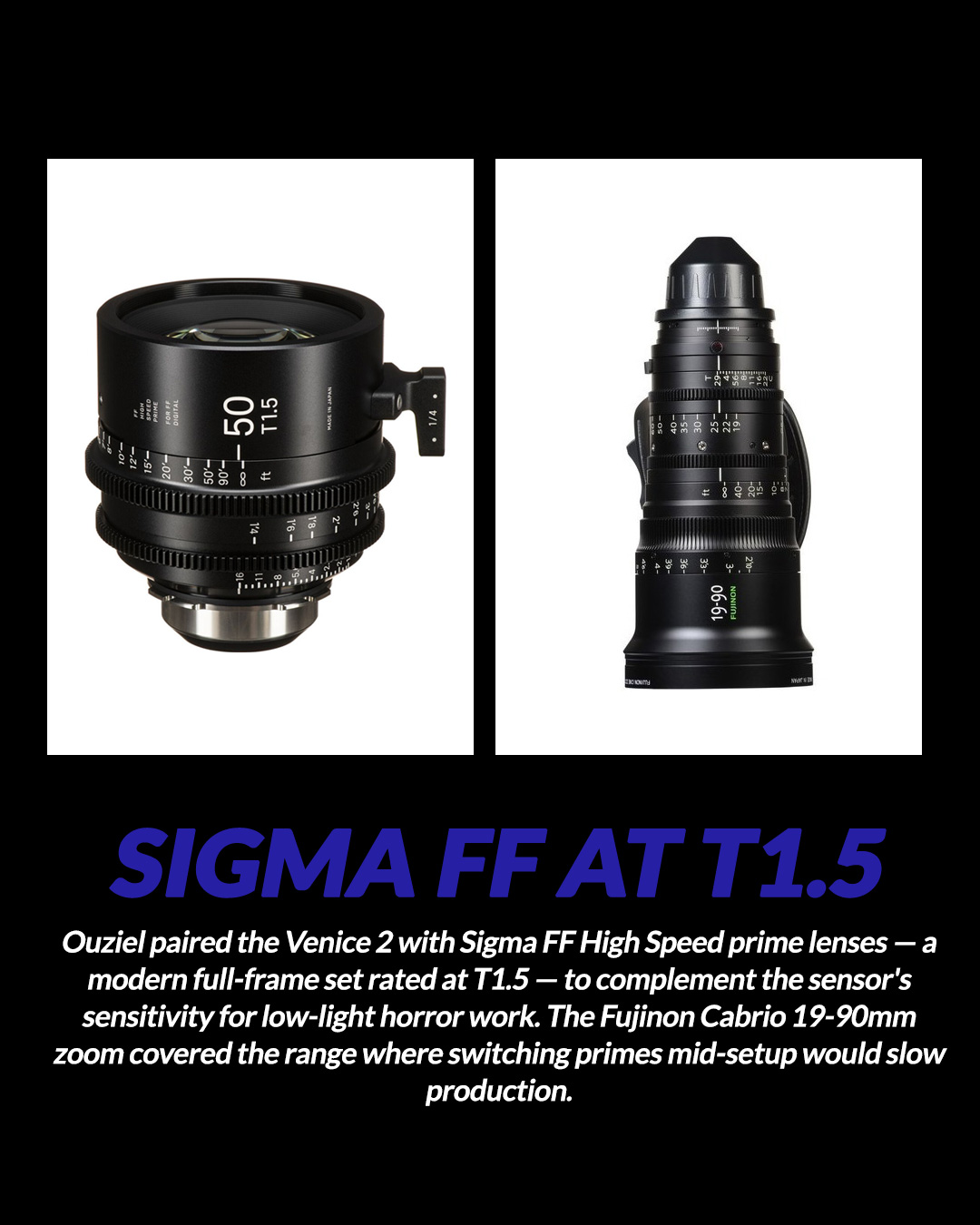
Complementing the Venice 2's low-light prowess were Ouziel's lens choices. The Sigma FF High Speed prime lenses, with their consistent T1.5 aperture, were a natural pairing. These primes are known for their sharpness, minimal chromatic aberration, and excellent performance wide open, allowing Ouziel to exploit the Venice 2's sensitivity to its fullest. Shooting at T1.5 in low light creates a shallow depth of field, artfully isolating subjects and drawing the viewer's eye, a classic horror technique for emphasizing vulnerability or hinting at unseen threats lurking just beyond the focal plane. The character of these lenses, often described as clean yet cinematic, ensures that the raw intensity of the horror is delivered with clarity.
For situations demanding greater flexibility, the Fujinon Cabrio 19-90mm PL-mount zoom lens was indispensable. While primes offer superior optical quality, the speed and efficiency of a high-quality zoom like the Cabrio cannot be overstated, especially on a fast-paced production. This lens covers a broad focal range, allowing for quick adjustments to framing without needing to swap lenses, a process that can significantly slow down production and break the creative flow. For a horror film where subtle pushes or pulls can dramatically alter tension, having a zoom on hand provides an agile tool. The Cabrio’s robust build and consistent T-stop across its range make it a reliable workhorse, ensuring that even when speed was paramount, image quality was not compromised. A Sony FX3 also served as a supplemental camera, likely for extreme POV shots or situations where even the Rialto proved too large, further underscoring the production's commitment to capturing every angle with appropriate tools.
Ouziel's technical orchestration for NEVER AFTER DARK is a masterclass in leveraging cutting-edge technology to serve narrative. The combination of the Sony Venice 2's exceptional low-light performance, the spatial freedom offered by the Rialto system, and a carefully selected lens package demonstrates a profound understanding of how tools shape storytelling. This production exemplifies how DPs are continually pushing the boundaries, not just of what's possible, but of what's visually compelling, proving that innovation in cinematography is as much about strategic deployment as it is about raw capability. For those of us passionate about the craft, NEVER AFTER DARK offers a compelling glimpse into the future of horror cinematography, where technology seamlessly integrates with artistic vision to conjure our deepest fears.
This article contains affiliate links. We may earn a small commission at no extra cost to you. Learn more.