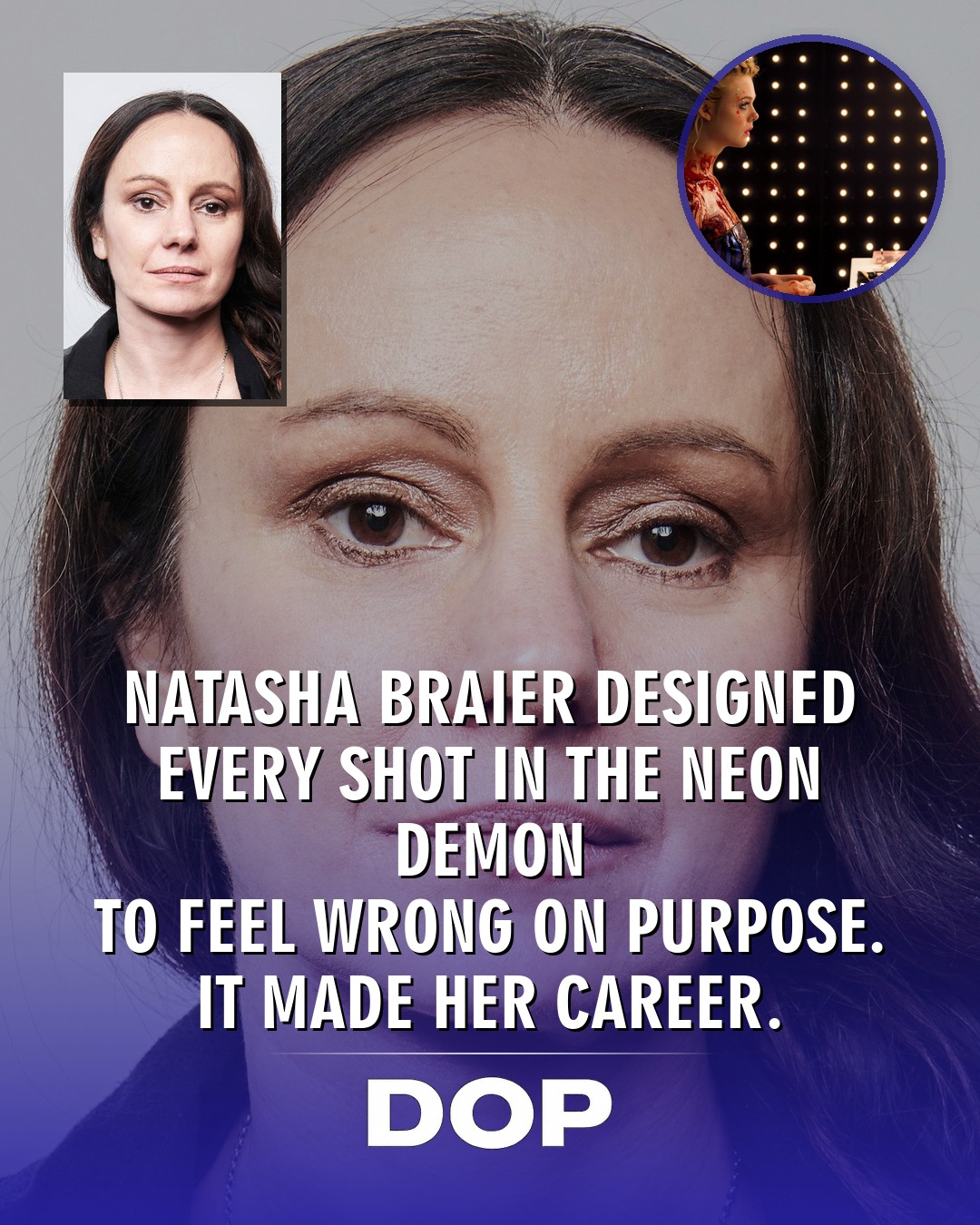
In the often-homogenized landscape of contemporary cinema, where the pursuit of 'naturalism' can sometimes stifle genuine artistic expression, Natasha Braier's work on Nicolas Winding Refn's 2016 psychological horror, The Neon Demon, stands as a blazing, defiant anomaly. It was a film that didn't just push boundaries; it gleefully incinerated them, and Braier's cinematography was the accelerant. This wasn't merely a visual style; it was a philosophical statement, a deliberate rejection of conventional verisimilitude in favor of a hyper-stylized, psychologically charged artificiality.
Braier, a master of evocative imagery, understood that for Refn's fable of beauty, envy, and consumption, realism would be a narrative impediment. Instead, she crafted a world where light itself was a character, a menacing, seductive force. The Instagram caption rightly highlights her pioneering use of tools like Digital Sputnik LED units and video projectors. These weren't employed to subtly augment existing light or mimic natural sources; their purpose was to boldly paint the screen with graphic, shifting hues – peacock blues, virulent magentas, and searing reds – directly onto actors and sets. This wasn't about creating a mood; it was about manifesting inner torment and external glamour through pure, unadulterated color, a direct conduit to the film's unsettling psychological undercurrents.
The Art of Intentional Artifice
The intentionality behind Braier's choices is what truly elevates her work. Every beam, every hue, every shadow was meticulously constructed, designed to feel manufactured, almost alien. Consider the character of Jesse (Elle Fanning) as she navigates the predatory world of modeling. Her innocence, or lack thereof, is often underscored by cool, sterile light, only for her to be drenched in aggressive, saturated colors as the narrative descends into its more grotesque phases. The technical execution here is crucial: Digital Sputniks, known for their precise color control and high output, allowed Braier to dial in specific Kelvin temperatures and RGB values with unprecedented accuracy, enabling her to create these jarring, expressive shifts with surgical precision. This wasn't about 'fixing it in post'; this was about designing the light, and thus the emotion, on set, in camera.
"Every lighting choice was designed to feel constructed... These choices were treated as expressive, psychological tools rather than attempts to mimic natural light."
The use of video projectors, in particular, offered an extraordinary level of dynamic control. Instead of static gels or practicals, Braier could project moving patterns, abstract textures, or even literal imagery onto surfaces and performers, blurring the lines between set dressing, lighting, and visual effects. This technique allowed for an almost painterly quality, where light wasn't just illuminating but actively transforming the visual information on screen, making the environment as mutable and unreliable as the characters' moral compasses. The effect is disorienting, beautiful, and utterly unforgettable, forcing the audience to confront the artificiality of the world presented, mirroring the superficiality of the fashion industry depicted.
A Calling Card for the Visionary
The Neon Demon's divisive reception at Cannes – a cacophony of boos and rapturous applause – perfectly encapsulated the audacity of Braier's vision. It was a film that demanded a reaction, and her cinematography was central to that provocation. For DPs and serious film enthusiasts, it was a masterclass in how to wield light as a psychological weapon, how to eschew conventional beauty for something far more challenging and resonant. Braier's bold, risk-taking style wasn't a one-off experiment; it became her signature, a calling card that attracted other visionary directors eager to push visual boundaries.
Her subsequent collaborations, such as with Alma Har'el on Honey Boy and Sebastian Lelio on Gloria Bell, while stylistically distinct from The Neon Demon, nonetheless carry the indelible mark of a cinematographer unafraid to make strong, deliberate choices. In Honey Boy, she brought a more grounded, yet still deeply expressive, visual language to Shia LaBeouf's raw, autobiographical narrative, proving her versatility beyond hyper-stylization. With Gloria Bell, her camera danced with Julianne Moore's character, capturing an intimate, vibrant portrayal of a woman embracing life's complexities with a quiet yet profound visual lyricism. Each project, in its own way, benefits from Braier's keen understanding of how light, color, and composition can serve as potent narrative devices, speaking volumes where dialogue might fall short. She is a cinematographer who understands that sometimes, the most profound truth can be found not in mimicking reality, but in artfully distorting it.