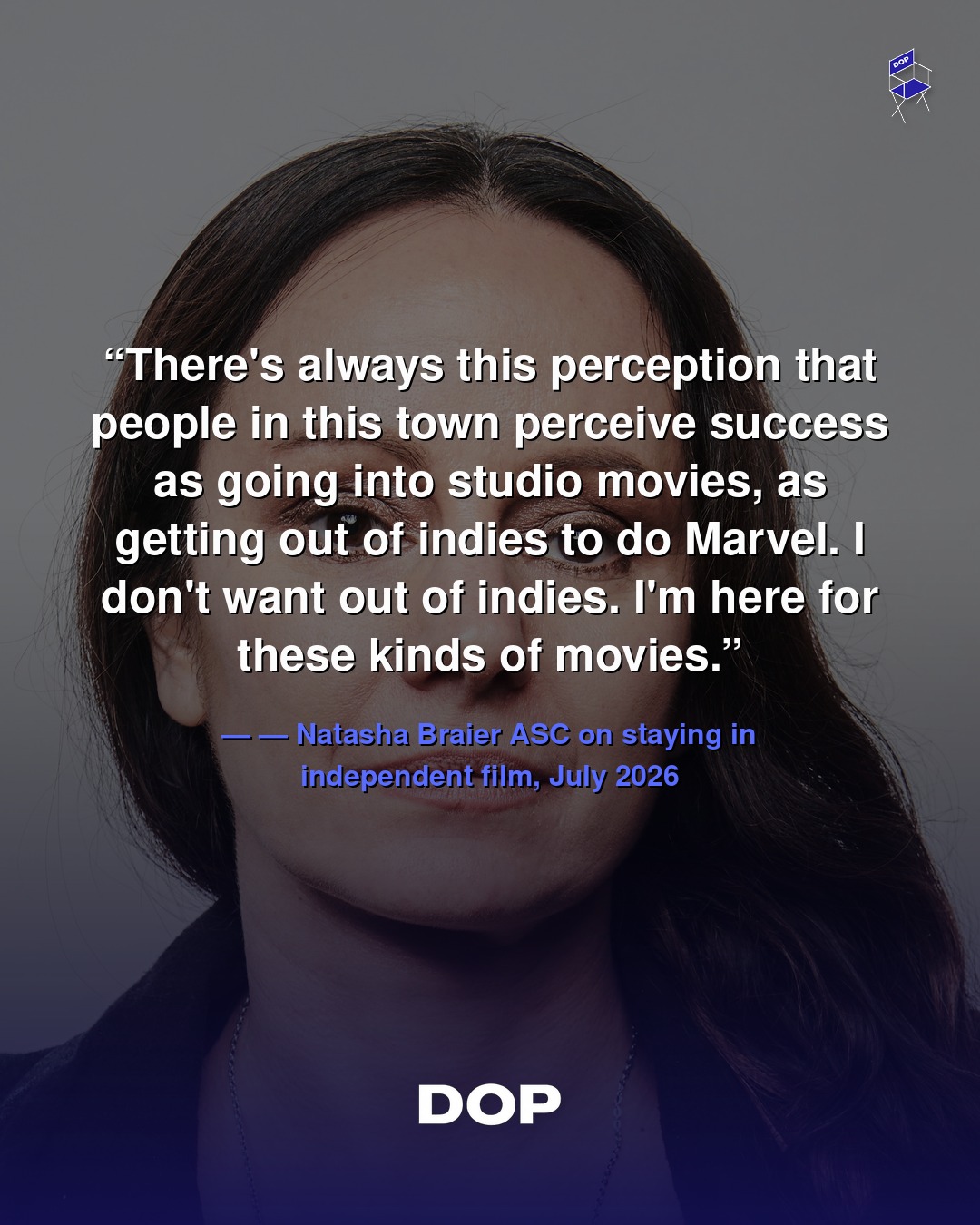
In an industry often obsessed with linear career progression, Natasha Braier, ASC, ADF stands as a refreshing counter-narrative. Known for her distinctive and often unsettling visual language in films like Nicolas Winding Refn's The Neon Demon, Alma Har'el's Honey Boy, and Sebastián Silva's I Love Boosters, Braier has carved a path that prioritizes artistic integrity and personal fulfillment over the conventional climb from indie darling to blockbuster behemoth. Her recent insights, particularly in an interview with IndieWire, reveal a cinematographer deeply committed to challenging the status quo, not just in her work, but in the very definition of a 'successful' career in cinematography.
Braier's filmography is a testament to her versatility and her ability to immerse herself in diverse narratives. In The Neon Demon, she masterfully crafted a hyper-stylized, almost alienating aesthetic, utilizing stark, high-contrast lighting and a precise color palette to evoke both the allure and the horror of the fashion world. Her choice of anamorphic lenses amplified the film's grandiose yet claustrophobic atmosphere, rendering Los Angeles as a glittering, predatory dreamscape. Conversely, for Honey Boy, Braier adopted a more intimate, vérité style, employing handheld cameras and naturalistic lighting to capture the raw emotional landscape of its characters. This adaptability, moving seamlessly between the meticulously controlled and the organically observed, speaks volumes about her profound understanding of visual storytelling.
Beyond the Blockbuster Blueprint
The prevailing industry narrative often dictates a trajectory: prove yourself on indies, then transition to mid-budget features, and finally, ascend to the zenith of studio tentpoles and superhero franchises. Braier, however, rejects this ladder outright. She articulates a vision where success isn't measured by budget size or franchise involvement, but by the artistic merit of the project and the personal resonance it holds. This stance is particularly resonant in an era where the line between art and commerce in filmmaking is increasingly blurred, and where the pressure to conform to commercial expectations can often stifle creative expression.
"The assumed trajectory runs indie to studio to Marvel, with each step up. Braier refuses the ladder outright."
This rejection isn't born of a lack of opportunity, but a conscious choice. It's a powerful statement about agency and the importance of maintaining one's artistic compass in a highly commercialized field. Her approach to cinematography is not about showcasing technical prowess for its own sake, but about serving the story and amplifying its emotional core. Whether she's using the ARRI Alexa Mini for its robust dynamic range in low-light scenarios or experimenting with vintage lenses to achieve a specific textural quality, every technical decision is in service of the narrative, not the industry's perceived hierarchy.
Deep-Light: Illuminating the Path for Others
Braier's commitment to reshaping industry norms extends beyond her personal career choices. She is the founder of Deep-Light, a knowledge-sharing community for cinematographers. This initiative directly addresses a critical gap she identified early in her career. She recalls how, as a student, she knew the names of only three female cinematographers and had no visual reference for who they were. This profound lack of visibility and mentorship for women and underrepresented groups in cinematography is precisely what Deep-Light aims to rectify.
Deep-Light fosters an environment where experienced DPs can share their insights, techniques, and philosophies, demystifying the craft and making it more accessible. It’s a powerful antidote to the often insular nature of the film industry, promoting a more inclusive and collaborative future. By creating a platform for dialogue and mentorship, Braier is not only challenging the definition of success but also actively building a more equitable and diverse landscape for the next generation of visual storytellers.
Her work in films like The Neon Demon, with its deliberate and often unsettling color grading, favoring cool blues, stark whites, and jarring reds, showcases a DP unafraid to push boundaries. Her lighting philosophy often involves a nuanced interplay of practicals and carefully sculpted artificial light, creating environments that are both visually stunning and psychologically charged. She understands that color science and the character of light are not just aesthetic choices, but fundamental tools for conveying mood, character, and narrative subtext.
Natasha Braier's journey is a compelling reminder that true success in cinematography, and indeed in any creative field, is not a monolithic concept. It is not about following a prescribed path but about forging one's own, guided by passion, integrity, and a commitment to the art form. Through her impactful cinematography and her visionary work with Deep-Light, Braier is not just shooting films; she is illuminating a new way forward for the entire industry.
This article contains affiliate links. We may earn a small commission at no extra cost to you. Learn more.