Cinematography is rarely a discipline built in isolation; it is a trade of inherited lineage, where secrets of lighting ratios, optical quirks, and exposure thresholds are passed down from gaffers and key grips to operating DPs. Few contemporary cinematographers embody this living lineage quite like Michael Bauman. Having spent decades in the trenches running lighting departments for masters like Robert Elswit on Paul Thomas Anderson’s The Master and Inherent Vice, Bauman transitioned into the co-cinematographer chair on Anderson’s Licorice Pizza before stepping into his own as one of the most versatile visual stylists working today.
The Lineage of Soft Light and Storied Bodies
When Bauman and Anderson co-photographed Licorice Pizza, the production famously rolled on the exact two Panavision Millennium XL2 35mm camera bodies that J.J. Abrams and Dan Mindel used on Star Wars: The Force Awakens. Still bearing the engraved call signs “Millennium Falcon” and “Death Star,” these cameras were loaded with Kodak Vision3 stock to capture the sun-baked, hazy nostalgia of the 1970s San Fernando Valley. Yet the true soul of that visual approach was tucked inside the interiors, where Bauman employed a bespoke lighting rig: clusters of 50 to 60 bare 15-watt household tungsten bulbs mounted together into broad, low-intensity emissive blankets.
This bulb-array technique was not an accident of convenience; it represents direct cinematic pedigree. Originally pioneered by double-Oscar-winning British DP Chris Menges (The Mission, The Killing Fields), the technique was adopted and refined by the late, legendary Harris Savides to achieve his signature milky, ultra-soft tonal rolloff. By diffusing dozens of micro-point-sources over a wide surface area, Bauman created an enveloping ambient bounce that preserved skin tones without ever creating harsh specular highlights or telltale shadows.
“The craft is an inheritance: Menges gave the bulb clusters to Savides, Savides gave them to the Valley, and Bauman proved that true optical warmth comes from practical physics, not digital post-production lookup tables.”
Pushing Large-Format Physics in VistaVision
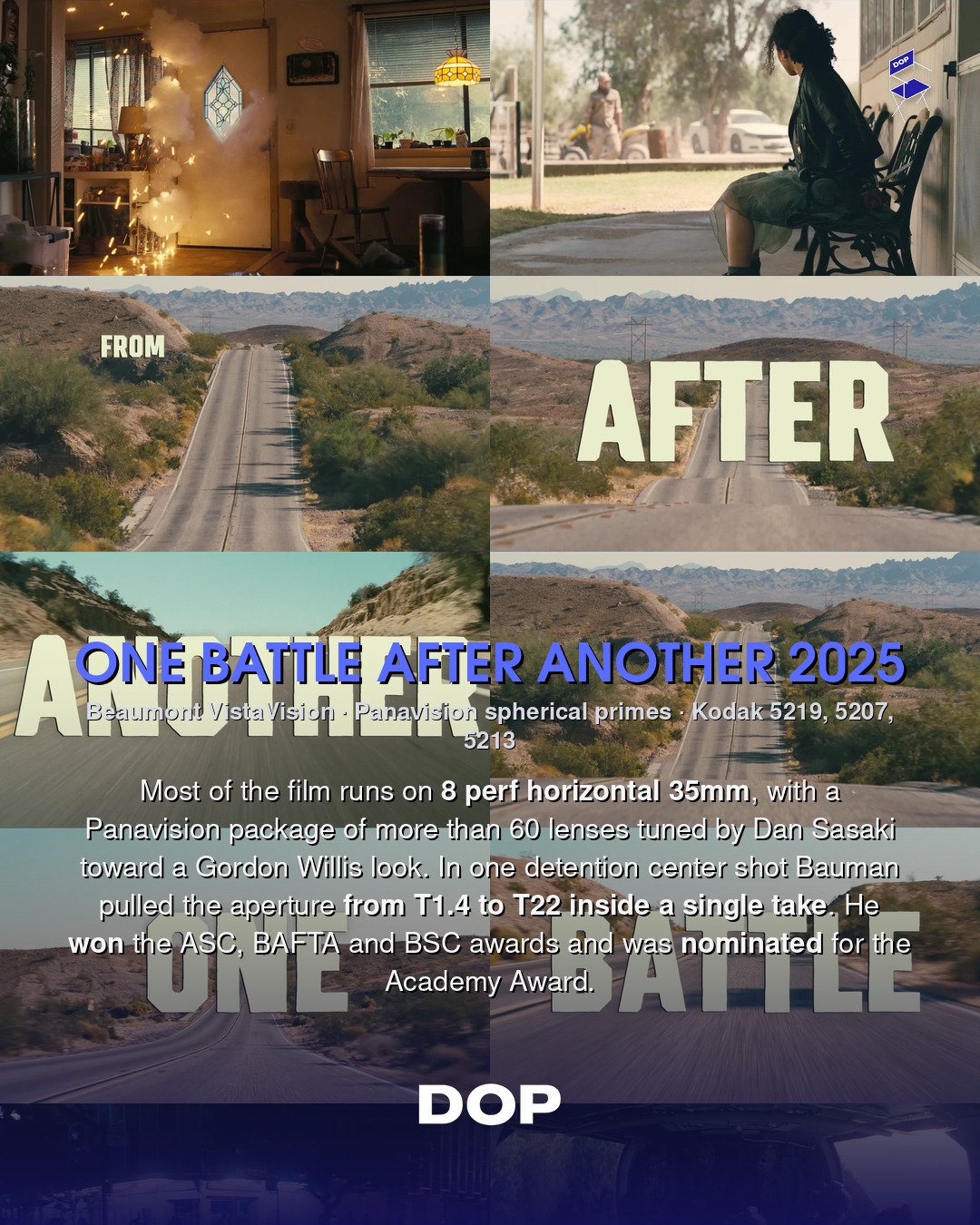
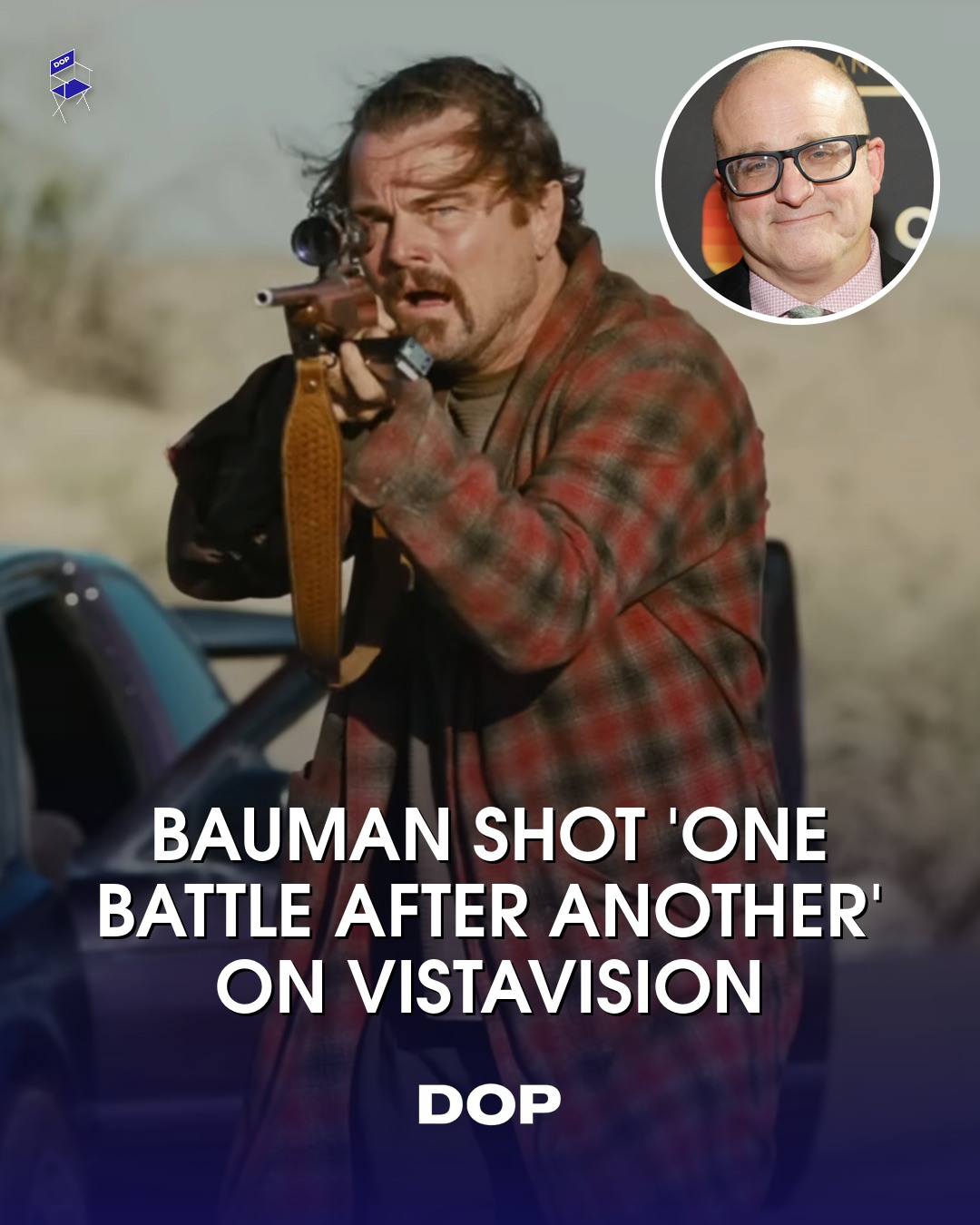
Bauman’s technical audacity reached a high-water mark on One Battle After Another, an endeavor that swept the ASC, BAFTA, and BSC awards while earning him an Academy Award nomination. Opting to shoot the bulk of the film on horizontal 8-perf 35mm VistaVision, Bauman married massive negative real estate with vintage optical imperfection. He collaborated closely with Panavision’s VP of Optical Engineering, Dan Sasaki, tuning over 60 proprietary lenses to evoke the brutal, high-contrast chiaroscuro and atmospheric depth characteristic of Gordon Willis’s seminal 1970s output.
Because the 8-perf VistaVision gate demands incredible precision due to its razor-thin depth of field, handling extreme dynamic range in continuous camera moves requires nerves of steel. In one virtuosic sequence, Bauman executed a continuous in-shot aperture pull from wide-open T1.4 inside an unlit corridor to a pin-sharp T22 in blinding daylight, a staggering six-stop shift within a single uninterrupted take. Balancing optical resolution, focal plane tracking, and mechanical iris control at that magnitude pushed both the custom Panavision mechanics and the chemistry of the film stock to their absolute limits.
The Working Kitchen: Control Versus Chaos
Yet for all his command over large-format studio rigor, Bauman remains equally potent when thrown into absolute chaos. On director Matt Johnson’s Anthony Bourdain project, Tony, Bauman abandoned the comfort of closed stages for the sensory overload of active, working commercial kitchens. Rather than blocking actors around carefully placed Key and Fill units, Johnson directed without second takes, treating the environment with the unrelenting realism of cinéma vérité.
In a tight, steam-filled kitchen where stainless steel creates unpredictable specular kickers and talent refuses to hit standard marks, a cinematographer cannot rely on classical three-point lighting. Instead, Bauman leaned into high-sensitivity capture, hyper-reactive operating, and ambient light sculpting, proving that visual eloquence does not always require hours of rigging. It poses the fundamental question facing modern cinematographers: do you build a fortress of controlled studio perfection, or do you step into a room that will not hold still and learn to dance with the chaos?