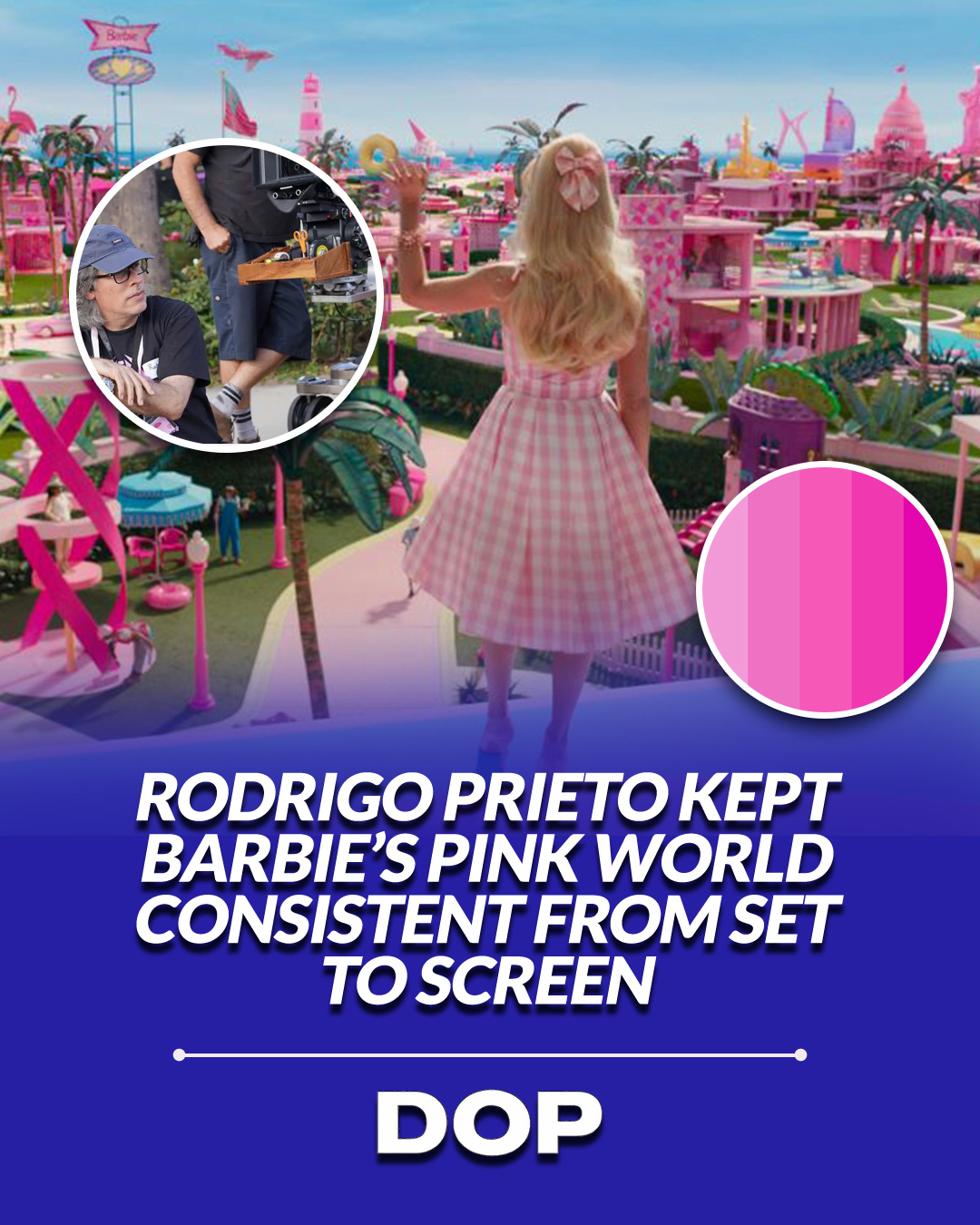
When Rodrigo Prieto, ASC, AMC took on Greta Gerwig’s Barbie, he stepped away from the grounded, textually rich imagery of Martin Scorsese’s Killers of the Flower Moon directly into a hyper-saturated, synthetic universe. Transforming Mattel's iconic plastic aesthetic into a tangible, cinematic reality required more than creative bold vision, it demanded an uncompromising technical strategy centered around managing a single, highly volatile hue: vibrant pink.
Highly saturated pinks and magentas present a notorious challenge for digital camera sensors. Because these shades rely on a precise balance across the red and blue channels, even slight exposure shifts can degrade the image. Overexpose by a fraction of a stop, and the saturated hue clips into an unsightly, unrecoverable digital white. Underexpose slightly, and the color rapidly desaturates into a muddy, dark magenta that destroys the toy-like optimism of the frame.
Engineering the 'Techni-Barbie' Pipeline
To navigate this narrow latitude, Prieto collaborated closely with senior colorist Yvan Lucas during pre-production to engineer a bespoke color workflow. Shooting on large-format ARRI Alexa 65 cameras paired with customized Panavision System 65 glass, the team built a custom lookup table dubbed "Techni-Barbie." Inspired by the rich saturation of classic three-strip Technicolor film stocks, the LUT shifted high-chroma pinks into a manageable digital gamut while retaining natural skin tones across a diverse cast.
"When a production design leans heavily on one color, cinematography has to be a partner in protecting that color's integrity all the way through post."
This pipeline was rigorously implemented from prep to post. Prieto shot extensive camera tests featuring set paint swatches, costume fabrics, and miniature materials under various studio lighting setups. Monitoring on set was meticulously mapped to account for both standard dynamic range (SDR) and high dynamic range (HDR) deliveries, ensuring that the high luminance levels required for HDR displays would not cause color clipping or viewer eye strain.
Lighting Ratios and Specular Highlight Control
Lighting Barbieland demanded an environment that felt bright, shadowless, and perpetually sunny without becoming flat or washed out. Prieto favored soft, expansive keys over hard, direct sources. Overhead rigs composed of massive ARRI SkyPanel arrays bounced through heavy diffusion frames created clean, wrap-around illumination, while subtle fill light maintained low contrast ratios across every corner of the set.
A critical technical hurdle was controlling specular highlights on the high-gloss painted surfaces, plastic vehicles, and set pieces. Direct hard lights on reflective pink paint create high-intensity hot spots that strip away color saturation. By controlling the angle of incidence, employing heavy polarization filters, and using broad softboxes, Prieto maintained vivid color saturation across glossy surfaces while keeping highlights roll-off creamy and natural.
Prieto’s work on Barbie serves as an essential lesson for modern cinematographers. It proves that when production design commits to a extreme palette, color management cannot be pushed to post-production. True visual success relies on the cinematographer actively managing sensor dynamic range, custom color science, and lighting ratios on set to preserve color integrity in every single frame.
This article contains affiliate links. We may earn a small commission at no extra cost to you. Learn more.